
The Relationship Between Generative AI Use, Emotional Intelligence, and Resilience
Eliana Negron
Co-Presenters: Individual Presentation
College: College of Liberal Arts
Major: BA.PSYCHOLOGY
Faculty Research Mentor: Peri Yuksel, Nicolas Zapparrata
Abstract:
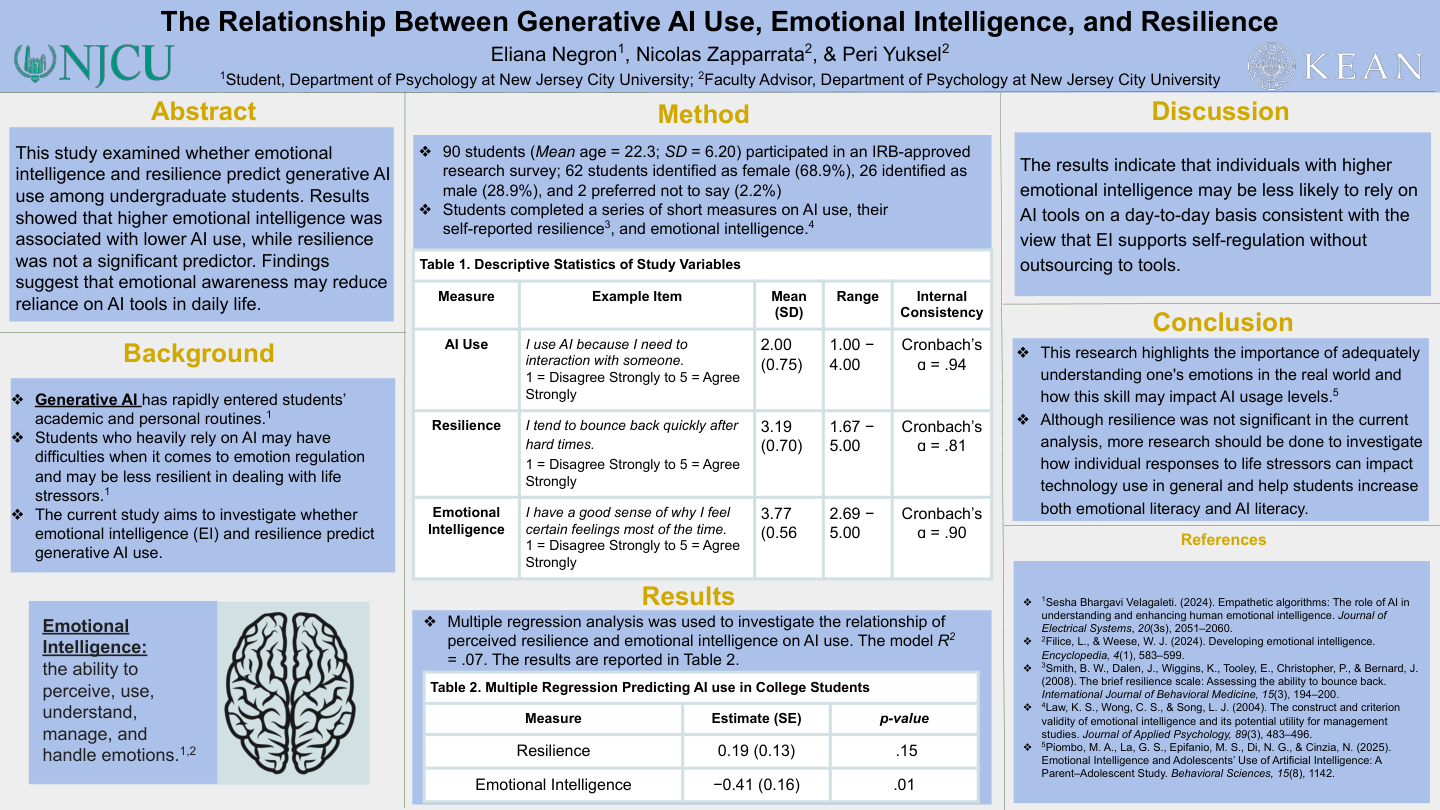
Generative AI has rapidly entered students’ academic and personal routines. Students who heavily rely on AI may have difficulties when it comes to emotion regulation and may be less resilient in dealing with life stressors. The current study aims to investigate whether emotional intelligence (EI) and resilience predict generative AI use.
A total of 91 undergraduate students participated in an IRB-approved research survey. Students completed a series of short, validated measures on everyday AI practices and their self-reported emotional intelligence and resilience.
Multiple linear regression was conducted in RStudio using EI and resilience as variables in predicting generative AI use. The results indicated that as emotional intelligence increases, AI usage decreases (beta = – .40; p-value = .012). Resilience, however, was not significant in predicting AI usage.
The results indicate that individuals with higher emotional intelligence may be less likely to rely on AI tools on a day-to-day basis consistent with the view that EI supports self-regulation without outsourcing to tools. This research highlights the importance of adequately understanding one's emotions in the real world and how this skill may impact AI usage levels. Although resilience was not significant in the current analysis, more research should be done to investigate how individual responses to life stressors can impact technology use in general and help students increase both emotional literacy and AI literacy.
Keywords: AI, Resilience, Technology, Emotional Intelligence