
The Role of Age of Acquisition and Language Exposure in Self-Rated and Objective Language Proficiency in Bilinguals
Lucia Blanco
Co-Presenters: Cristina Alarcon, Samuel Clerge
College: College of Health Professions and Human Services
Major: MA.SPEECH-LNGPATH
Faculty Research Mentor: Anne Neveu
Abstract:
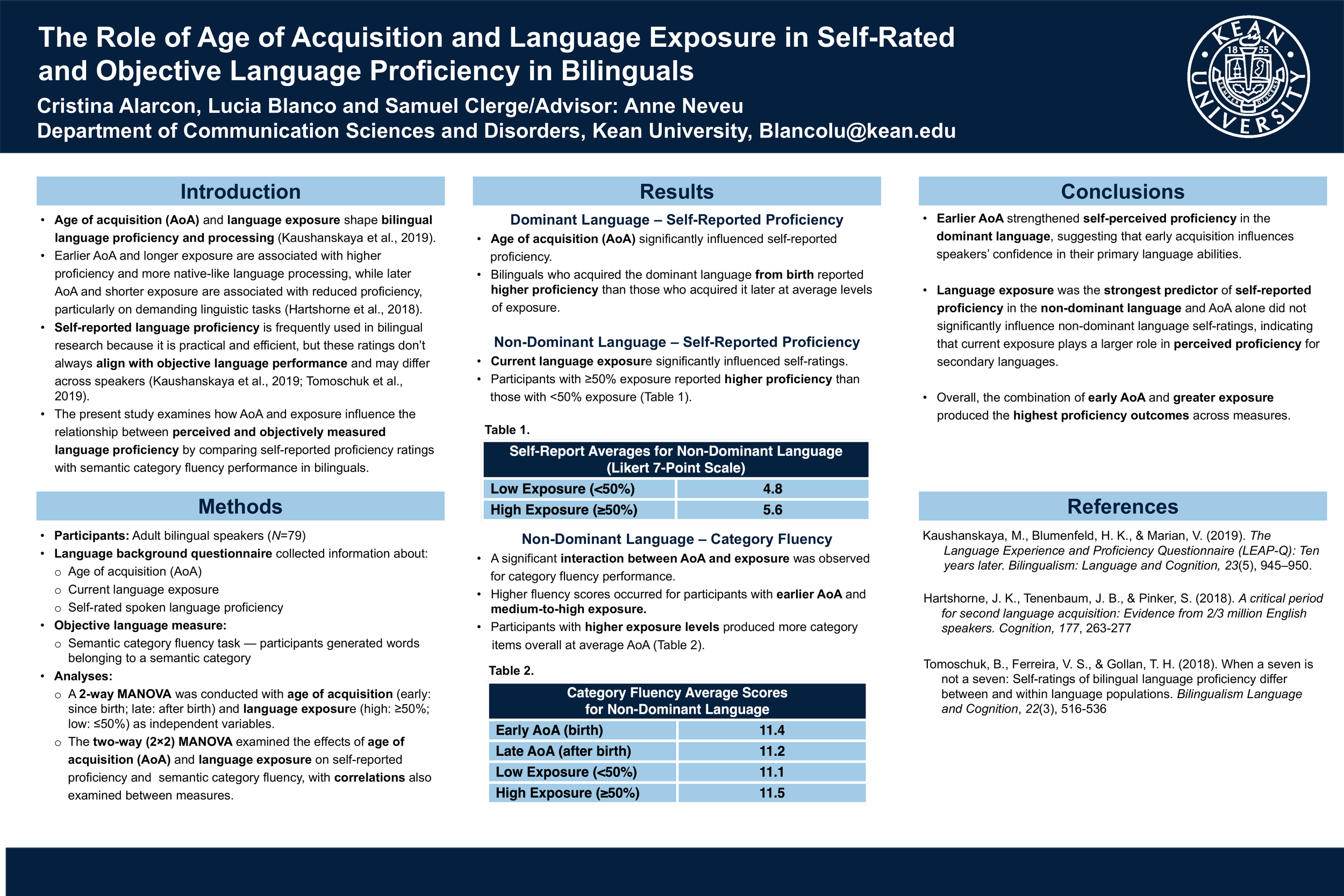
Age of acquisition (AoA), or the age at which a language is learned, and length of language exposure are known to affect language proficiency in bilinguals However, it is not always clear how these factors relate to both self-reported language ability and objective language performance. Self-reported proficiency is often used in bilingual research because it is practical, but these ratings do not always match actual language skills. This study addresses this gap by examining how age of acquisition and length of exposure influence self-reported and objectively measured language proficiency in bilinguals. Participants complete a language background questionnaire reporting age of acquisition, duration of exposure, and self-rated proficiency. They also complete a category (semantic) fluency task to measure objective language performance. We will run a 2-way MANOVA where age of acquisition and exposure are categorized respectively as early (before 16 years) or late (16 years and older) and high (6 months and over) and low (under 6 months). We will additionally run correlations between self-reported proficiency and category fluency scores within the four groups. It is expected that languages learned earlier and used for longer periods will show higher self-reported proficiency and better fluency performance. Self-reported proficiency is also expected to more closely reflect objective performance for languages learned earlier. These findings will help clarify when self-reported proficiency is a reliable measure and have important implications for bilingual research and clinical practice.