
Traffic Stops and Policing Profits: Analyzing the Connection within Florida
Bakari Wiltshire
Co-Presenters: Keliel Soto, Leilani Field-Riddley
College: Hennings College of Science Mathematics and Technology
Major: BA.MATHSCI
Faculty Research Mentor: Louis Beaugris
Abstract:
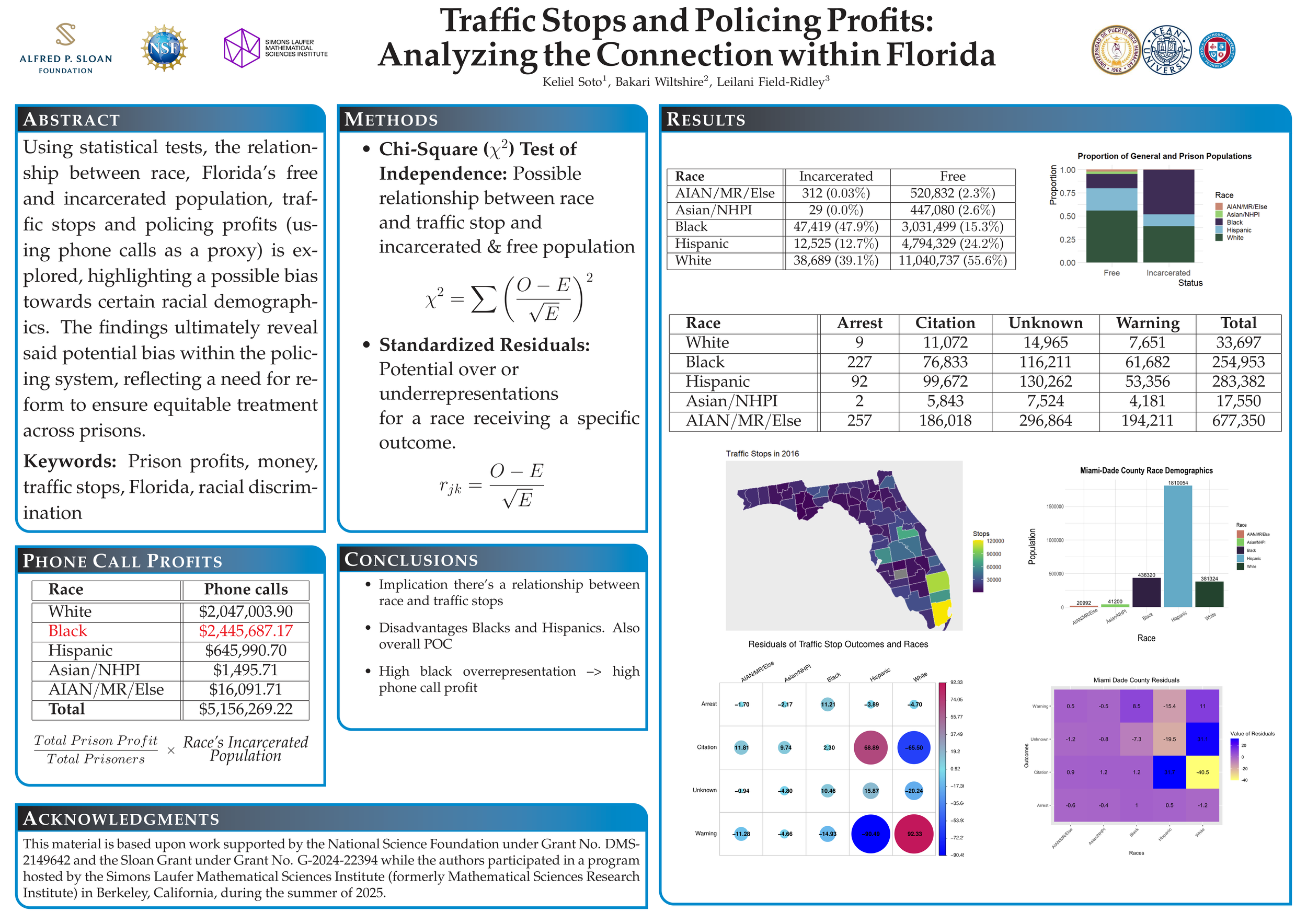
With over 23 million people, Florida has a very diverse population, but their state and federal prison population does not mirror the state's demographics. Despite Black individuals making up less than 15% of Florida’s total population, the Black population composes nearly 50% of the prison population, suggesting that this group is heavily overrepresented within the prison population. Using data primarily from the National Campaign of Prison Phone Justice, Data USA, and the Stanford Open Policing Project, this study examines the relationship between race, Florida’s free and incarcerated populations, traffic stop outcomes, and policing profits–with a focus on phone call rates–in hopes of revealing trends within Florida's incarceration system in the year 2016. To do so, a thorough investigation across Florida’s five counties with the most traffic stops was performed, employing the Chi-Squared Test of Independence to reveal racial disparities between the incarcerated and general population, as well as race and various traffic stop outcomes. An elaborate analysis of each tests’ residuals was also conducted, highlighting substantial differences between the way various races are represented in prison in comparison to the general population. This study’s findings ultimately suggest bias within Florida's policing and incarceration system, reflecting a need for reform to ensure equitable treatment across prisons.