
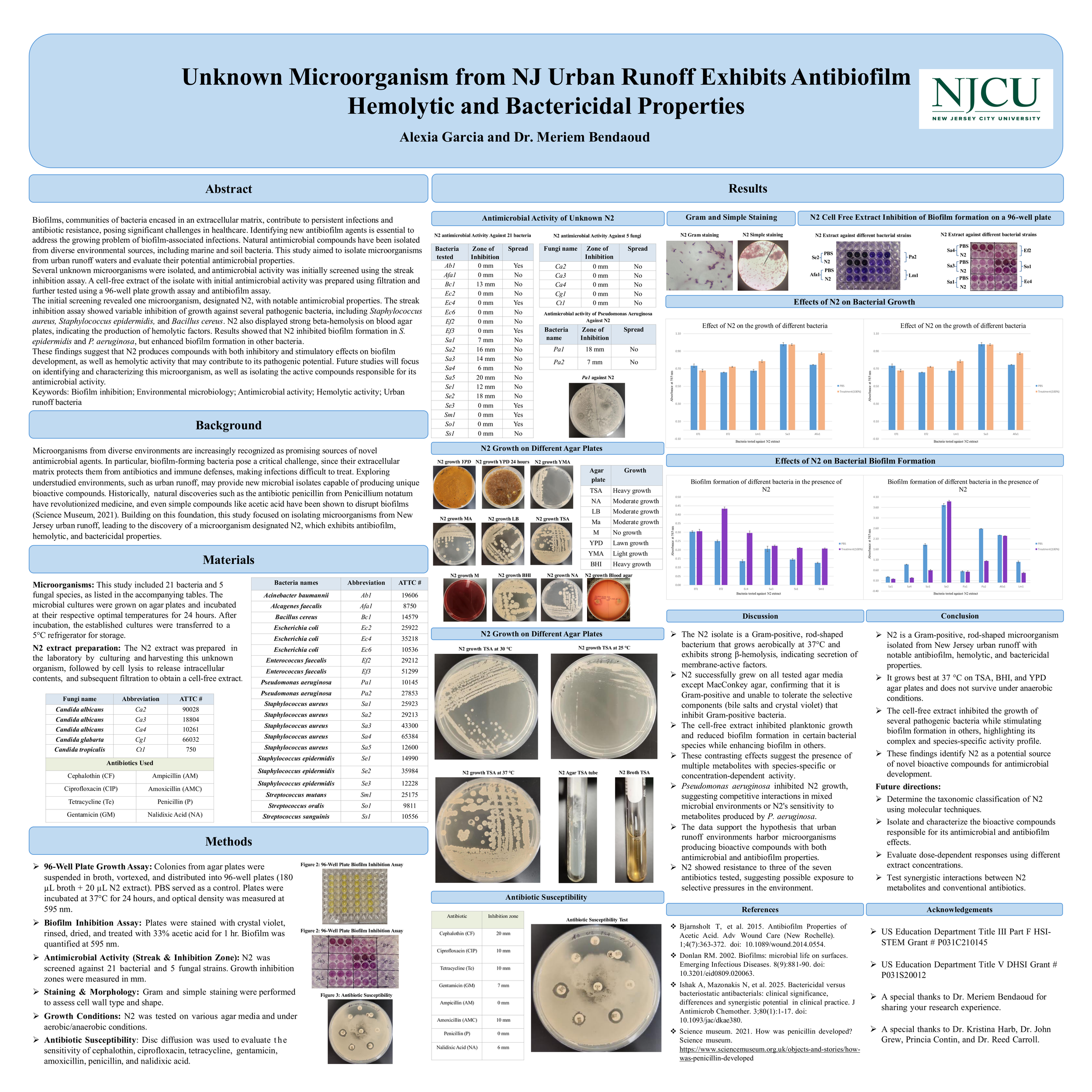
Unknown Microorganism from NJ Urban Runoff Exhibits Antibiofilm, Hemolytic, and
Alexia Garcia
Co-Presenters: Individual Presentation
College: Hennings College of Science Mathematics and Technology
Major: BS.BIO/CELL/MOLEC
Faculty Research Mentor: Meriem Bendaoud
Abstract:
Biofilms, communities of bacteria encased in an extracellular matrix, contribute to persistent infections and antibiotic resistance, posing significant challenges in healthcare. Identifying new antibiofilm agents is essential to address the growing problem of biofilm-associated infections. Natural antimicrobial compounds have been isolated from diverse environmental sources, including marine and soil bacteria. This study aimed to isolate microorganisms from urban runoff waters and evaluate their potential antimicrobial properties. Several unknown microorganisms were isolated, and antimicrobial activity was initially screened using the streak inhibition assay. Screening revealed one microorganism, designated N2, with notable antimicrobial properties. The streak inhibition assay showed variable inhibition of growth against several pathogenic bacteria, including Staphylococcus aureus, Staphylococcus epidermidis, and Bacillus cereus. N2 also displayed strong beta-hemolysis on blood agar plates, indicating the production of hemolytic factors. A cell-free extract of this isolate was further tested using a 96-well plate growth assay and antibiofilm assay. Results showed that N2 inhibited biofilm formation in S. epidermidis and P. aeruginosa, but enhanced biofilm formation in other bacteria. These findings suggest that N2 produces compounds with both inhibitory and stimulatory effects on biofilm development, along with hemolytic activity that may contribute to its pathogenic potential. Future studies will focus on identifying and characterizing this microorganism, as well as isolating the active compounds responsible for its antimicrobial activity.