
Virtual Reality Training Assists with Police De-escalation
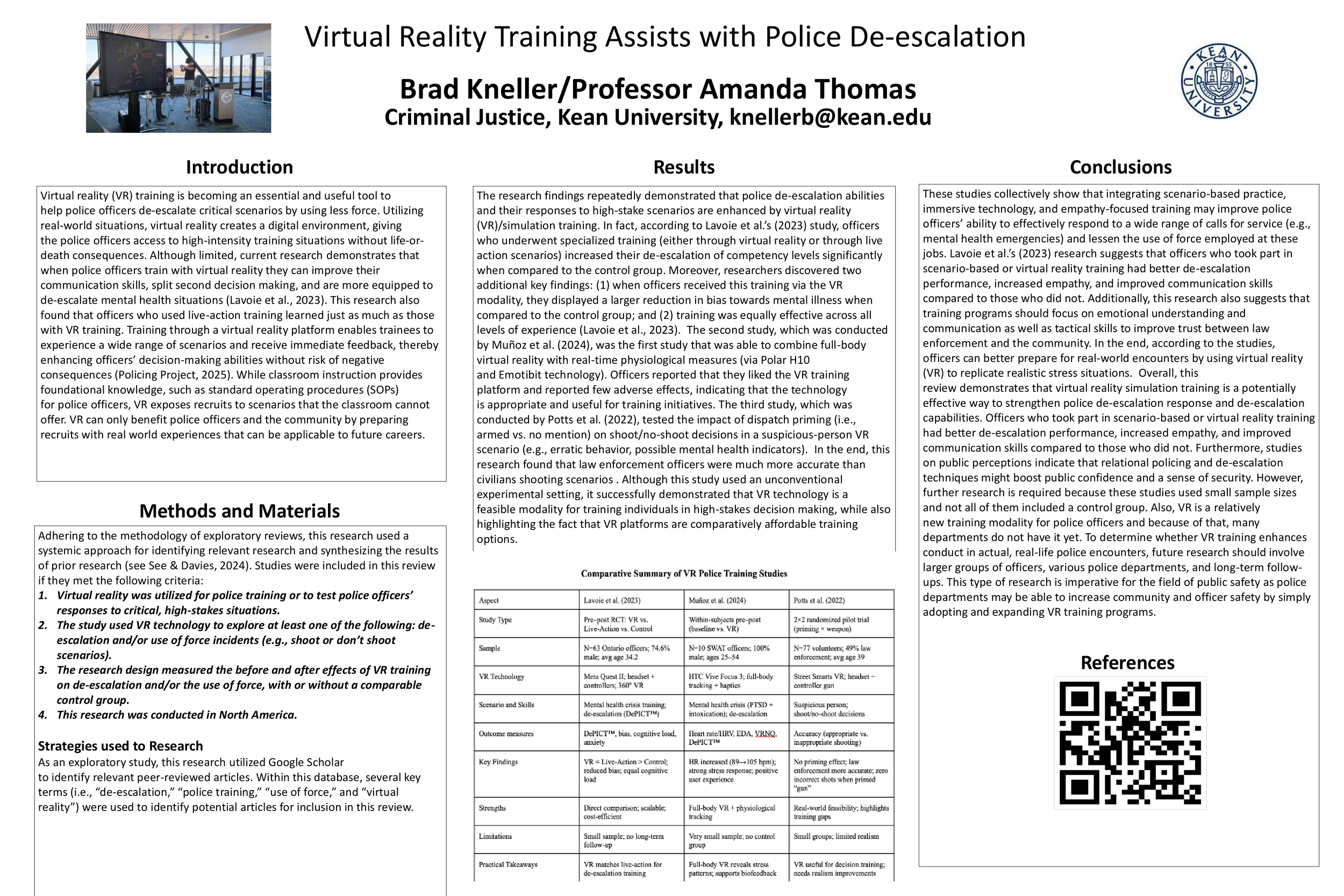
Brad Kneller
Co-Presenters: Individual Presentation
College: College of Business and Public Management
Major: BA.CRIMINALJUSTICE
Faculty Research Mentor: Dennis Bogdan, Amanda Thomas
Abstract:
Title: Virtual Reality Training Assists with Police De-escalation
Author: Brad Kneller, Department of Criminal Justice, Kean University
Abstract:
Objective/Overview: Everyday police officers encounter high-stakes situations that require split-second decisions, where outcomes can be life or death. In many cases, de-escalation techniques could replace or reduce the need for force, potentially leading to safer resolutions for both officers and civilians. To support officers in developing these skills, universities, police departments, and community agencies are exploring innovative training methods, such as the use of virtual reality (VR). VR enables officers and trainees to engage in realistic, immersive scenarios that traditional classroom or role-play settings cannot fully replicate, allowing repeated practice without real-world risks or consequences.
Methods: Given that this approach to police training is relatively new, the available research on the subject remains rather limited. To address this, this research aims to explore the existing literature to assess how practical VR training is for police officers and trainees learning de-escalation techniques. To accomplish this, this research will synthesize recent findings from prior peer-reviewed research on VR-based training for police de-escalation. Relevant studies will be reviewed and compared to assess VR’s impact on key outcomes, including communication skills, decision-making, emotional regulation, confidence, and reductions in use-of-force incidents.
Findings: In the end, the synthesized evidence indicates that VR training significantly enhances officers’ confidence and ability to select appropriate de-escalation strategies tailored to diverse scenarios. A key advantage of this technology is the provision of immediate, objective feedback, which highlights the strengths and limitations of trainees’ approaches and promotes reflective learning. Overall, this exploratory review demonstrates that VR serves as a valuable, evidence-based tool for improving de-escalation proficiency, ultimately contributing to greater safety for police officers and community members alike.
Key Words: Police training, virtual reality, de-escalation, use of force