
Visualizing Higher Education Accessibility in New Jersey: Institution Density and Travel Proximity
Bobbi Perry
Co-Presenters: Individual Presentation
College: Hennings College of Science Mathematics and Technology
Major: BS.COMPUTER/SCI
Faculty Research Mentor: Ching-Yu Huang
Abstract:
Introduction
This project visualized the geographic distribution and accessibility of 4-year universities using the U.S. accredited institutions dataset and Simplemaps U.S zipcode dataset stored in a MySQL database The larger problem this work relates to is inequitable access to higher education, which is influenced by where institutions are located, how far people must travel to reach them
Data and Methods
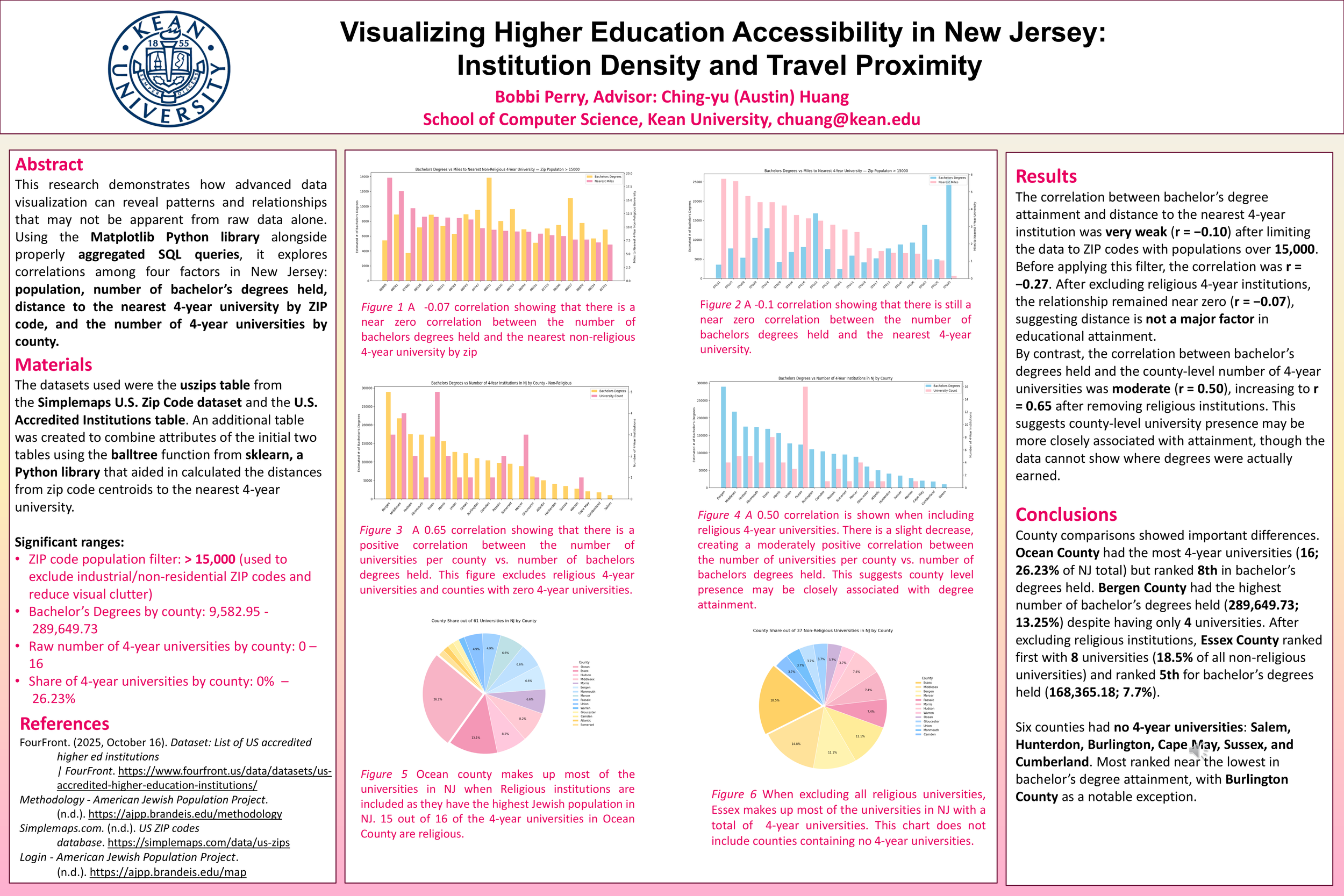
The datasets used for this project was the uszips table from the Simplemaps U.S. Zip Codes dataset and the U.S Accredited Institutions table(universities table). The uszips table contains 41,612 raw records, representing U.S zip codes. The universities table consisted of 6,289 raw records, representing all higher education institutions in the country. The scope was narrowed to New Jersey, producing 598 records for the uszips table and 162 records in the universities table. For accuracy, MySQL Workbench CE was utilized to create queries that extract relevant variables. These queries aggregated data at the county level, reducing the dataset to 21 records, corresponding to New Jersey’s 21 counties within the uszips datasets. An additional table was created to combine attributes of the initial two tables using the balltree function from sklearn, a Python library that aided in calculating the distances from zip code centroids to the nearest 4-year university.
Significant ranges:
ZIP code population filter: > 15,000
Bachelor’s Degrees by county: 9,582.95 - 289,649.73
Raw number of 4-year universities by county: 0 – 16
Share of 4-year universities by county: 0% – 26.23%
Conclusion
This research showed that visualization can reveal how educational attainment relates to institutional presence across New Jersey counties. The findings suggest that distance alone is not strongly associated with educational attainment at the county level. However, when bachelor’s degrees held were compared to the ratio of 4-year universities, the relationship became moderately positive, indicating that counties with a higher share of universities tend to also show higher counts of bachelor’s degrees held. Overall, the findings support the idea that 4-year university distribution may contribute to educational attainment, but it does not fully explain county differences, and additional variables would be needed to better model the patterns observed.