
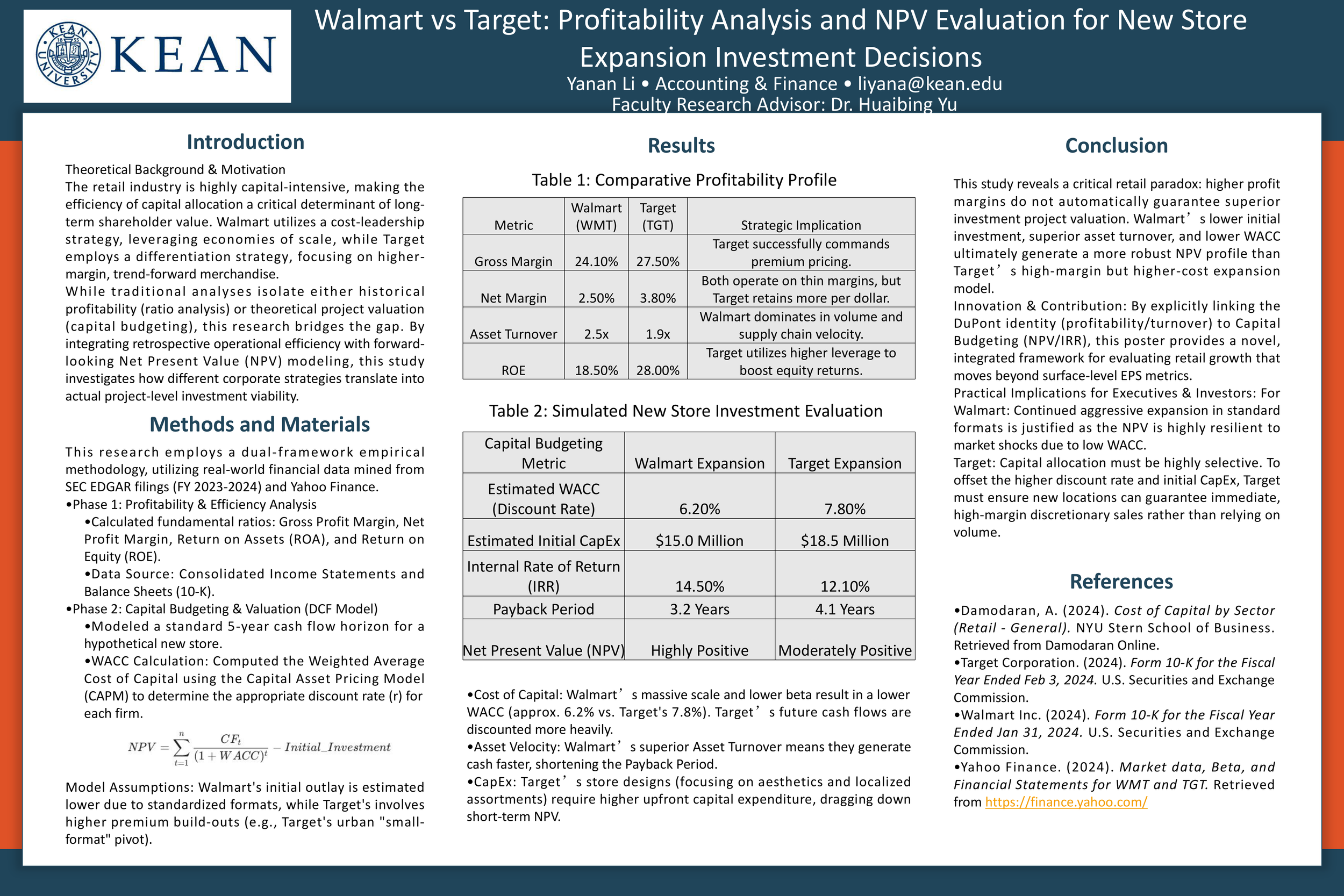
Walmart vs Target: Profitability Analysis and NPV Evaluation for New Store Expansion Investment Decisions
Yanan Li
Co-Presenters: Individual Presentation
College: College of Business and Public Management
Major: BS.FINANCE
Faculty Research Mentor: Huaibing Yu
Abstract:
This research investigates the financial attractiveness of new store expansion projects for two leading U.S. retail companies, Walmart and Target, by integrating profitability analysis and Net Present Value (NPV) investment evaluation. Profitability ratios, including gross profit margin, net profit margin, return on assets (ROA), and return on equity (ROE), are calculated using company financial statements to assess operational efficiency and capital utilization. Simultaneously, NPV, internal rate of return (IRR), and payback period are computed to evaluate the expected cash flow and investment return of new store projects over a five-year horizon. The study compares Walmart and Target on both profitability and investment efficiency, highlighting how operational performance impacts investment value. Results show that Walmart’s lower initial investment, efficient asset utilization, and lower weighted average cost of capital (WACC) lead to higher NPV and shorter payback periods, while Target exhibits higher margins but suffers from higher initial costs and discount rates, reducing short-term NPV. By combining financial health indicators with investment valuation, this research provides practical insights for investors and corporate managers in making informed expansion decisions.