
What impact does gender have on the pay of full-time employees in the public and private sectors?
Janay Brown
Co-Presenters: Chukwu Elumelu, Maverick Boateng, Jerry Therlonge
College: College of Business and Public Management
Major: BS.MARKETING
Faculty Research Mentor: Ipek Kocoglu
Abstract:
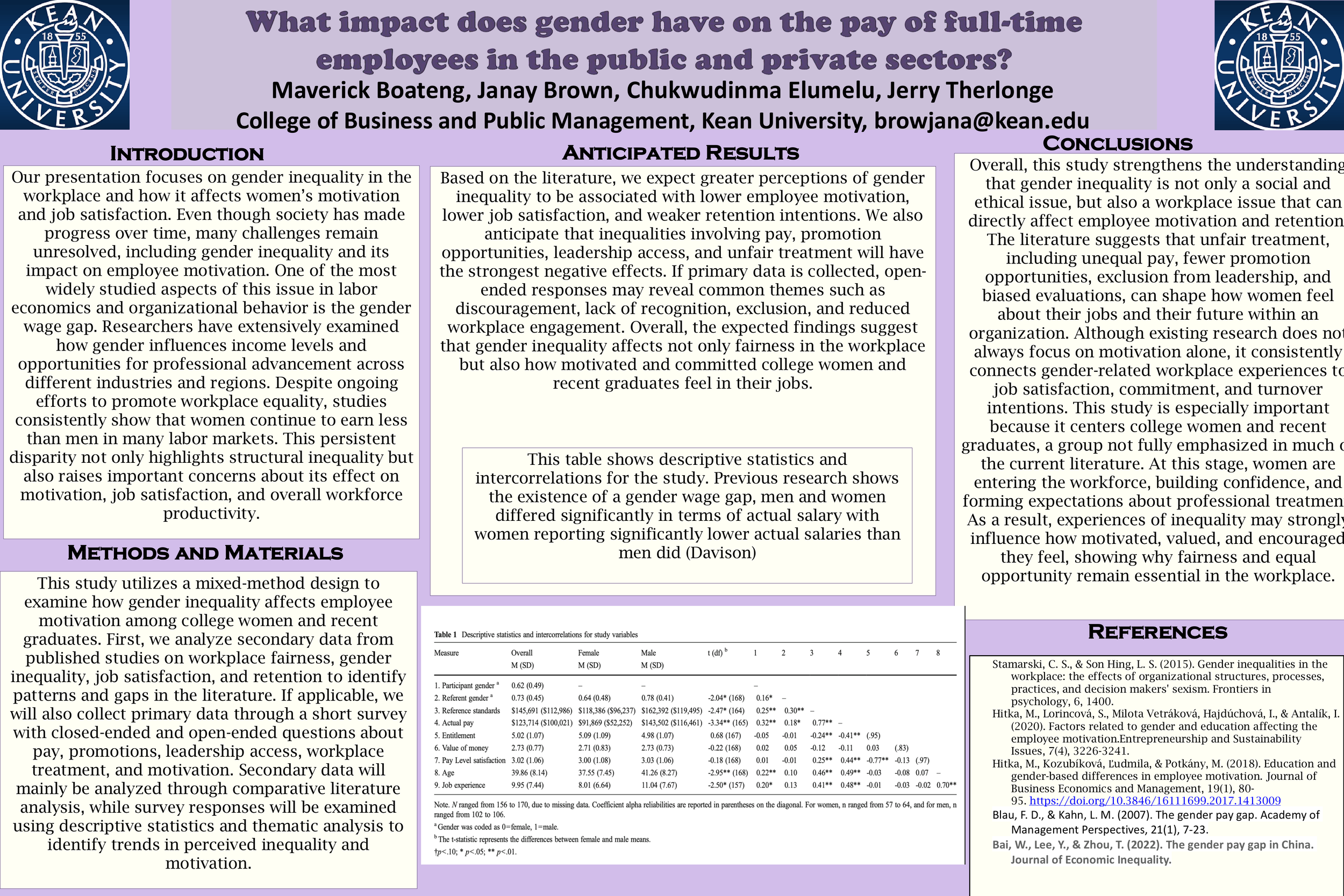
Even though we as a human race have advanced, there are still many issues we haven’t solved. One of those issues is gender inequality and how it affects employee motivation. Gender inequality remains a persistent issue in many workplaces, even in organizations that publicly promote equal opportunity. Employees may experience inequality through unequal pay, fewer promotion opportunities, biased performance evaluations, exclusion from leadership, and different standards of behavior based on gender. Although these patterns are often discussed as ethical and legal concerns, they also have a practical organizational impact, especially on employee motivation and engagement. We will collect data by reviewing academic journals and analyzing existing studies. We are going to use a mixed-methods research design built around existing literature and a survey-based comparison based on this existing literature. We’ll use quantitative and qualitative data by reviewing published studies on workplace gender inequality. The anticipated outcome is that a greater perception of gender inequality is associated with decreased employee motivation, lower job satisfaction, and diminished commitment to stay with an organization. Additionally, we predict that inequalities regarding compensation, promotions, and access to leadership will have the most significant impact on these outcomes. This study highlights the consequences of gender inequality, mainly its effects on employee retention and motivation.