
The Effect of Orthotics on Pain & Gait in Patients with Medial Knee Osteoarthritis: A Systematic Review
Justin Behnke
Co-Presenters: Saira Khan, Nicole Pula, Andria Reber
College: College of Health Professions and Human Services
Major: DPT.PHYSTHERAPY
Faculty Research Mentor: Carla Enriquez, Alka Bishnoi
Abstract:
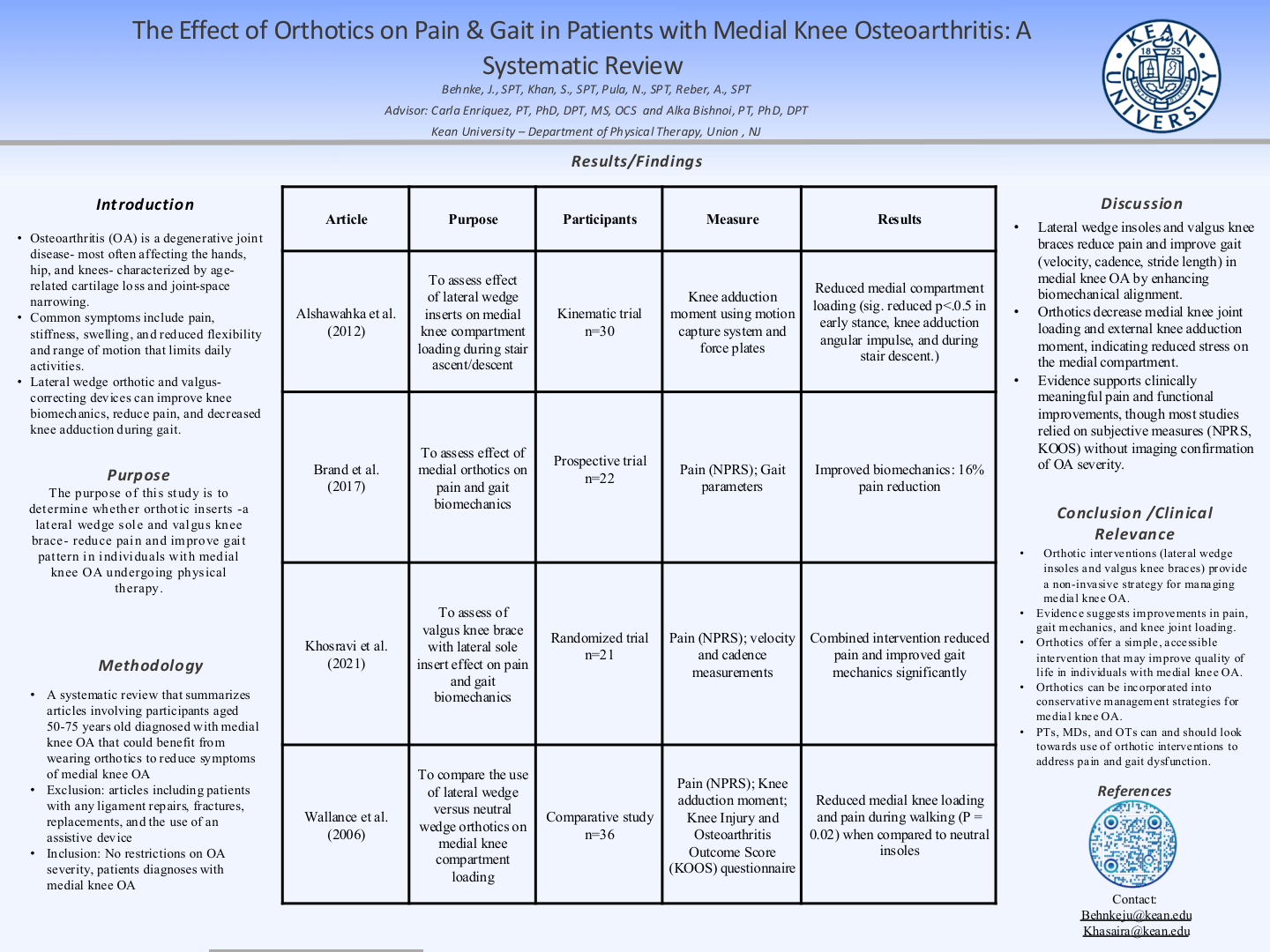
BackgroundMedial knee osteoarthritis (OA) is a prevalent musculoskeletal condition affecting a large proportion of older adults and is associated with pain, altered gait mechanics, and progressive functional decline. Non-invasive interventions that reduce medial compartment loading, such as lateral wedge insoles and valgus knee braces, have been proposed as conservative management strategies to delay disease progression and improve patient outcomes.MethodsThe purpose of this systematic review is to analyze orthotic interventions, including lateral wedge insoles and valgus knee braces, as potential non-invasive strategies to mitigate symptoms and improve functional outcomes in patients with medial knee OA. Through following PRISMA guidelines, a search was conducted across databases (PubMed, ProQuest, Google Scholar). Fifteen studies ranging from 2006 to 2021 were identified and systematically appraised for methodological quality and outcome measures. Inclusion criteria for source collection included randomized control trials, prospective cohort studies, and case studies. Exclusion criteria included those with ligament repairs, fractures, replacements, or assistive device use.ResultsFindings reveal diverse outcomes regarding the efficacy of orthotic interventions, with some studies demonstrating significant pain alleviation and gait improvement, and others reporting modest or inconclusive results. Furthermore, potential mechanisms underlying the observed effects are discussed, including alterations in distribution of joint forces and neuromuscular adaptation. Inconsistencies in findings may be attributed to differences in study design, orthotic prescription type, duration of orthotic wear intervention, outcome measures utilized, and patient compliance with prescribed interventions.DiscussionThe variability in outcomes highlights the complexity of orthotic intervention effects in medial knee OA and suggests that patient-specific factors and orthotic type and wear time may influence treatment outcomes. Differences in dependent variables assessed, including pain, gait parameters, and functional performance, further contribute to heterogeneity across selected studies.ConclusionUltimately, the data synthesis aims to inform clinical practice and guide evidence-based decision-making in the management of medial knee OA, offering insights into the role of orthotic interventions in optimizing patient outcomes. While lateral wedge insoles and valgus knee braces demonstrate potential benefits, additional research is required to clarify orthotic effectiveness and generalizability to selected patient population of medial knee OA