
What’s on the Menu? How Diamondback Terrapin Diet Impacts Macroinvertebrates in Sawmill Creek, NJ
Talayeh Aviles
Co-Presenters: Drew McQuade, Aleshanee Mooney, Michael Turso, Terry Doss
College: Hennings College of Science Mathematics and Technology
Major: BA.BIOLOGY
Faculty Research Mentor: Allison Fitzgerald
Abstract:
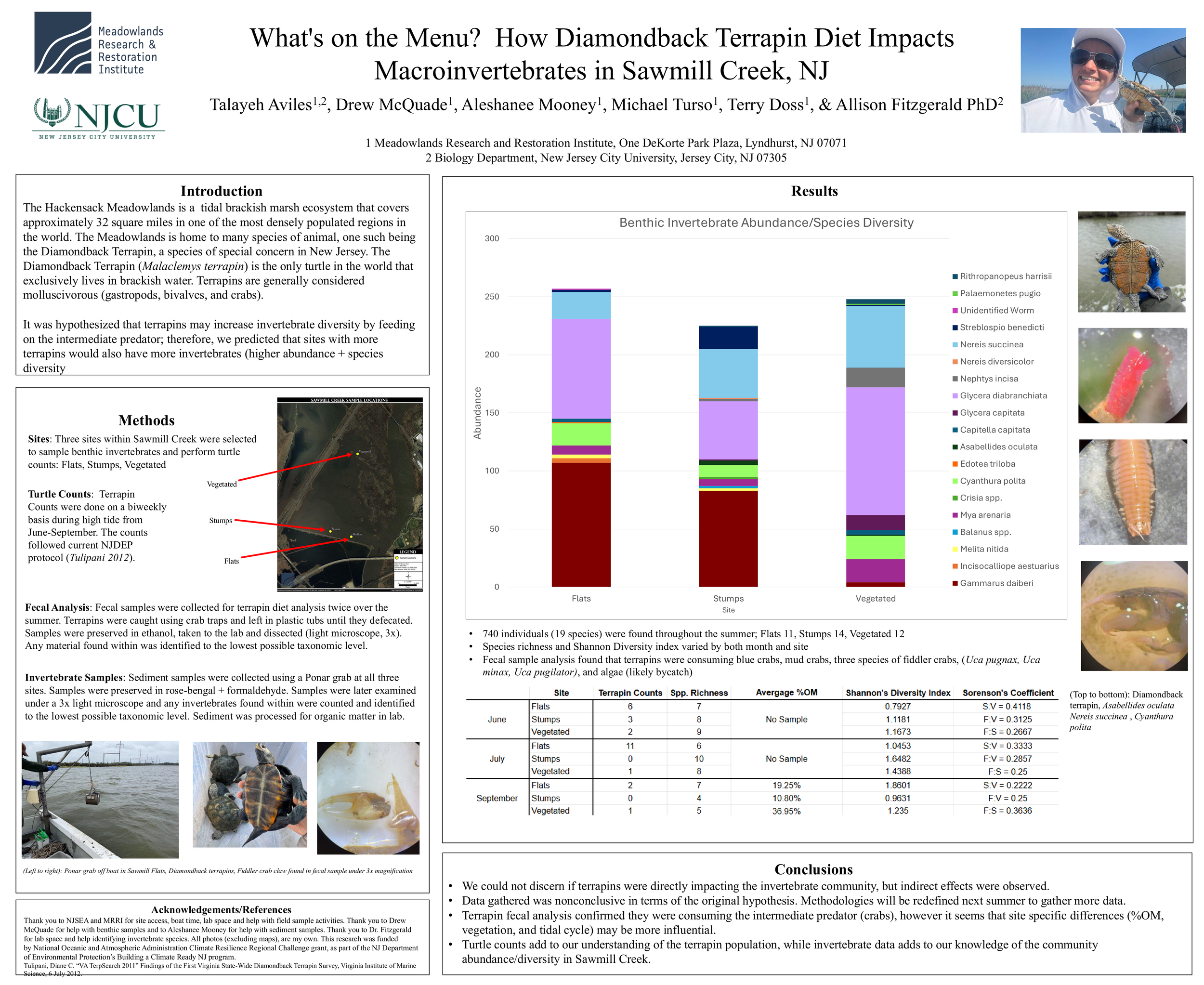
The Hackensack Meadowlands is a saltmarsh ecosystem that covers about 32 square miles in one of the most populated regions in the world, New Jersey. This urban wildlife refugee is home to many endangered species. These species include, but are not limited to, black skimmers and peregrine falcons. Another species that is listed as a species of concern is the diamondback terrapin. Diamondback terrapins, Malaclemys terrapin, are turtles that are found throughout the brackish waters of the New Jersey Meadowlands. The population severely lowered at one point as terrapins were considered a delicacy. The current Meadowlands population is unknown. However, the Meadowlands Research and Restoration Institute is currently conducting a long-term population study that started in 2009. Over 1,300 terrapins have been tagged, and that number continues to grow.Terrapins are crucial in maintaining saltmarsh ecosystems through food web dynamics. One such interaction is by controlling periwinkle, Littoraria irrorata, populations. Without terrapins, snail populations would boom and overgraze on Spartina alterniflora leaving behind a barren environment. This study aims to investigate if terrapins cause an impact on benthic invertebrate abundance and diversity in the Meadowlands. Diamondback terrapins’ diet includes fiddler crabs and blue crabs. These two macroinvertebrate taxons prey on smaller macroinvertebrates, such as annelids and amphipods. Thus, the macroinvertebrate populations in sites with terrapins would have a higher abundance and diversity compared to sites without terrapins, as the terrapins would reduce biodiversity by removing the intermediate predator (crabs).Three sites within Sawmill Creek were chosen and classified as Stumps, Flats, and Vegetated. Terrapin counts were started in June 2025 and done on a biweekly basis. Mud samples were taken from the sites once per month from June through August. Mud samples were analyzed, with all organisms counted and identified to the lowest possible taxon. Diamondback terrapin fecal samples were collected, and analyzed under a microscope to see what terrapins were consuming. There were site specific differences based on terrapin counts and macroinvertebrate diversity/abundance. This study adds to our understanding of diamondback terrapins' importance in saltmarsh habitats and emphasizes the potential consequences of not protecting the diamondback terrapin.