
A Comparative Study of Avian Biodiversity at Two Sites in the New Jersey Meadowlands
Allison Brizuela
Co-Presenters: Individual Presentation
College: The Dorothy and George Hennings College of Science, Mathematics and Technology
Major: Biology/Enviornmental Option
Faculty Research Mentor: Cailin Oconnor Fitzpatrick
Abstract:
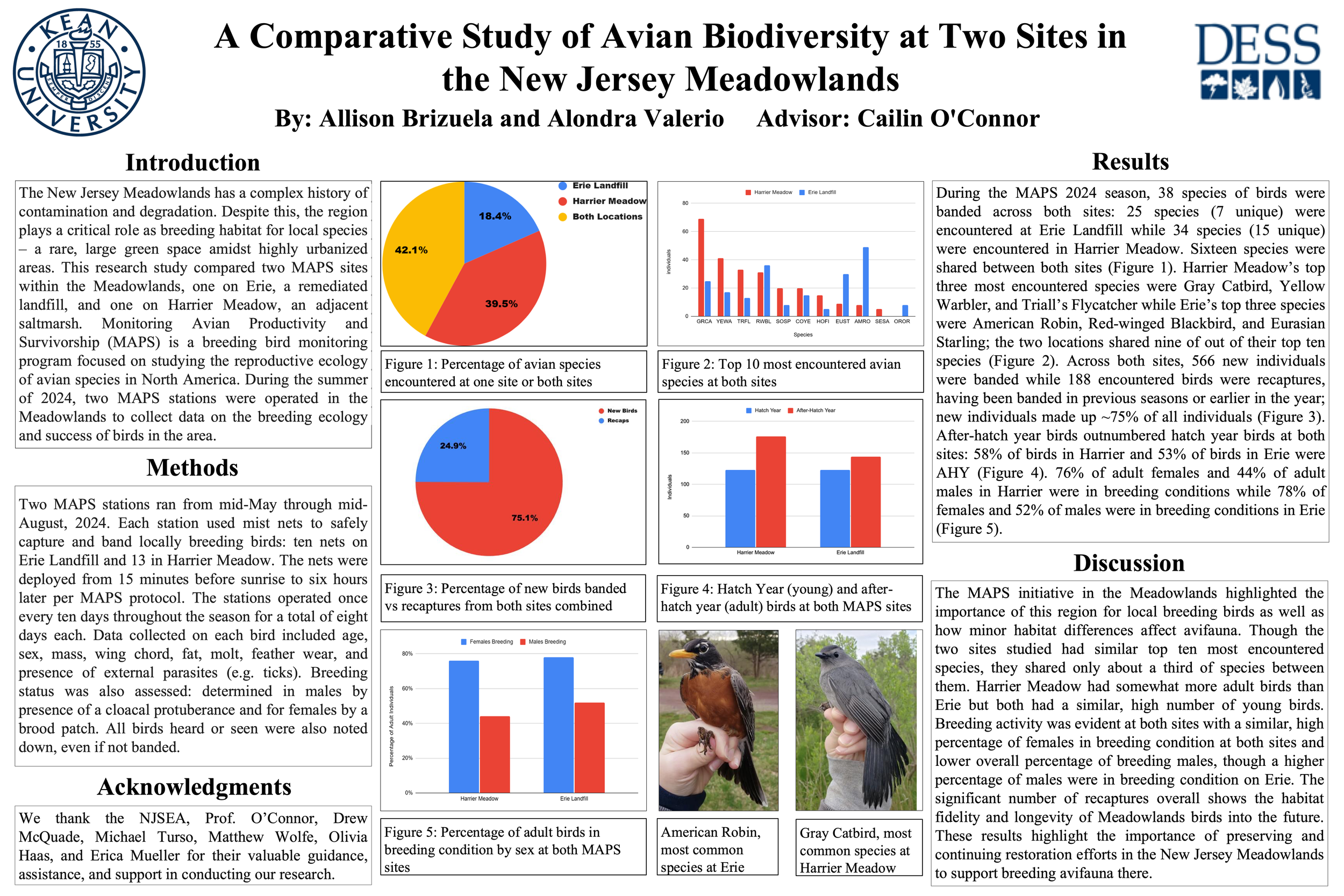
The New Jersey Meadowlands is one of the largest wetland ecosystems in northeastern New Jersey and one of the region's biggest urban open spaces. The region has high biodiversity and is home to many native species, especially birds, many of which breed in the area. During the summer of 2024, protocol provided by the Monitoring Avian Productivity and Survivorship (MAPS) breeding bird program was followed to study biodiversity and breeding success of birds on two locations within the Meadowlands: Harrier Meadow and nearby Erie Landfill. Erie Landfill is a capped landfill with mid-successional vegetation dominated by invasive plants while Harrier Meadow is saltwater marsh with low, mostly native vegetation. Both sites have a history of contamination with heavy metals and volatile organic compounds. This study focused on determining what species were present, if individuals were in breeding condition, and how many offspring were produced in local species to determine if birds utilizing the Meadowlands as breeding habitat were successful. During the MAPS 2024 season, 566 birds of 38 species were banded across both stations with roughly the same number of individuals at each. While 16 species were found at both sites, Erie had seven unique species while Harrier had 15, showing greater species richness at the latter. The most frequently encountered specie in Harrier Meadow were the Gray Catbird, Yellow Warbler, and Traill’s Flycatcher, while on Erie Landfill, American Robins, Red-winged Blackbirds, and European Starlings - an invasive species - were most common. Sixty percent of individuals encountered were adult birds; out of the adult birds in Harrier, 62% were in breeding condition while 64% were in breeding condition on Erie. Forty percent of birds encountered were hatch-year individuals, indicating successful reproduction at both locations. The young produced were mostly Gray Catbirds, Yellow Warblers, and Song Sparrows in Harrier Meadow and American Robins, European Starlings, and Yellow Warblers on Erie Landfill. This research project highlighted the biodiversity of the New Jersey Meadowlands and its importance for breeding birds in a highly urbanized landscape, as well as the importance of habitat heterogeneity for maximum biodiversity.