
Analyzing Salary Patterns by Job Code and Experience
Emma Toledo
Co-Presenters: Lia Trenery, Emir Pupovic, Blessing Scotland
College: The Dorothy and George Hennings College of Science, Mathematics and Technology
Major: Mathematics - STEM Teacher Education 5 Year
Faculty Research Mentor: Brian Baldwin
Abstract:
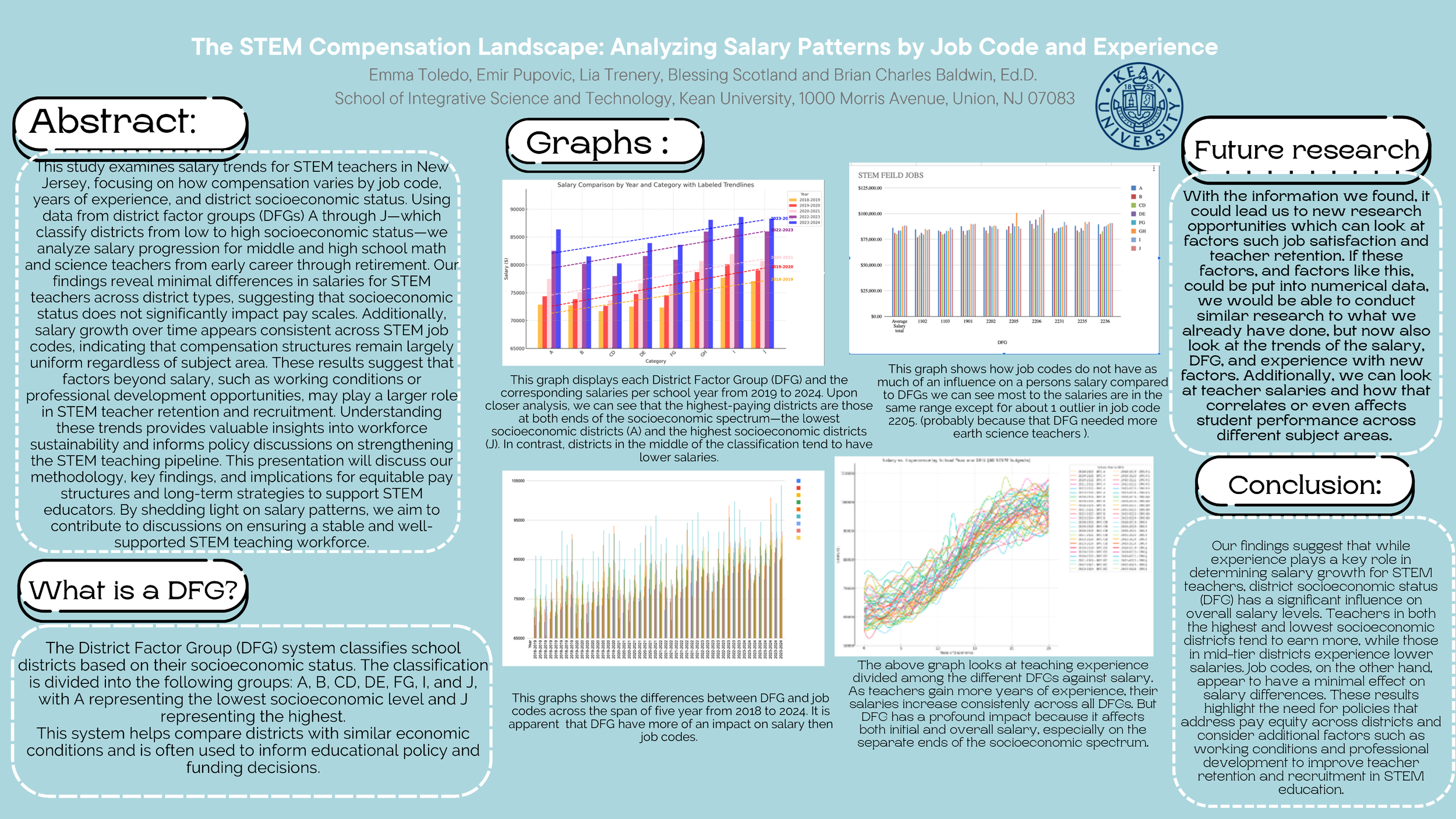
This study examines salary trends for STEM teachers in New Jersey, focusing on how compensation varies by job code, years of experience, and district socioeconomic status. Using data from district factor groups (DFGs) A through J—which classify districts from low to high socioeconomic status—we analyze salary progression for middle and high school math and science teachers from early career through retirement. Our findings reveal minimal differences in salaries for STEM teachers across district types, suggesting that socioeconomic status does not significantly impact pay scales. Additionally, salary growth over time appears consistent across STEM job codes, indicating that compensation structures remain largely uniform regardless of subject area. These results suggest that factors beyond salary, such as working conditions or professional development opportunities, may play a larger role in STEM teacher retention and recruitment. Understanding these trends provides valuable insights into workforce sustainability and informs policy discussions on strengthening the STEM teaching pipeline. This presentation will discuss our methodology, key findings, and implications for equitable pay structures and long-term strategies to support STEM educators. By shedding light on salary patterns, we aim to contribute to discussions on ensuring a stable and well-supported STEM teaching workforce.