
The Morphological Characterization on the correlation of particle size and delivery in lotion-based products
Lamont Lee
Co-Presenters: Individual Presentation
College: The Dorothy and George Hennings College of Science, Mathematics and Technology
Major: Biology
Faculty Research Mentor: Brian Ree
Abstract:
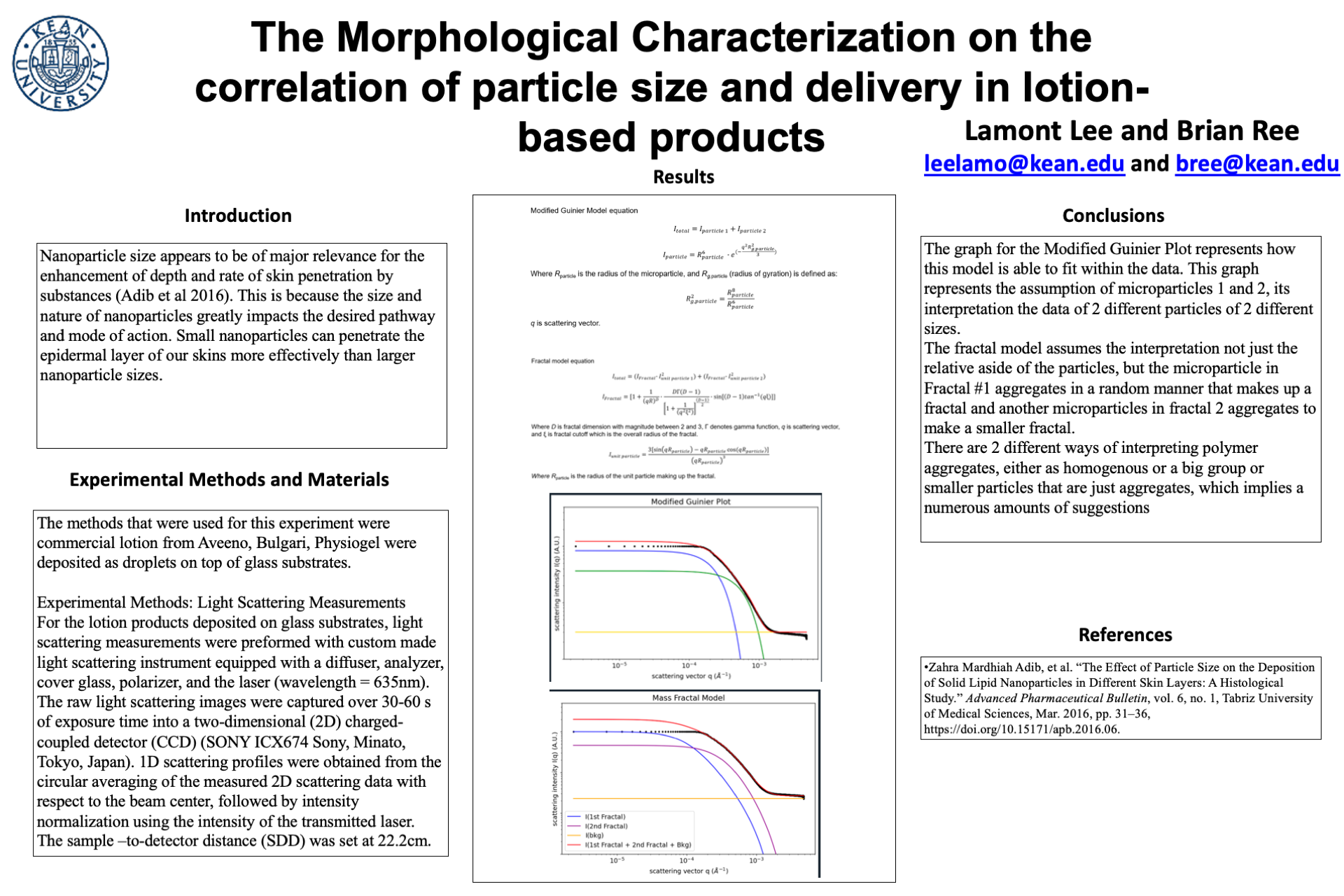
Particle size and delivery both play significant proportionality to the mechanism of action of lotion-based products. It is also apparent that the efficacy of skin penetration depends on the size of particles because it affects the penetration pathways (i.e., transcellular, intercellular, and transappendageal routes) for smaller particles (Jin et al 2022). In practice, smaller particles possess a greater surface area that causes the skin to absorb the solution much faster compared to a large particle size. An example of how particle size affects lotion-based products is in sunscreen; zinc oxide is a mineral that is commonly found in nature and is used in most skincare products. Small particles are more useful compared to larger particles in sunscreen because how they offer more production by reflecting the UV radiation from the sun. To analyze the mass of the particles in lotion-based products, a technique referred to as “Light Scattering” is practiced. Light scattering-based particle size analysis enables optical sample characterization which can be enhanced by computer processes to improve speed and accuracy (Pilkington 2022). Using light scattering in lotion-based products offers incredible quality control to ensure stability and efficacy to the general public.