
Enhancing Lunar Lander Stability with Adaptive Deep Q-Networks
Abiodun Obafemi
Co-Presenters: Individual Presentation
College: The Dorothy and George Hennings College of Science, Mathematics and Technology
Major: Computer Information Systems (M.S.)
Faculty Research Mentor: Israel Curbelo
Abstract:
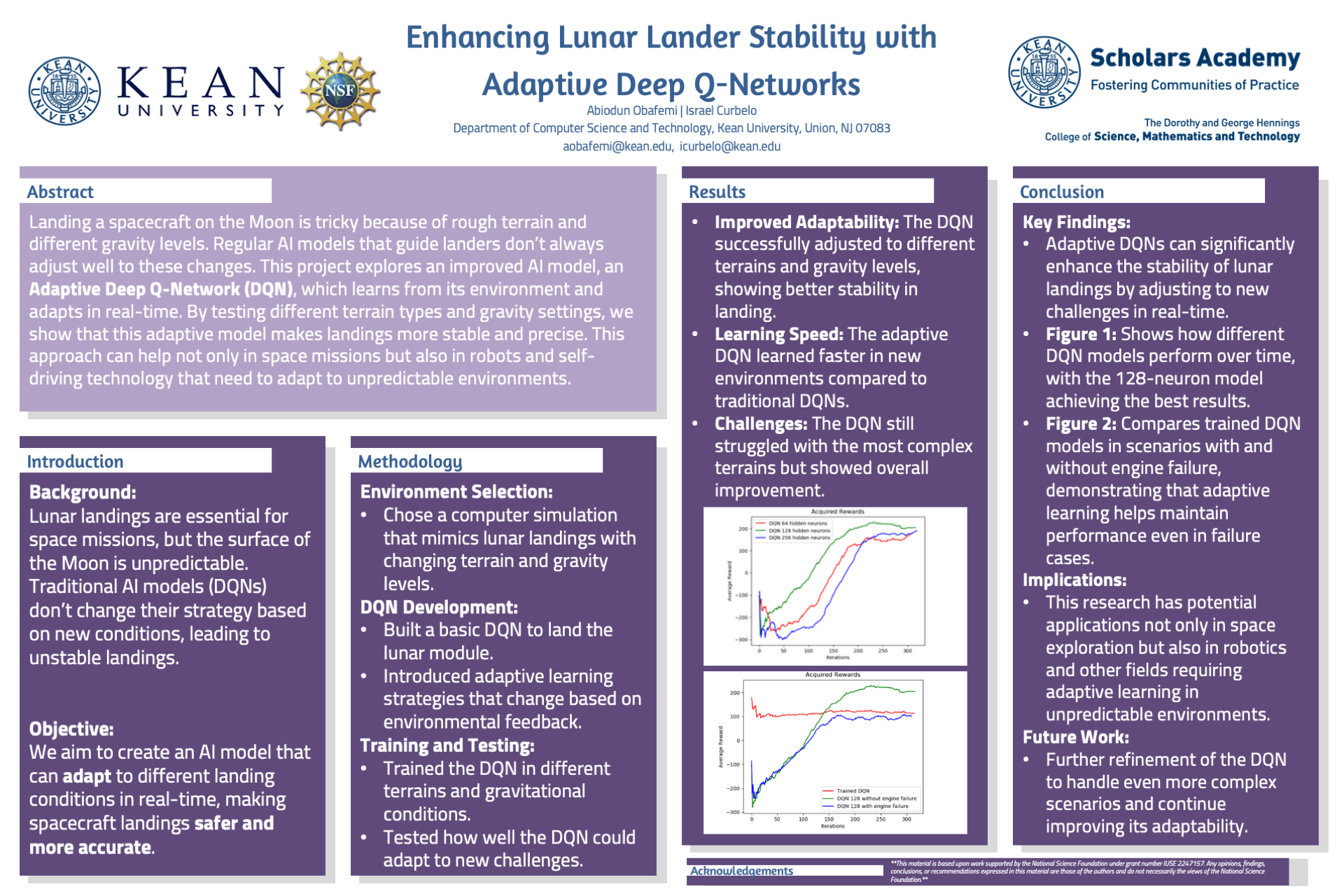
This project explores how adaptive Deep Q-Networks (DQNs) can improve the stability and accuracy of lunar landings in different environments. Landing on the Moon is challenging because the terrain and gravity can change, making it hard for traditional methods to land safely. Regular DQNs use fixed learning strategies, meaning they don’t adjust well to new conditions, which can lead to failed landings.To solve this problem, we designed an adaptive DQN that can change how it learns based on its environment. This means the model can adjust in real-time, improving its ability to land successfully on different types of terrain. Our approach involved choosing a lunar landing simulation with different gravity levels and surface types, creating a basic DQN model, and enhancing it with adaptive learning so it could react to new challenges.After training and testing, we found that the adaptive DQN performed much better than traditional models. It was able to adjust quickly to different landing conditions, making its landings more stable and accurate. It also learned faster, meaning it needed less time to improve its landings in new environments. However, the model still struggled with the most complex terrains, though it showed overall progress.These results suggest that adaptive DQNs could be very useful, not just for space missions, but also in other fields like robotics and self-driving technology, where machines need to adapt to changing environments. In the future, we plan to improve the adaptive DQN even further so it can handle more difficult situations and become even more reliable. This research shows how machine learning can help make space exploration safer and more efficient by allowing autonomous systems to make smarter decisions in uncertain conditions.