
Evaluation of Melt Extrusion Induced Crystallization of Poly(lactic acid) Via Raman Spectroscopy
Frank Souza Silva
Co-Presenters: Vivian Ukor
College: The Dorothy and George Hennings College of Science, Mathematics and Technology
Major: Chemistry
Faculty Research Mentor: Brian Ree
Abstract:
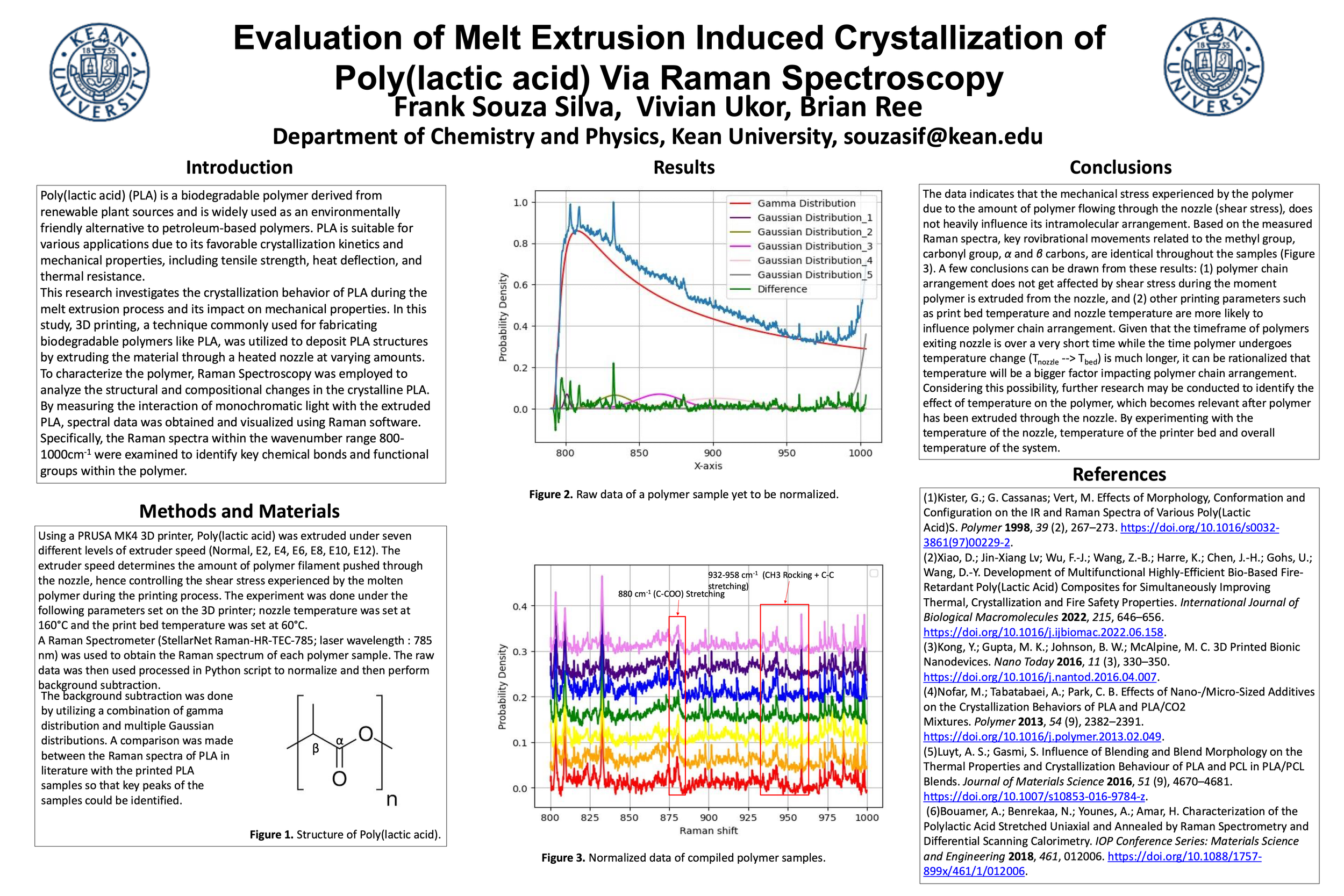
Poly(lactic acid) is a polymer commonly used in 3D printing. The properties of PLA can change depending on the parameters at which they are printed and the crystallinity of the printed polymer. The crystallization of PLA can affect properties such as the tensile strength, heat resistance, flexibility and degradation. These factors may lead to positive mechanical changes up to a point before the improvements degrade again. This research evaluates the crystallization of PLA caused by the melt extrusion method to reveal significant changes in PLAs mechanical properties. 3D printing known for its customizable and simplified process was used to obtain the polymers in different dimensions. Raman Spectroscopy was used to analyze the structure and composition of the crystalline polymers. The interaction of the monochromatic light in Raman and the PLA extruded is measured and displayed as a graph in the Raman software. The data was then normalized using coding software to be able to evaluate and compare intramolecular structures of the PLAs. PLA crystallization properties can vary with the printing conditions and evaluating the limits at which these changes can occur can lead to improvements in its uses in the medical field, clothing, 3D printing and many more. This research leads to identifying methods to refine and improve the mechanical properties of PLA through understanding the crystallinity in the polymers.