
Quantitative Evaluation of Polymer-Based Particles in Lotion Via Light Scattering
Angelina Appleton
Co-Presenters: Angelina Appleton, Raquel Lopez
College: The Dorothy and George Hennings College of Science, Mathematics and Technology
Major: Chemistry
Faculty Research Mentor: Brian Ree
Abstract:
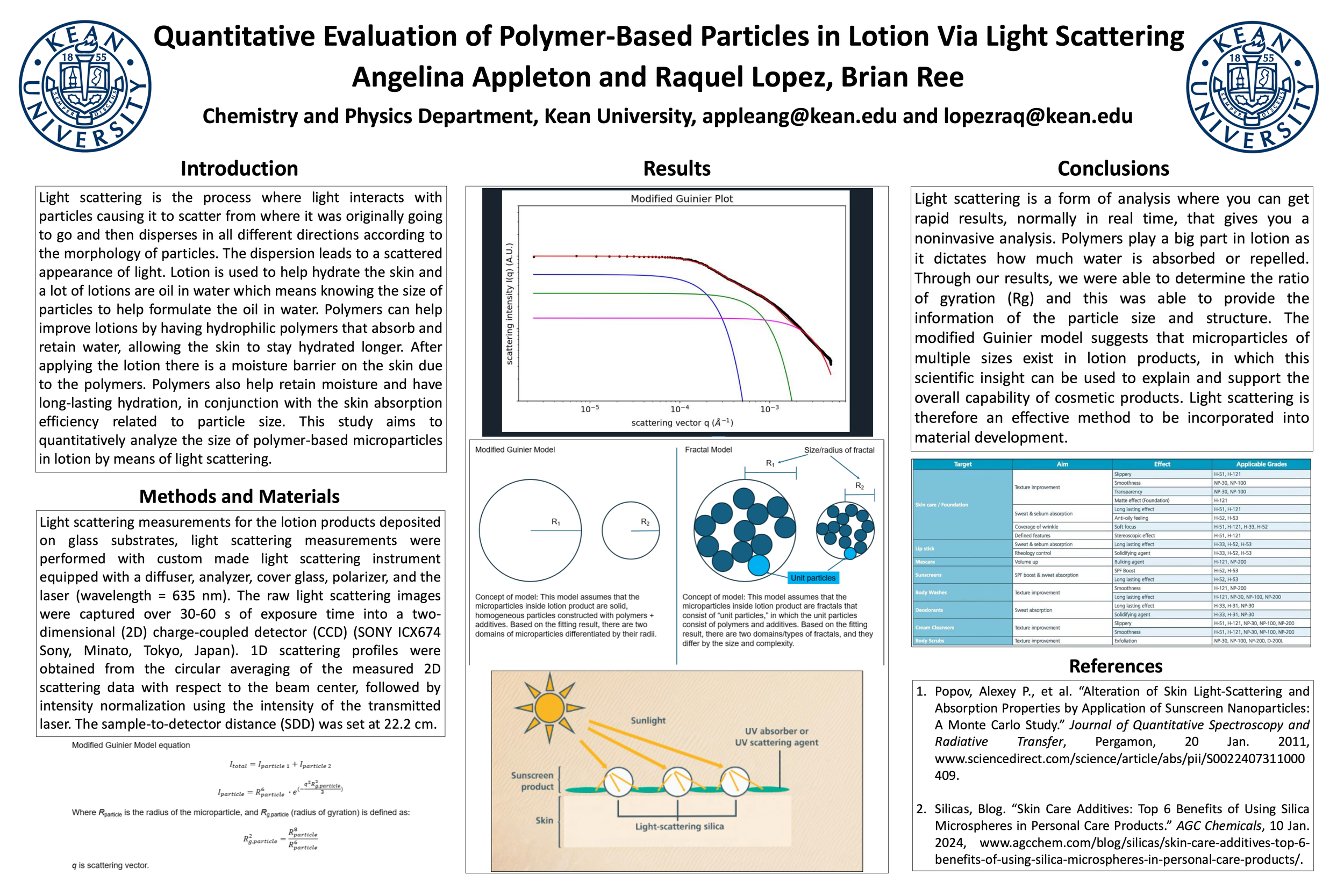
Light scattering is the process where light interacts with particles causing it to scatter from where it was originally going to go and then disperses in all different directions according to the morphology of particles. The dispersion leads to a scattered appearance of light. Lotion is used to help hydrate the skin and a lot of lotions are oil in water which means knowing the size of particles to help formulate the oil in water. Polymers can help improve lotions by having hydrophilic polymers that absorb and retain water, allowing the skin to stay hydrated longer. After applying the lotion there is a moisture barrier on the skin due to the polymers. Polymers also help retain moisture and have long-lasting hydration, in conjunction with the skin absorption efficiency related to particle size. This study aims to quantitatively analyze the size of polymer-based microparticles in lotion by means of light scattering.