
GIS Informs Sample Site Choice for Study of Urban Evolution
Renato Mendez
Co-Presenters: Individual Presentation
College: The Dorothy and George Hennings College of Science, Mathematics and Technology
Major: Enviornmental Sciences
Faculty Research Mentor: Brenna Levine
Abstract:
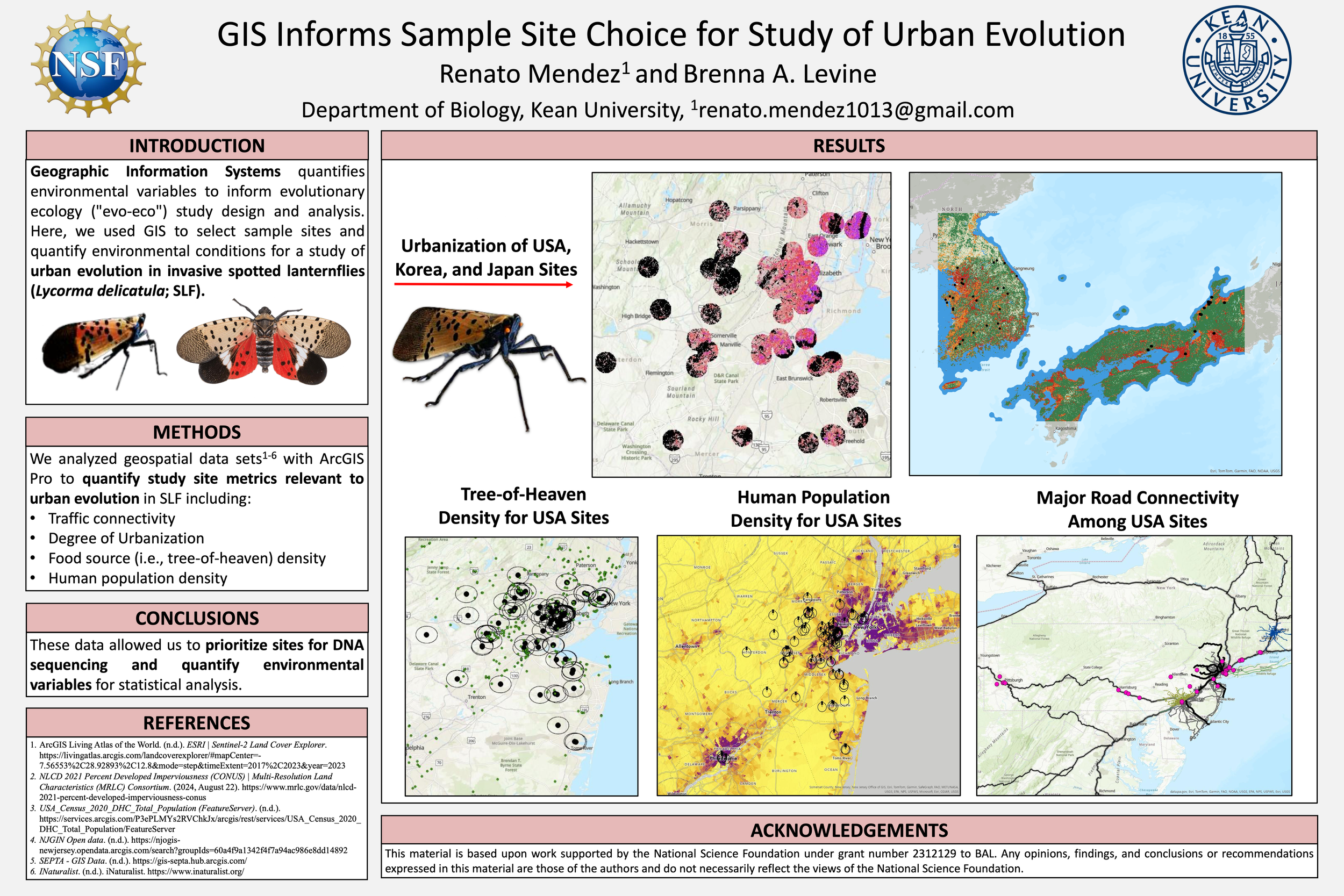
Geographic Information Systems (GIS) encompasses a suite of analytical tools that analyze anddisplay data corresponding to specific geographic locations. These data comprise twocategories: Vector data represents geographic objects (points, lines, and polygons), and rasterdata represents images of geographic locations (e.g., digital aerial images, satellite images, andscanned maps). In evolutionary ecology studies, GIS is an important analytical tool foroptimizing study design (e.g., selecting sampling locations), generating data for statisticalmodels (e.g., percent impervious surface), and controlling for nuisance variables (e.g., distancebetween sampling sites). Here, I used GIS to inform sample site selection for a study of urbanevolution in invasive spotted lanternflies. To do so, I quantified urbanization of each sample siteby calculating mean percent impervious surface within a 5 KM buffer around each study site. Ithen calculated pairwise distances among all study sites so that these data may be used to testwhether genomic differences among populations are a result of physical distances among sites(i.e., isolation-by-distance). This study exemplifies the utility of GIS for evolutionary ecology studies.