
Exploring Demographics and Voting
Max Kaiser
Co-Presenters: Adam Spencer
College: The Dorothy and George Hennings College of Science, Mathematics and Technology
Major: Computer Information Systems (M.S.)
Faculty Research Mentor: Ching-yu Huang
Abstract:
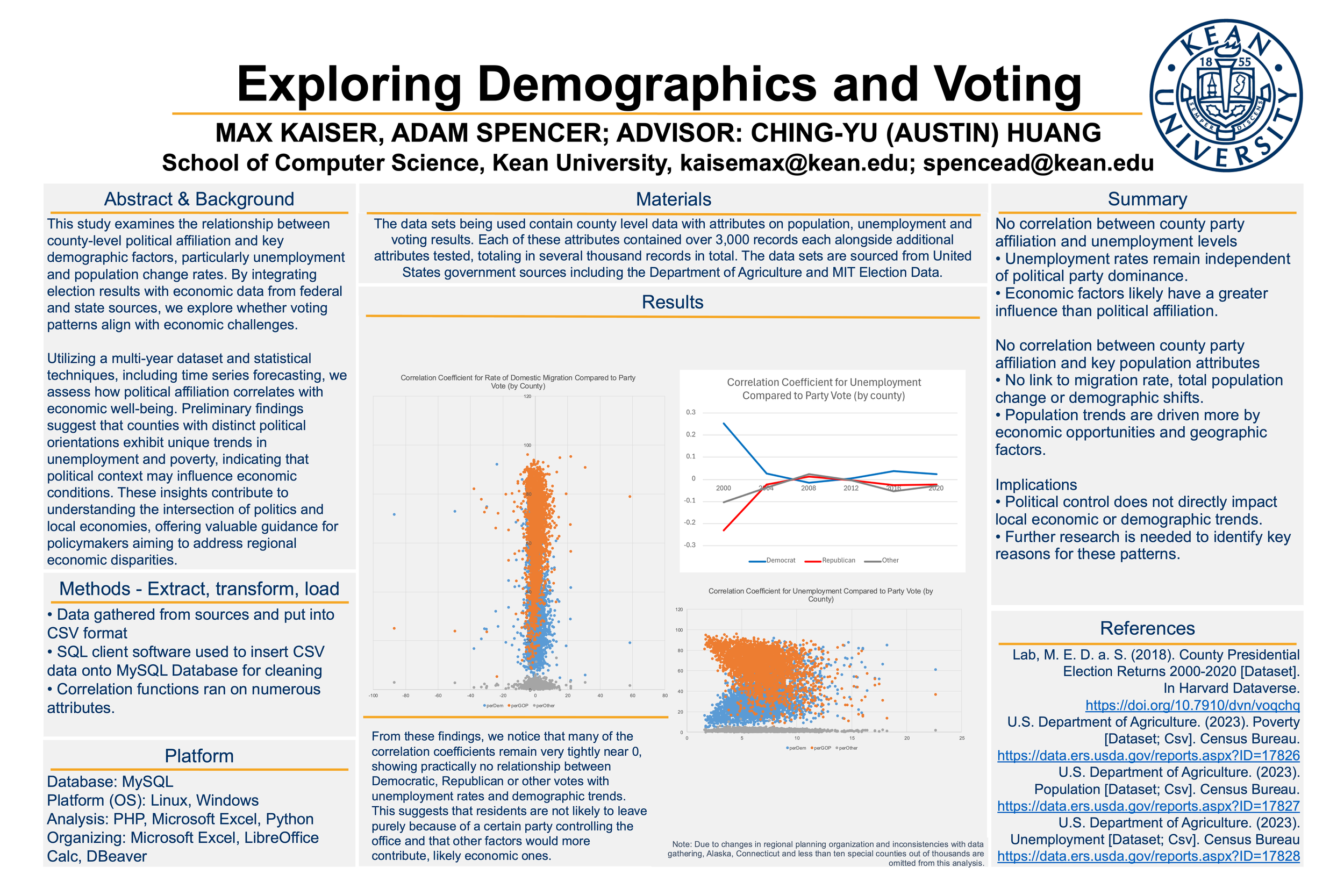
This study examines the relationship between county-level political party affiliation and key demographic attributes, notably focusing on unemployment and poverty rates, among others. We explore whether a county's voting patterns correlate with economic challenges by integrating political data from county election results with demographic indicators sourced from federal and state agencies.Using a comprehensive dataset spanning multiple years, this research aims to reveal patterns that suggest local political leanings may be linked to variations in unemployment and poverty levels, potentially reflecting differences in local policy priorities and economic development strategies. Employing data mining techniques and statistical methods—including time series forecasting—we assess how political affiliation might indicate economic well-being at the county level.Preliminary findings indicate that counties with distinct political orientations tend to exhibit unique trends in unemployment and poverty, implying that the political context can influence economic outcomes. These insights not only contribute to our understanding of the interplay between politics and local economies but also offer valuable guidance for policymakers and community leaders seeking to implement targeted interventions that address regional disparities in economic health.