
Gender Disparities in Sentencing Outcomes
Laney Fenton
Co-Presenters: Individual Presentation
College: College of Liberal Arts
Major: Forensic Psychology (M.A.)
Faculty Research Mentor: Christine Doyle
Abstract:
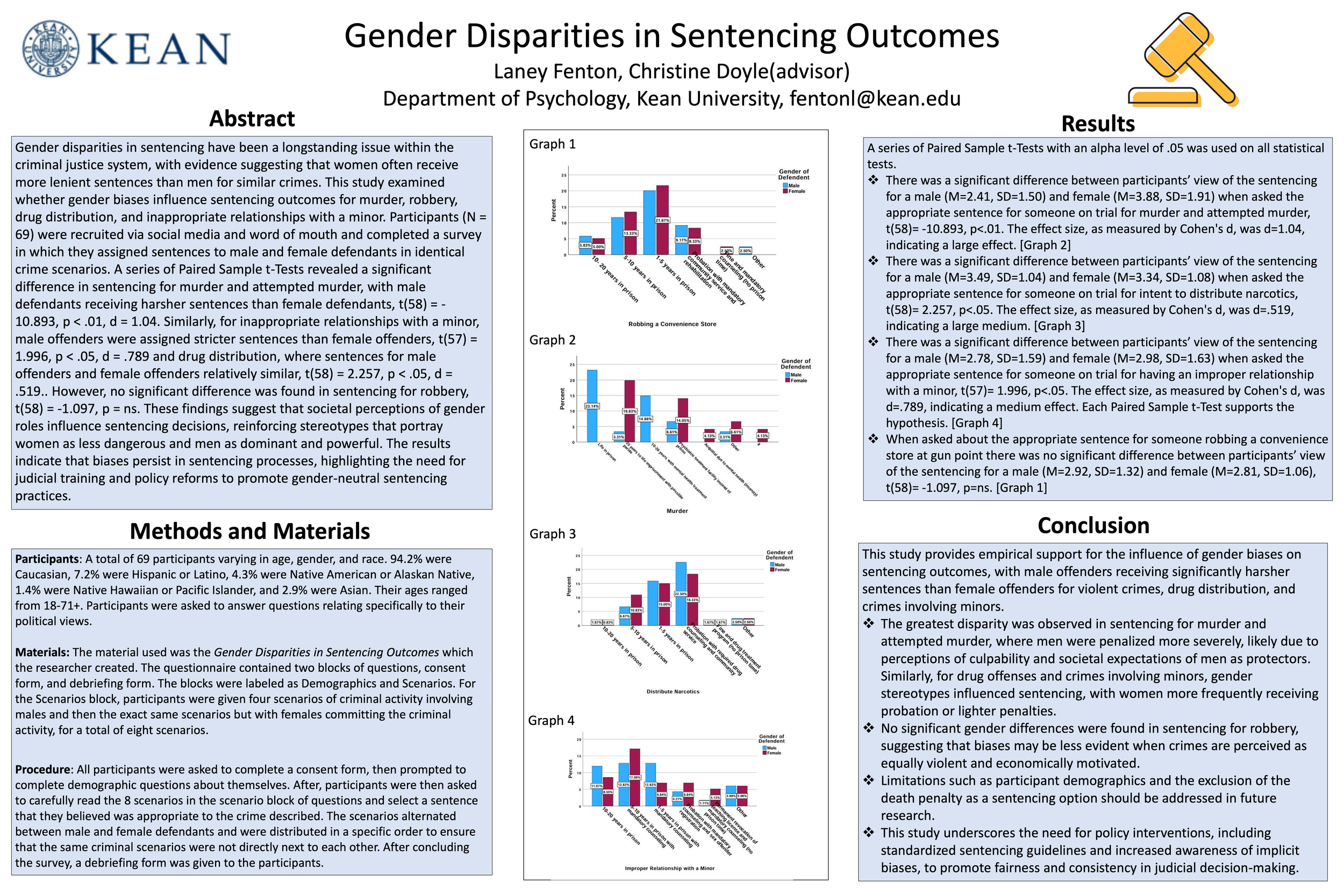
Gender disparities in sentencing have been a longstanding issue within the criminal justice system, with evidence suggesting that women often receive more lenient sentences than men for similar crimes. This study examined whether gender biases influence sentencing outcomes for murder, robbery, drug distribution, and inappropriate relationships with a minor. Participants (N = 69) were recruited via social media and word of mouth and completed a survey in which they assigned sentences to male and female defendants in identical crime scenarios. A series of Paired Sample t-Tests revealed a significant difference in sentencing for murder and attempted murder, with male defendants receiving harsher sentences than female defendants, t(58) = -10.893, p < .01, d = 1.04. Similarly, for inappropriate relationships with a minor, male offenders were assigned stricter sentences than female offenders, t(57) = 1.996, p < .05, d = .789 and drug distribution, where sentences for male offenders and female offenders relatively similar, t(58) = 2.257, p < .05, d = .519.. However, no significant difference was found in sentencing for robbery, t(58) = -1.097, p = ns. These findings suggest that societal perceptions of gender roles influence sentencing decisions, reinforcing stereotypes that portray women as less dangerous and men as dominant and powerful. The results indicate that biases persist in sentencing processes, highlighting the need for judicial training and policy reforms to promote gender-neutral sentencing practices.
Keywords: gender disparities, sentencing bias, gender stereotypes, social perceptions