
Offender Culpability
Rhiannon Ginnetti
Co-Presenters: Individual Presentation
College: College of Liberal Arts
Major: Forensic Psychology (M.A.)
Faculty Research Mentor: Christine Doyle
Abstract:
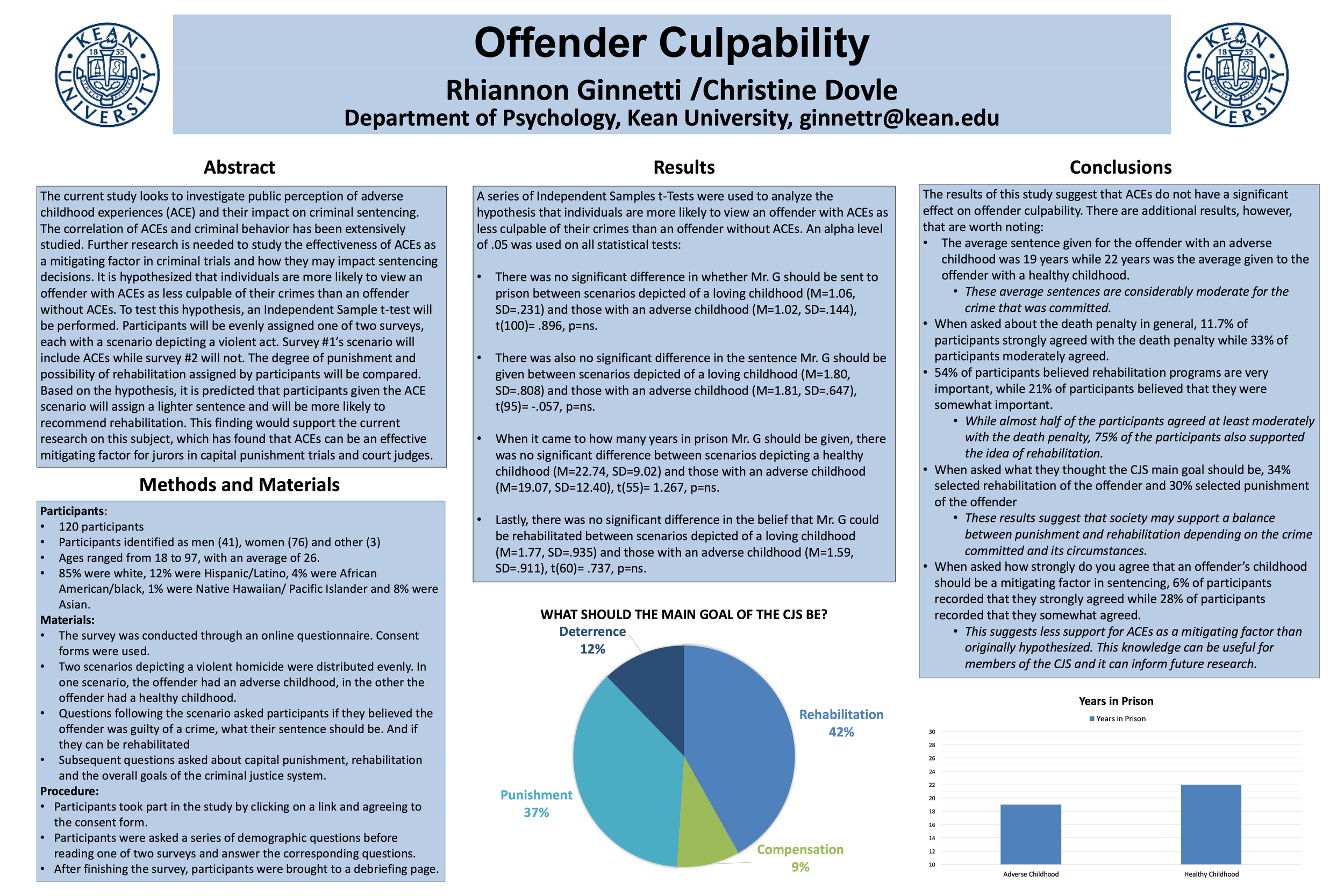
The current study looks to investigate public perception of adverse childhood experiences (ACE) and their impact on criminal sentencing. The correlation of ACEs and criminal behavior has been extensively studied. Further research is needed to study the effectiveness of ACEs as a mitigating factor in criminal trials and how they may impact sentencing decisions. It is hypothesized that individuals are more likely to view an offender with ACEs as less culpable of their crimes than an offender without ACEs. To test this hypothesis, an Independent Sample t-test will be performed. Participants will be evenly assigned one of two surveys, each with a scenario depicting a violent act. Survey #1’s scenario will include ACEs while survey #2 will not. The degree of punishment and possibility of rehabilitation assigned by participants will be compared. Based on the hypothesis, it is predicted that participants given the ACE scenario will assign a lighter sentence and will be more likely to recommend rehabilitation. This finding would support the current research on this subject, which has found that ACEs can be an effective mitigating factor for jurors in capital punishment trials and court judges.