
Gender Identity and Juror Decision Making
Jaedan Carnahan
Co-Presenters: Individual Presentation
College: College of Liberal Arts
Major: Forensic Psychology (M.A.)
Faculty Research Mentor: Christine Doyle
Abstract:
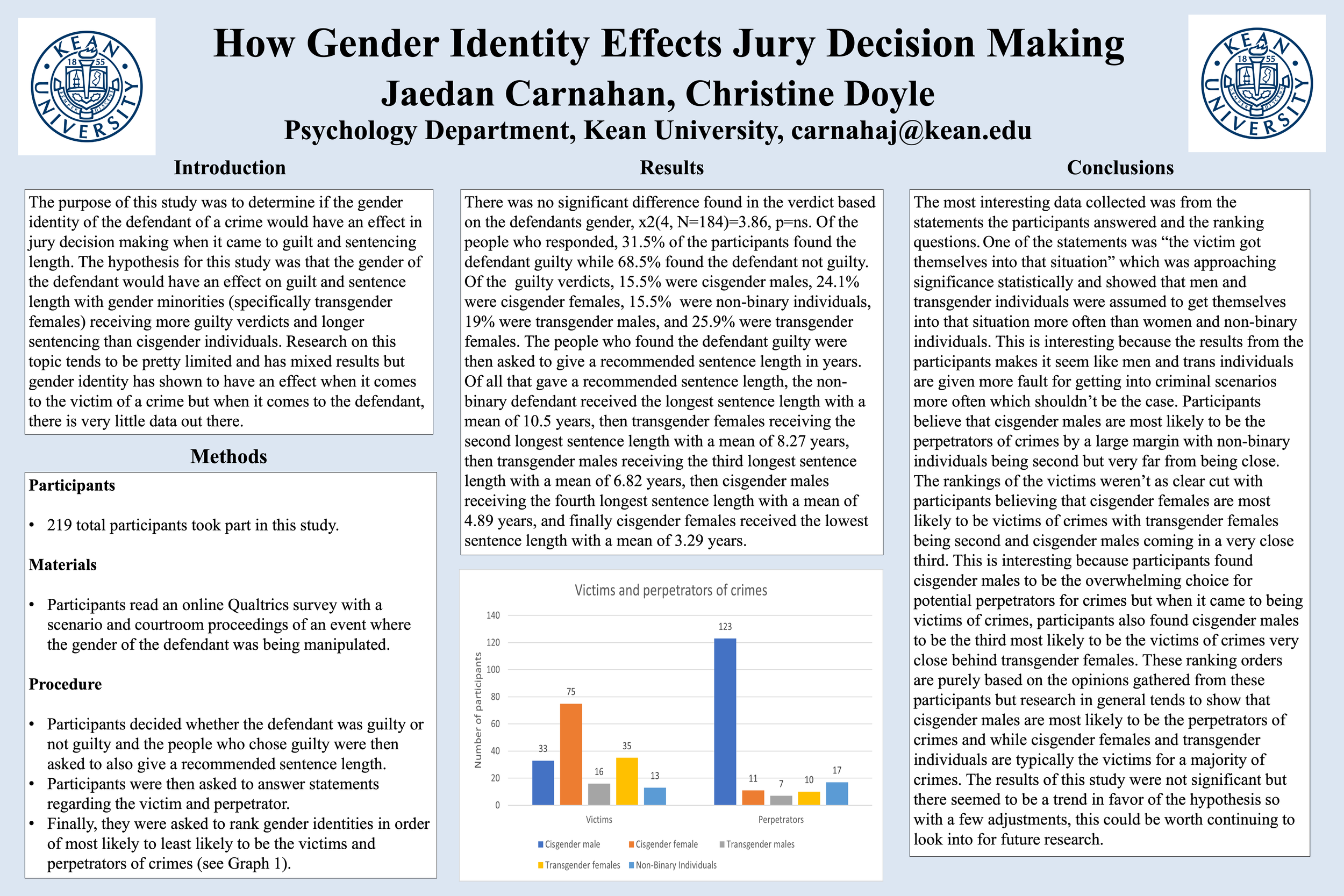
The purpose of this study was to determine if the gender identity of the defendant of a crime would have an effect in jury decision making when it came to guilt and sentencing length. The hypothesis for this study was that the gender of the defendant would have an effect on guilt and sentence length with gender minorities (specifically transgender females) receiving more guilty verdicts and longer sentencing than cisgender individuals. Research on this topic tends to be pretty limited and has mixed results but gender identity has shown to have an effect when it comes to the victim of a crime but when it comes to the defendant, there is very little data out there. Participants in this study were sent an online survey with a scenario and courtroom proceedings of an event where the gender of the defendant was being manipulated. Participants read through the scenario and decided whether the defendant was guilty or not guilty and the people who chose guilty were then asked to also give a recommended sentence length. A total of 219 participants participated in this study and the results were found to be non-significant. Although the results showed this was non-significant, there was a trend in the results that leaned in favor of the hypothesis of this study. This paper aims to expand the research on this given topic and shine some more light on how gender identity can have an effect on juror perceptions and decision making.