
Gold Nanoparticles as AB-Toxin Delivery Systems: A Preliminary Report
Amr Mahmoud
Co-Presenters: Individual Presentation
College: The Dorothy and George Hennings College of Science, Mathematics and Technology
Major: Biotechnology/Molecular Biology - STEM 5 Year B.S./M.S.
Faculty Research Mentor: Pat Malkom
Abstract:
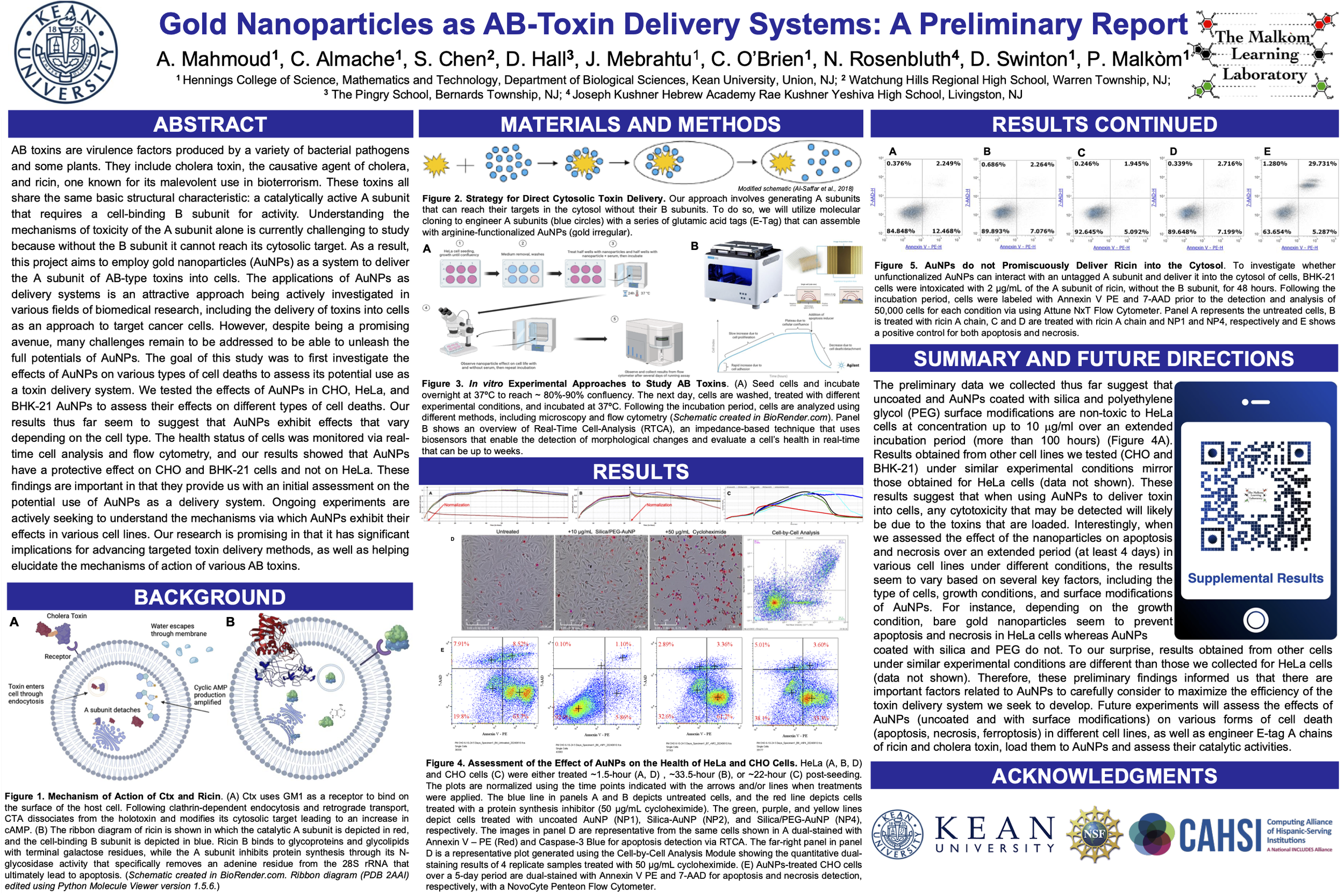
AB toxins are virulence factors produced by a variety of bacterial pathogensand some plants. They include cholera toxin, the causative agent of cholera,and ricin, one known for its malevolent use in bioterrorism. These toxins allshare the same basic structural characteristic: a catalytically active A subunitthat requires a cell-binding B subunit for activity. Understanding themechanisms of toxicity of the A subunit alone is currently challenging to studybecause without the B subunit it cannot reach its cytosolic target. As a result,this project aims to employ gold nanoparticles (AuNPs) as a system to deliverthe A subunit of AB-type toxins into cells. The applications of AuNPs asdelivery systems is an attractive approach being actively investigated invarious fields of biomedical research, including the delivery of toxins into cellsas an approach to target cancer cells. However, despite being a promisingavenue, many challenges remain to be addressed to be able to unleash thefull potentials of AuNPs. The goal of this study was to first investigate theeffects of AuNPs on various types of cell deaths to assess its potential use asa toxin delivery system. We tested the effects of AuNPs in CHO, HeLa, andBHK-21 AuNPs to assess their effects on different types of cell deaths. Ourresults thus far seem to suggest that AuNPs exhibit effects that varydepending on the cell type. The health status of cells was monitored via realtime cell analysis and flow cytometry, and our results showed that AuNPshave a protective effect on CHO and BHK-21 cells and not on HeLa. Thesefindings are important in that they provide us with an initial assessment on thepotential use of AuNPs as a delivery system. Ongoing experiments areactively seeking to understand the mechanisms via which AuNPs exhibit theireffects in various cell lines. Our research is promising in that it has significantimplications for advancing targeted toxin delivery methods, as well as helpingelucidate the mechanisms of action of various AB toxins.