
Group-Based Therapy for Children with Cerebral Palsy: A Literature Review
Shefali Roy
Co-Presenters: Individual Presentation
College: The Dorothy and George Hennings College of Science, Mathematics and Technology
Major: Biology
Faculty Research Mentor: Amanda Sarafian
Abstract:
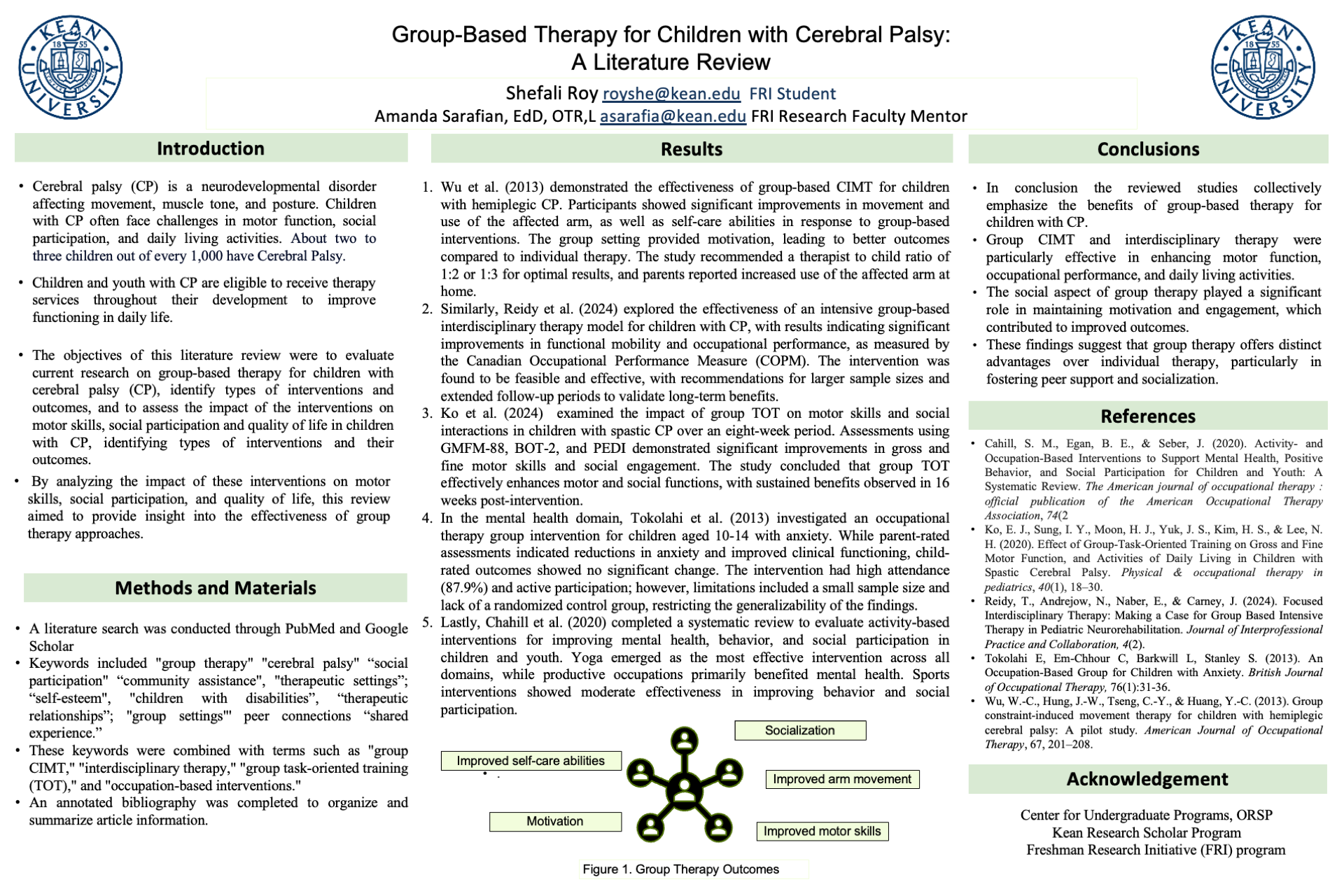
Title: Group-Based Therapy for Children with Cerebral Palsy: A Literature ReviewAbstract:The objectives of this literature review were to evaluate current research on group-based therapy for children with cerebral palsy (CP), identify types of interventions and outcomes, and to assess the impact of the interventions on motor skills, social participation and quality of life in children with CP. A literature review was conducted using academic data bases such as PubMed and Google Scholar for searching studies published between 2000 and 2024 reporting on group therapy in children with CP. We reviewed group occupational therapy, cerebral palsy, constraint-induced movement therapy (CIMT), interdisciplinary therapies, and task-oriented training. After screening, we included five studies investigating the influence of group therapies on motor skills, daily function, and social activity outcome measures. The studies highlighted that group-based intervention, particularly group CIMT and interdisciplinary therapy, leads to improvements in social connections, gross and fine motor functions, and activities of daily living. In a group setting, children with disabilities are motivated by shared experiences and support each other to achieve therapy goals. These results indicate certain benefits of group therapy compared to individual therapy, especially regarding peer support and socialization. This review provides an overview of the growing evidence supporting the role of group therapy in the population of children with CP. The studies emphasize the importance of group dynamics during therapy, wherein a sense of peer support and belongingness results in more motivation and improved outcomes. Additionally, the above-mentioned therapeutic benefits, group-based therapy is comparatively economical and opportunistic vs tailored individual therapy. All the important findings suggest the need for larger, community-based studies of the long-term effects of group therapy and the optimal ways of doing it in clinical and community settings.