
Cognitive-Motor Interactions Post-Concussion: A Systematic Review of Dual-Task Gait in Middle-Aged Adults
Hussnain Shakeel
Co-Presenters: Declan Cioffi
College: The College of Health Professions and Human Services
Major: Physical Therapy (DPT)
Faculty Research Mentor: Alka Bishnoi
Abstract:
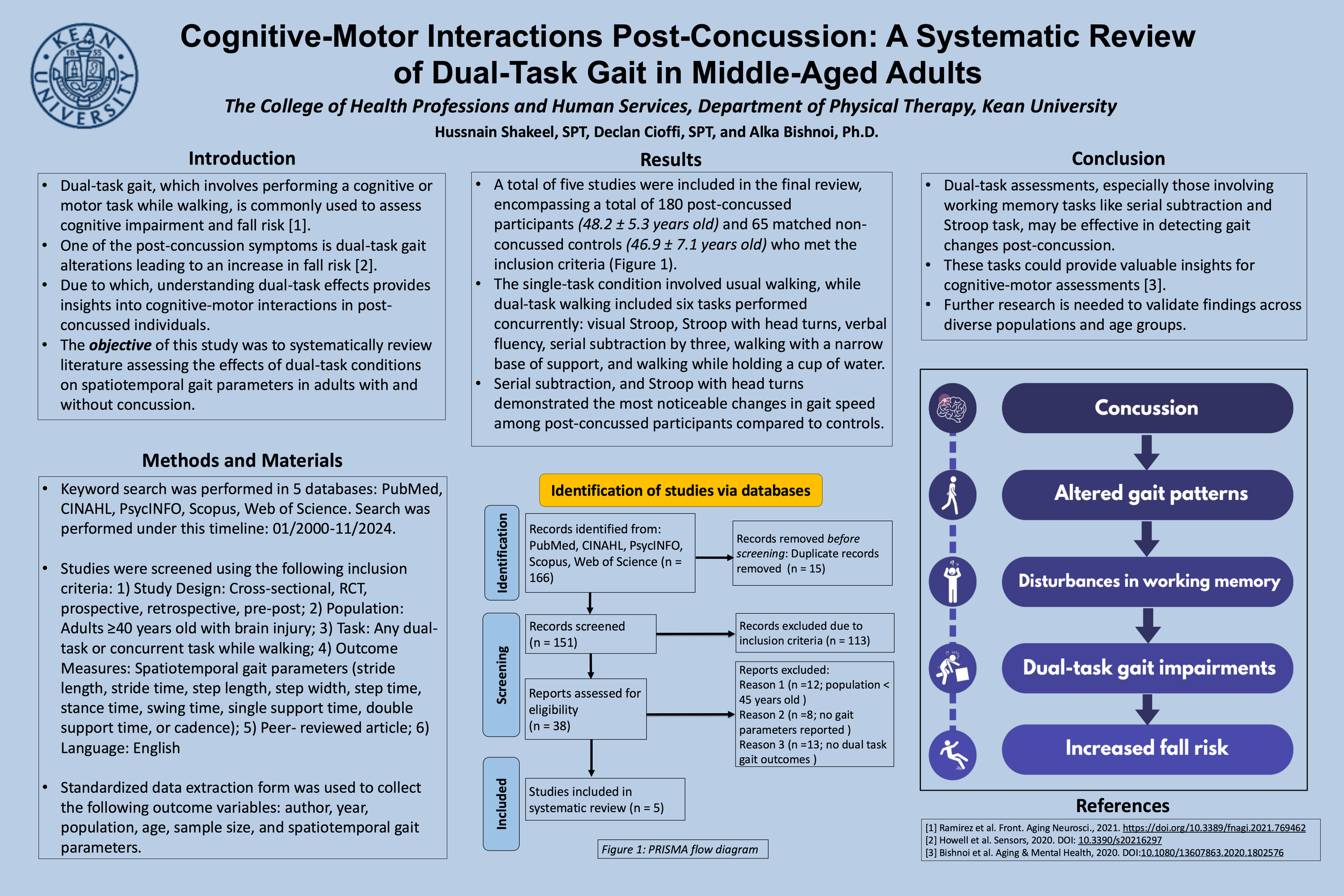
Dual-task walking, which involves performing a cognitive or motor task while walking, is often used to evaluate cognitive function and fall risk. Understanding these dual-task effects can provide valuable insights into cognitive-motor interactions in individuals with a history of concussion. This study aims to systematically review existing literature on the effects of dual-task conditions on spatiotemporal gait parameters in adults with and without a history of concussion.A comprehensive search was conducted across five databases (PubMed, CINAHL Academic Ultimate, PsycINFO, Scopus, and Web of Science) for studies published between January 2000 and November 2024. Eligible studies included cross-sectional, randomized controlled trials (RCTs), prospective, retrospective, or pre-post designs involving adults aged 40 and older with a history of brain injury. Dual-task conditions involved concurrent motor or cognitive tasks performed while walking, with gait measures including stride length, step length, step width, cadence, and other spatiotemporal parameters. Studies were excluded if they focused exclusively on healthy adults, did not report gait parameters, or were published prior to 2000.Five studies met the inclusion criteria, comprising 180 post-concussed individuals and 65 matched non-concussed controls. Single-task walking was compared to dual-task walking, which included tasks such as visual Stroop, Stroop with head turns, verbal fluency, serial subtraction by three, walking with a narrow base of support, and walking while holding a cup of water. Among these, serial subtraction,a working memory task, and Stroop with head turns were both associated with significant reductions in gait speed in post-concussed individuals compared to controls.These findings suggest that working memory tasks, such as serial subtraction by three, may be effective in detecting dual-task gait changes in post-concussed individuals. While these tasks show potential for evaluating cognitive-motor interactions, further studies are needed to validate their utility across diverse populations and age groups.