
The Relationship Between Emotion Regulation, Rejection Sensitivity and Loneliness
Kiany Probherbs
Co-Presenters: Styliani Petrou, Marwa Al-Hikaimy, Blanca Garcia, Morgan Fishmann
College: The College of Health Professions and Human Services
Major: School and Clinical Psychology (Psy.D)
Faculty Research Mentor: Aditi Vijay
Abstract:
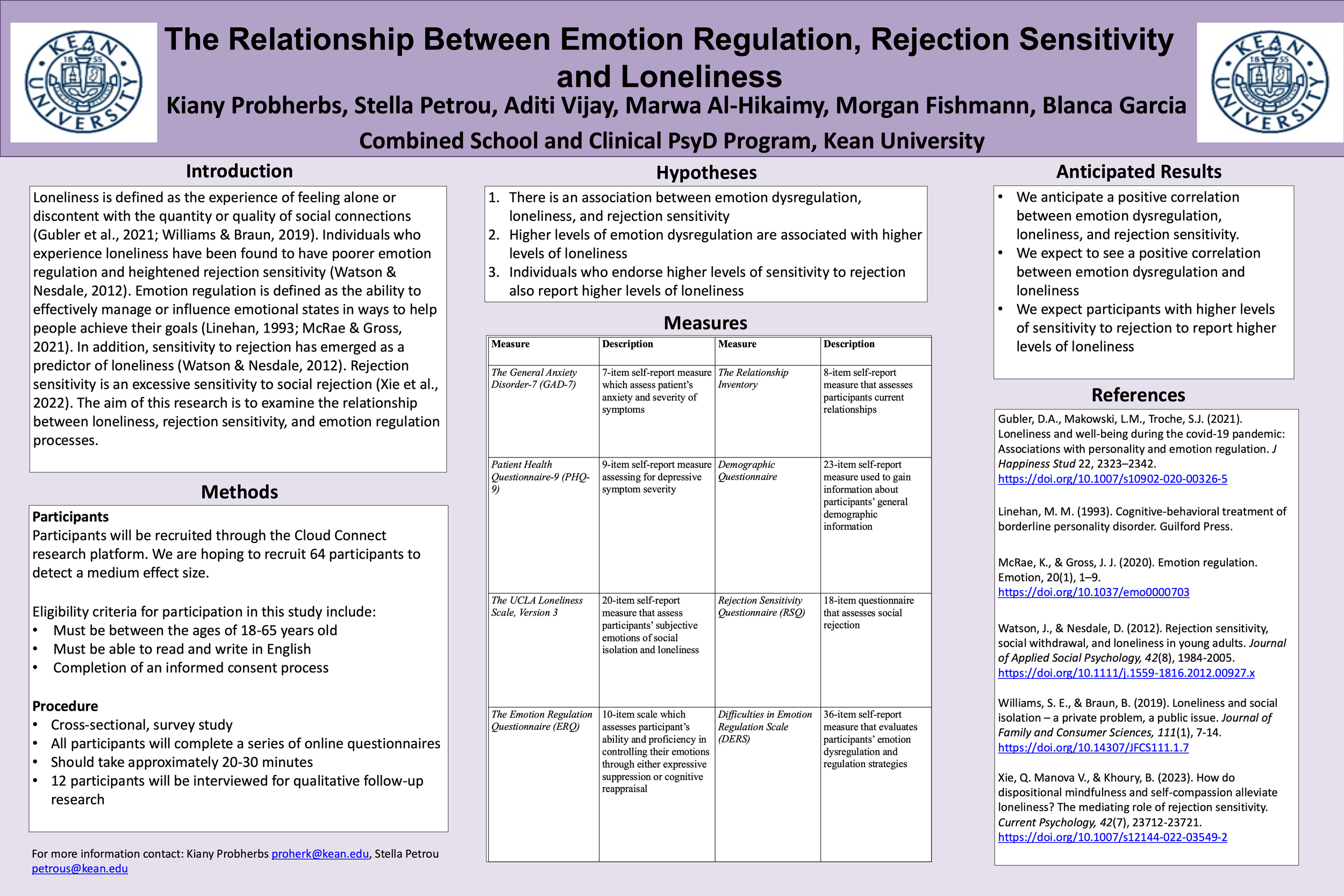
Loneliness is defined as the experience of feeling alone or discontent with the quantity or quality of social connections (Gubler et al., 2021; Williams & Braun, 2019). Individuals who experience loneliness have been found to have poorer emotion regulation and heightened rejection sensitivity, also known as sensitivity to social rejection (Watson & Nesdale, 2012). Therefore, this study seeks to examine the relationship between emotion regulation, loneliness, and rejection sensitivity. This will be done via cross-sectional survey. This study will explore current relationships, levels of loneliness, sensitivity to rejection, anxiety symptoms, depression symptoms and emotion dysregulation. The study aims to survey 64 participants to better understand the nature of the association between emotion dysregulation, loneliness, and rejection sensitivity. If a relationship is present, then the researchers expect to see a positive correlation between emotion dysregulation and loneliness. Finally, researchers anticipate that individuals who have higher levels of sensitivity to rejection will also report higher levels of loneliness.