
Information Gain-Based MCDM Approach for Urban Critical Freight Corridor Identification using Spatial-Temporal Data Analysis
Yiyang Liu
Co-Presenters: Individual Presentation
College: College of Business and Public Management
Major: Economics
Faculty Research Mentor: Dan Liu
Abstract:
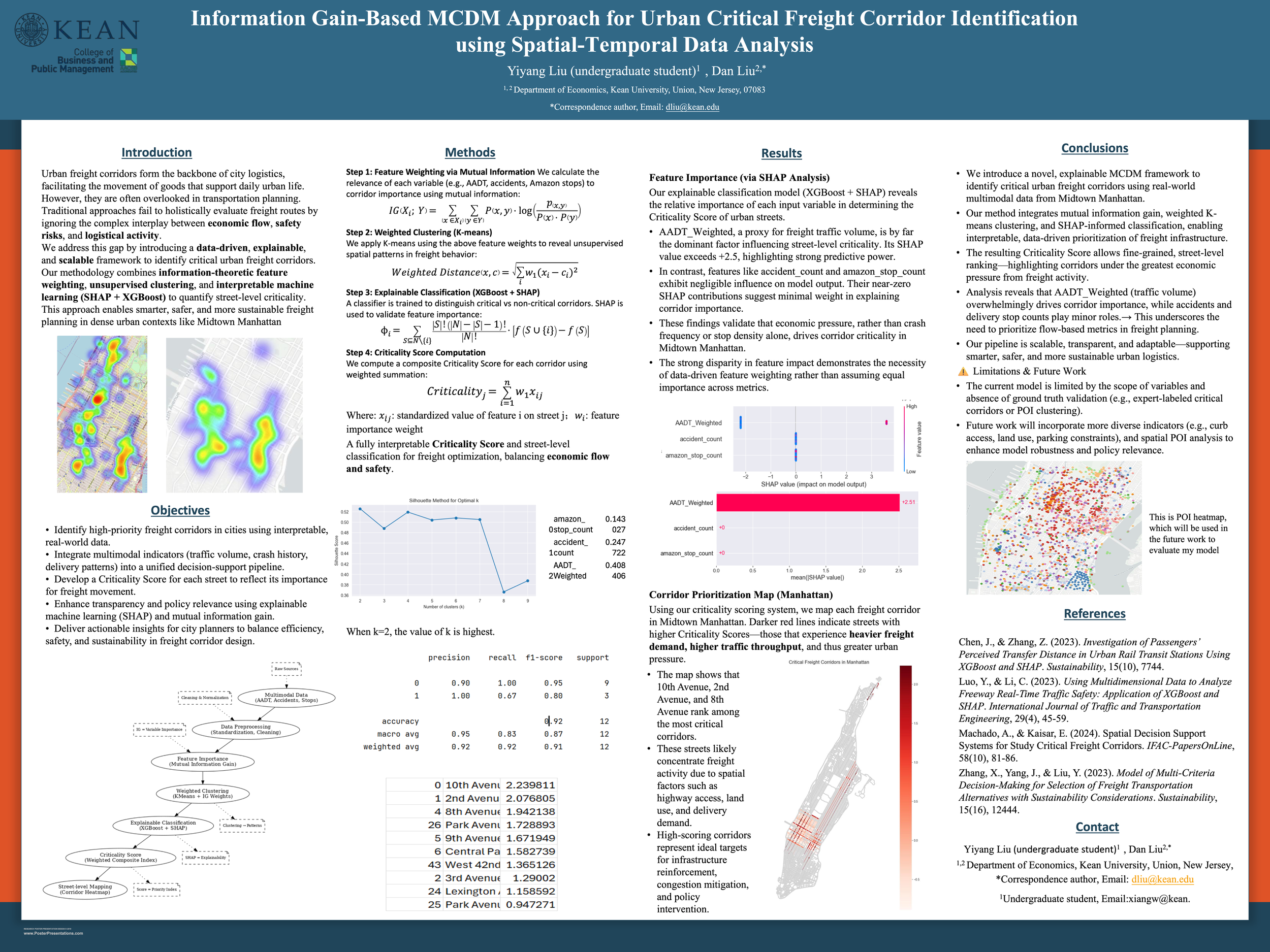
Urban freight corridors form the backbone of city logistics, facilitating the movement of goods that support daily urban life. However, they are often overlooked in transportation planning. Traditional approaches fail to holistically evaluate freight routes by ignoring the complex interplay between economic flow, safety risks, and logistical activity. We address this gap by introducing a data-driven, explainable, and scalable framework to identify critical urban freight corridors. Our methodology combines information-theoretic feature weighting, unsupervised clustering, and interpretable machine learning (SHAP + XGBoost)to quantify street-level criticality. This approach enables smarter, safer, and more sustainable freight planning in dense urban contexts like Midtown Manhattan