
The Effects of Leading Questions and Misinformation on Eyewitness Testimony
Delaney McGlade
Co-Presenters: Individual Presentation
College: College of Liberal Arts
Major: Forensic Psychology (M.A.)
Faculty Research Mentor: Christine Doyle
Abstract:
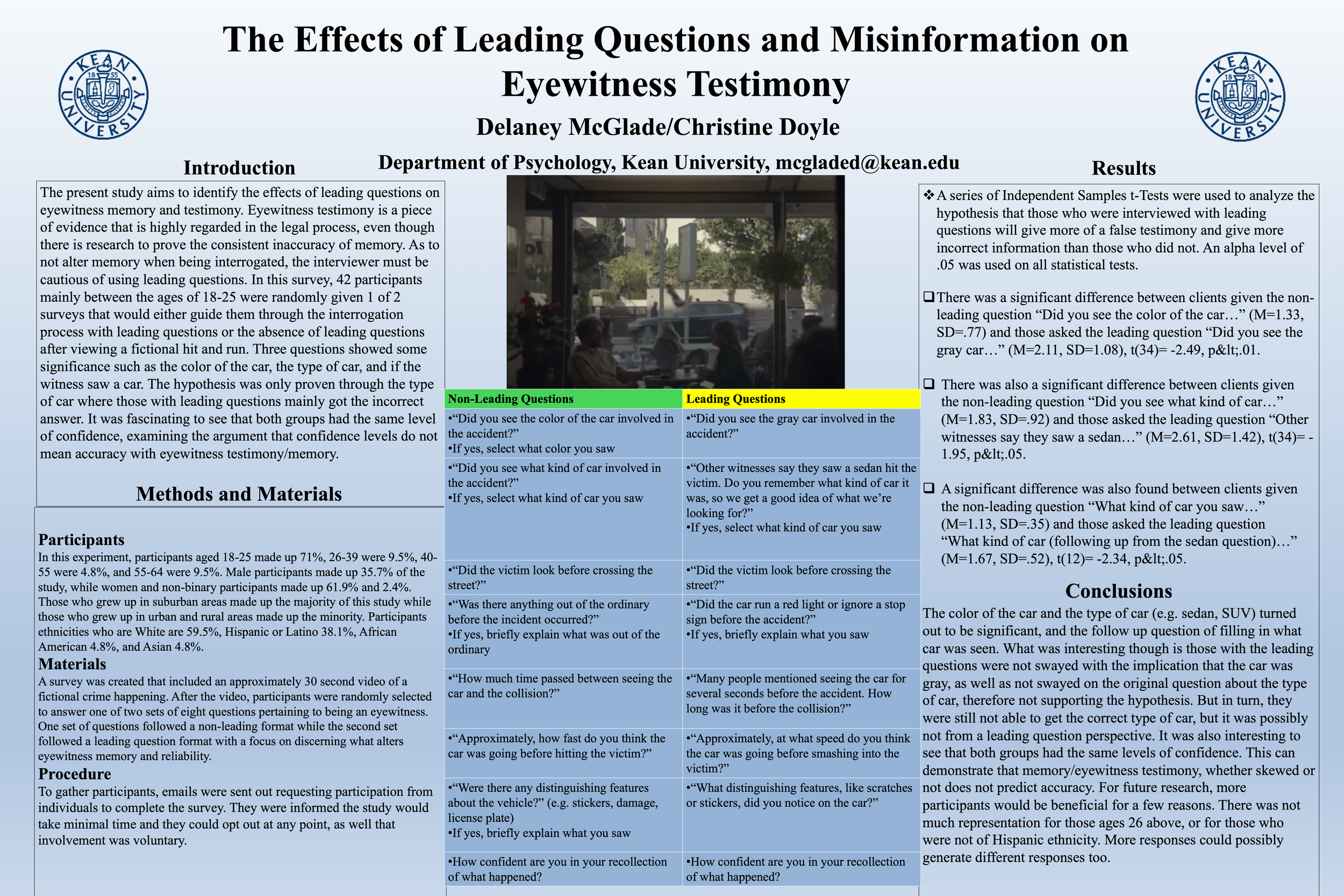
The present study aims to identify the effects of leading questions on eyewitness memory and testimony. Eyewitness testimony is a piece of evidence that is highly regarded in the legal process, even though there is research to prove the consistent inaccuracy of memory. As to not alter memory when being interrogated, the interviewer must be cautious of using leading questions. In this survey, 42 participants mainly between the ages of 18-25 were randomly given 1 of 2 surveys that would either guide them through the interrogation process with leading questions or the absence of leading questions after viewing a fictional hit and run. Three questions showed some significance such as the color of the car, the type of car, and if the witness saw a car. The hypothesis was only proven through the type of car where those with leading questions mainly got the incorrect answer. It was fascinating to see that both groups had the same level of confidence, examining the argument that confidence levels do not mean accuracy with eyewitness testimony/memory.