
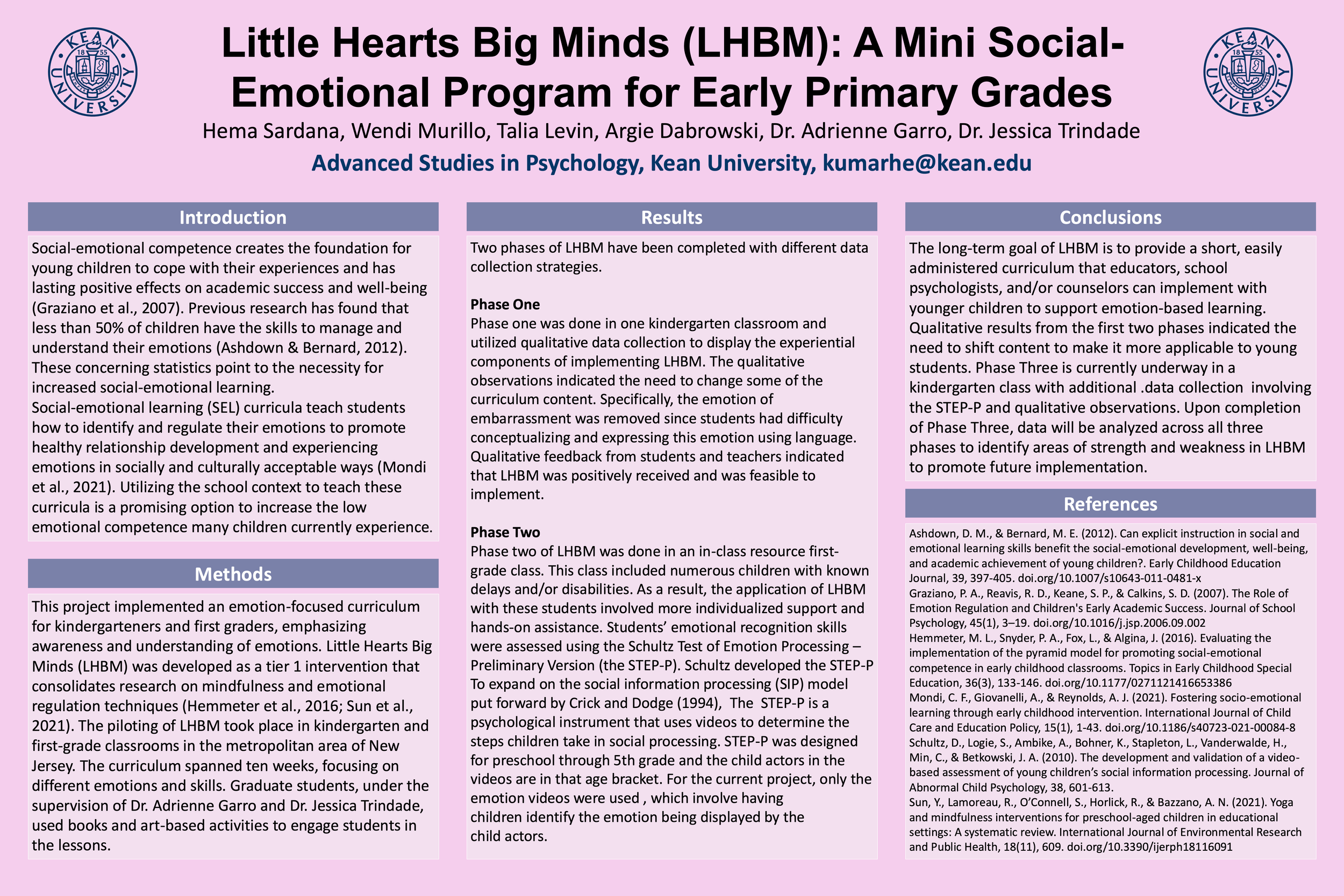
Little Hearts Big Minds (LHBM): A Mini Social-Emotional Program for Early Primary Grades
Hema Sardana
Co-Presenters: Wendi Murillo, Argie Dabrowski, Talia Levin
College: The College of Health Professions and Human Services
Major: School and Clinical Psychology (Psy.D)
Faculty Research Mentor: Adrienne Garro
Abstract:
Social-emotional competence sets the foundation for young children and has lasting positiveeffects on academic success and well-being (Graziano et al., 2007). Previous research has foundthat less than 50% of children have the skills to manage and understand their emotions(Ashdown & Bernard, 2012). Social-emotional learning (SEL) curricula teach students how toidentify and regulate their emotions (Mondi et al., 2021). This project implemented an emotion-focused curriculum for kindergarteners and first graders, emphasizing awareness andunderstanding of emotions. LHBM was developed as a tier 1 intervention that consolidatesresearch on mindfulness & emotion regulation techniques (Hemmeter et al., 2016; Sun et al.,2021). The piloting of LHBM took place in kindergarten and first grade classrooms in ametropolitan area of New Jersey. The curriculum spanned ten weeks, focusing on differentemotions and skills. Qualitative observations from the first application of LHBM indicated theneed to change some of the curriculum content. Specifically, we removed the emotion ofembarrassment since students had difficulty conceptualizing and expressing this emotion usinglanguage. The sessions focused on emotion recognition and regulation. Graduate students, underthe supervision of Dr. Adrienne Garro & Dr. Jessica Trindade, used books & art-basedactivities to engage students in the lessons. Qualitative feedback from students and teachersindicated that LHBM was positively received and was feasible to implement. In phase two of LHBM, students’ emotional recognition skills were assessed using an emotional identificationtask and the STEP-P. To expand on the social information processing (SIP) model put forwardby Crick and Dodge (1994), Dr. David Schultz developed an assessment tool to expand thisresearch to early childhood social development. The Schultz Test of Emotion Processing—Preliminary Version (STEP-P) is a psychological instrument using videos to determine the stepschildren take in social processing. STEP-P was designed for preschool through 5th grade and thechild actors in the videos are in that age bracket. There are three tests in STEP-P: Emotions, GoalAcquisition, and Provocation. The long-term goal of LHBM is to provide a short, easilyadministered curriculum that educators, school psychologists, and/or counselors can implementwith younger children to support emotion-based learning.