
People’s Beliefs on the Impact of Mental Illness on Violent Criminal Behavior
Jamie Smith
Co-Presenters: Individual Presentation
College: College of Liberal Arts
Major: Forensic Psychology (M.A.)
Faculty Research Mentor: Christine Doyle
Abstract:
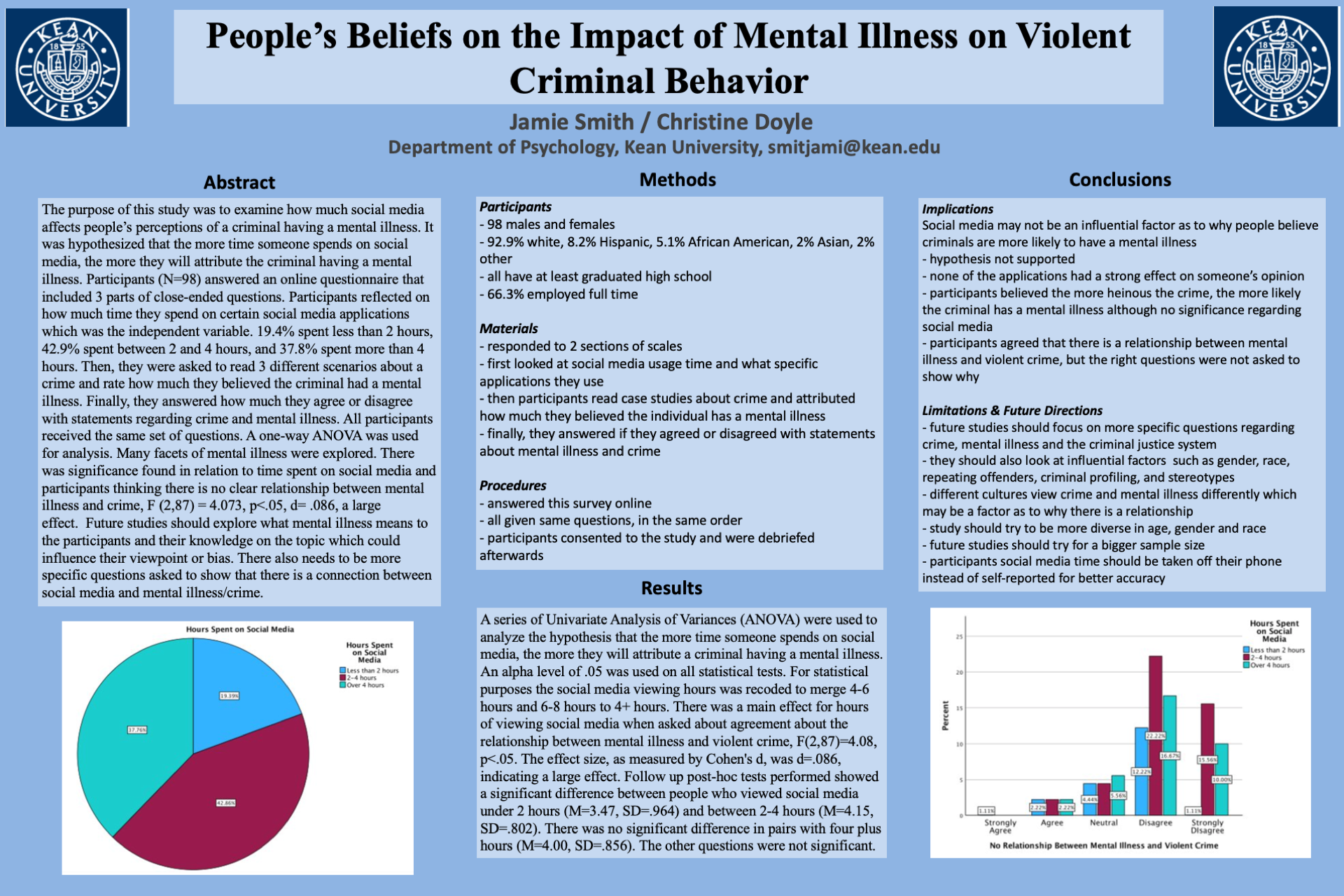
The purpose of this study was to examine how much social media affects people’s perceptions of a criminal having a mental illness. It was hypothesized that the more time someone spends on social media, the more they will attribute the criminal having a mental illness. Participants (N=98) answered an online questionnaire that included 3 parts of close-ended questions. Participants reflected on how much time they spend on certain social media applications which was the independent variable. 19.4% spent less than 2 hours, 42.9% spent between 2 and 4 hours, and 37.8% spent more than 4 hours. Then, they were asked to read 3 different scenarios about a crime and rate how much they believed the criminal had a mental illness. Finally, they answered how much they agree or disagree with statements regarding crime and mental illness. All participants received the same set of questions. A one-way ANOVA was used for analysis. Many facets of mental illness were explored. There was significance found in relation to time spent on social media and participants thinking there is no clear relationship between mental illness and crime, F (2,87) = 4.073, p<.05, d= .086, a large effect. Future studies should explore what mental illness means to the participants and their knowledge on the topic which could influence their viewpoint or bias. There also needs to be more specific questions asked to show that there is a connection between social media and mental illness/crime.