
Finding the Right Words: How People with and without Aphasia Use Verbs
Christine Wasiuk
Co-Presenters: Alyssa Fernandez, Meghan Clark
College: The College of Health Professions and Human Services
Major: Speech-Language Pathology (M.A.)
Faculty Research Mentor: Christa Akers
Abstract:
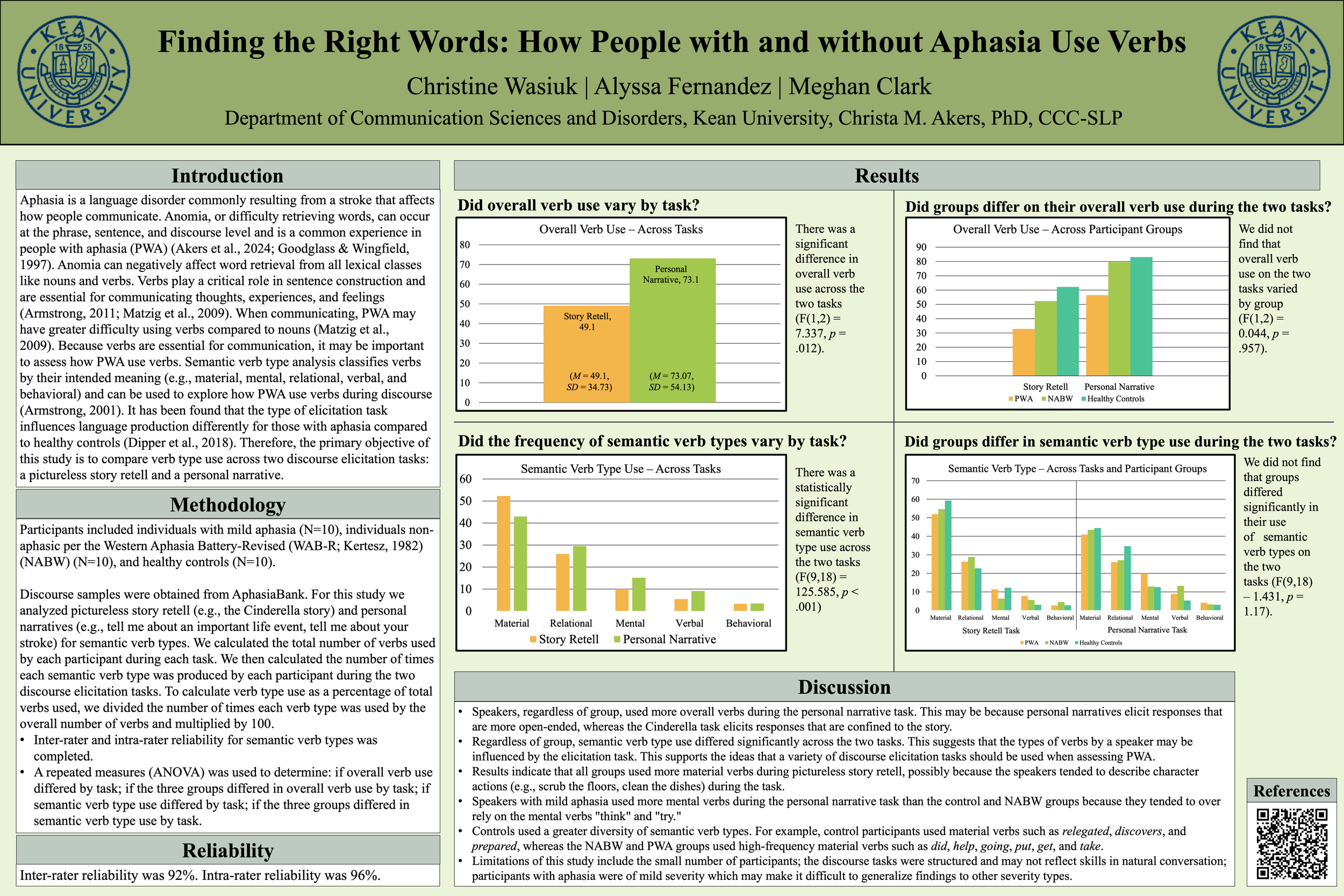
IntroductionAphasia is a language disorder commonly resulting from a stroke that affects how people communicate. Aphasia impacts word retrieval from all lexical classes (e.g., nouns, adjectives, and verbs). Research has focused on how people with aphasia (PWA) use nouns, but verbs may be a better indicator of language use by PWA. Semantic verb analysis categorizes verbs into five main categories. Material verbs describe doing and acting (e.g., walk). Mental verbs describe sensing or feeling (e.g., believe). Relational verbs describe being and having (e.g., has). Verbal verbs describe saying or talking (e.g., explain). Behavioral verbs describe physiological behaviors (e.g., look). Difficulty retrieving verbs across categories can limit what is expressed by PWA. Studies have revealed that verb type use can differ depending on the task type. This study investigates how PWA and people without aphasia use verb types across two discourse tasks: personal narratives and pictureless story retell with the goal of informing how speech language pathologists assess PWA.MethodologyFor our study, we will compare semantic verb type use by people with mild aphasia, people without aphasia, and people who tested above the threshold on a common aphasia assessment during personal narrative (e.g., tell me the story of your stroke) and pictureless story retell tasks (e.g., retelling the Cinderella story after presentation of a picture book).ConclusionSemantic verb type analysis is ongoing and will be completed in time for poster submission. We hypothesize the following: PWA will use fewer verbs compared to healthy controls; non-aphasic individuals will use more verbs than PWA, but less than healthy controls; all participants will use more verbs during personal narrative tasks; no differences in verb use are expected between the two tasks; healthy controls and people who are non-aphasic per a standardized assessment will use a greater diversity of verb types during personal narrative tasks. Discussion will focus on how the three groups use verbs across verb categories.
Keywords: Aphasia, verbs, discourse