
Student Engagement in Graduate School
Rashaad Couloote
Co-Presenters: Individual Presentation
College: College of Liberal Arts
Major: Forensic Psychology (M.A.)
Faculty Research Mentor: Christine Doyle
Abstract:
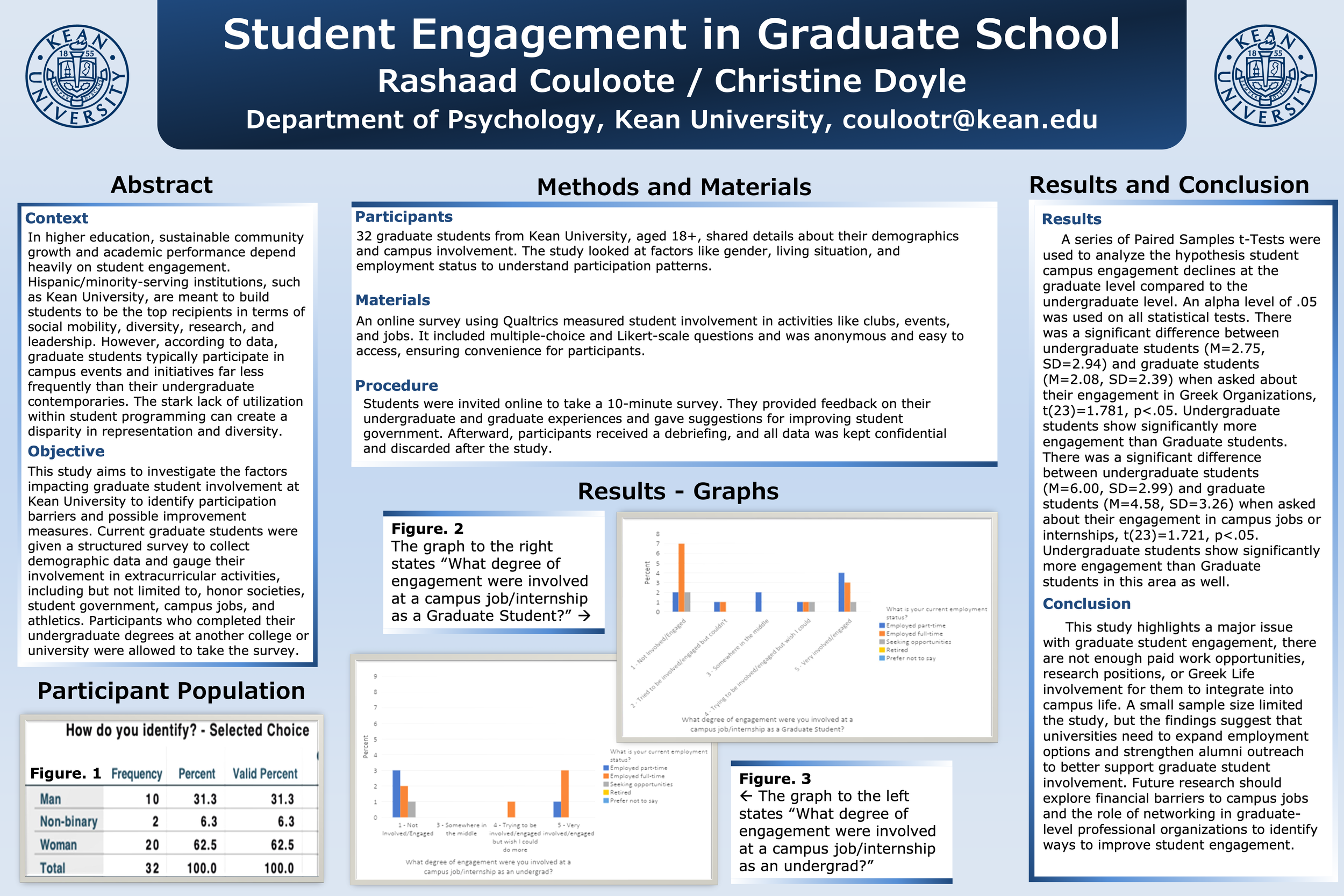
In higher education, sustainable community growth and academic performance depend heavily on student engagement. Hispanic/minority-serving institutions, such as Kean University, are meant to build students to be the top recipients in terms of social mobility, diversity, research, and leadership. However, according to data, graduate students typically participate in campus events and initiatives far less frequently than their undergraduate contemporaries. The stark lack of utilization within student programming can create a disparity in representation and diversity. This study aims to investigate the factors impacting graduate student involvement at Kean University to identify participation barriers and possible improvement measures. Current graduate students were given a structured survey to collect demographic data and gauge their involvement in extracurricular activities, including but not limited to, honor societies, student government, campus jobs, and athletics. Through campus activity, participants also considered how their undergraduate and graduate experiences differed. Participants who completed their undergraduate degrees at another college or university were allowed to take the survey and listed whether or not they were Kean undergraduates. The purpose of the study is to illuminate the reasons behind graduate students' lower involvement rates and how institutional initiatives could improve their engagement and commitment to graduate school. The results of this study will add to the conversation about enhancing graduate-level student life. Another goal would be to create more comprehensive strategies for encouraging graduate student engagement across campus, and potentially across the country if future research is conducted. More future research should think about extending the study to other schools.