
Variation of Length in Juvenile Sentencing
Alyssa Castillo
Co-Presenters: Individual Presentation
College: College of Liberal Arts
Major: Forensic Psychology (M.A.)
Faculty Research Mentor: Christine Doyle
Abstract:
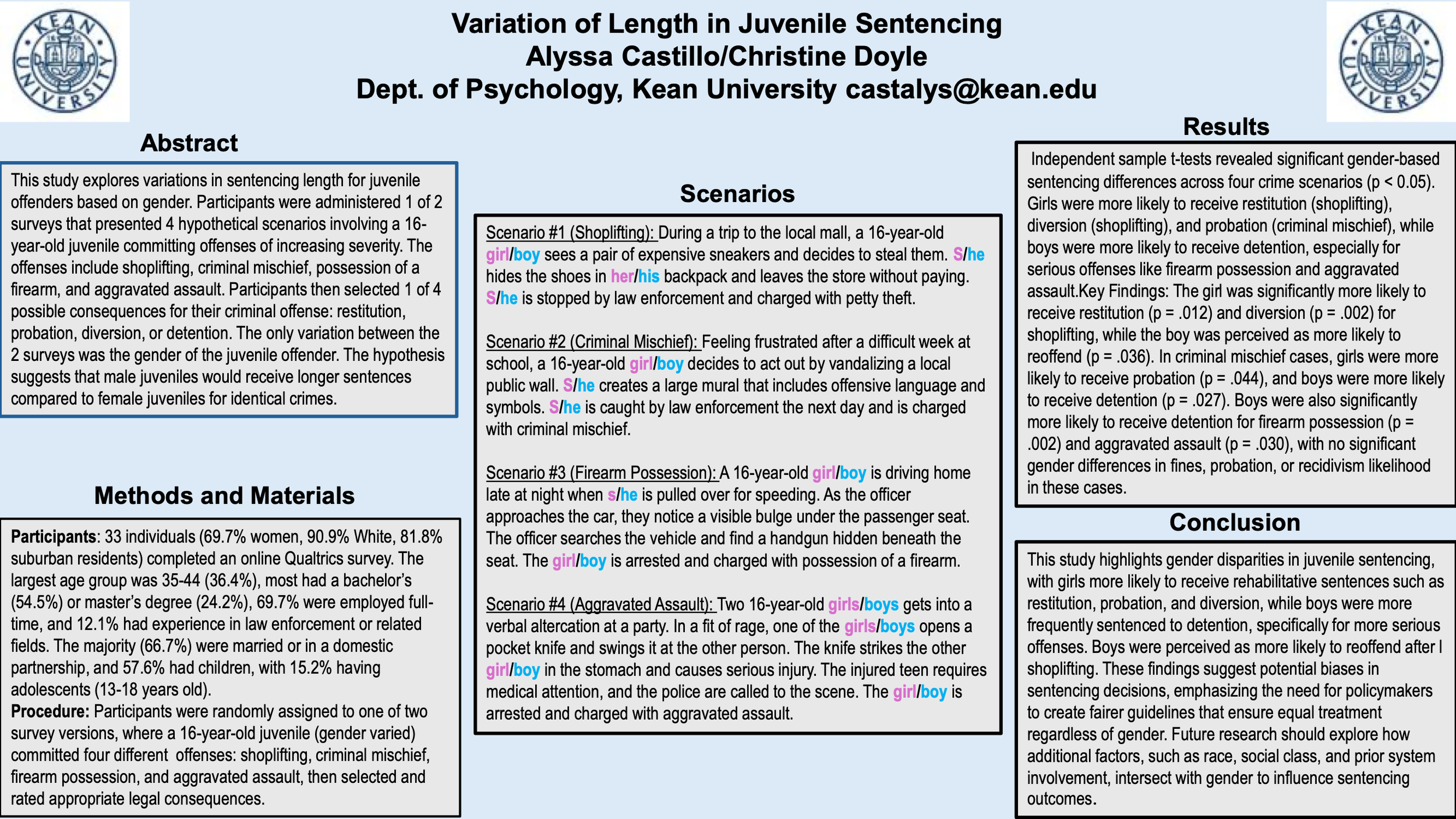
This study explores variations in sentencing length for juvenile offenders based on gender. Participants were administered 1 of 2 surveys that presented 4 hypothetical scenarios involving a 16-year-old juvenile committing offenses of increasing severity. The offenses include shoplifting, criminal mischief, possession of a firearm, and aggravated assault. Participants then selected 1 of 4 possible consequences for their criminal offense: restitution, probation, diversion, or detention. The only variation between the 2 surveys was the gender of the juvenile offender. The hypothesis suggests that male juveniles would receive longer sentences compared to female juveniles for identical crimes. The results indicated a potential gender bias in sentencing, supporting the hypothesis that boys are given longer penalties than girls. This study identifies the potential influence of gender stereotypes on judicial decisions for juveniles. It highlights the need for reform to ensure fair treatment of all juveniles involved in the justice system. Future research could study how gender bias intersects with other factors in the juvenile justice system, such as race, prior criminal history, or socioeconomic status.