
The Happiest Countries Aren't The Richest
Krisztina Balogh
Co-Presenters: Individual Presentation
College: College of Business and Public Management
Major: Finance
Faculty Research Mentor: Chen Meng
Abstract:
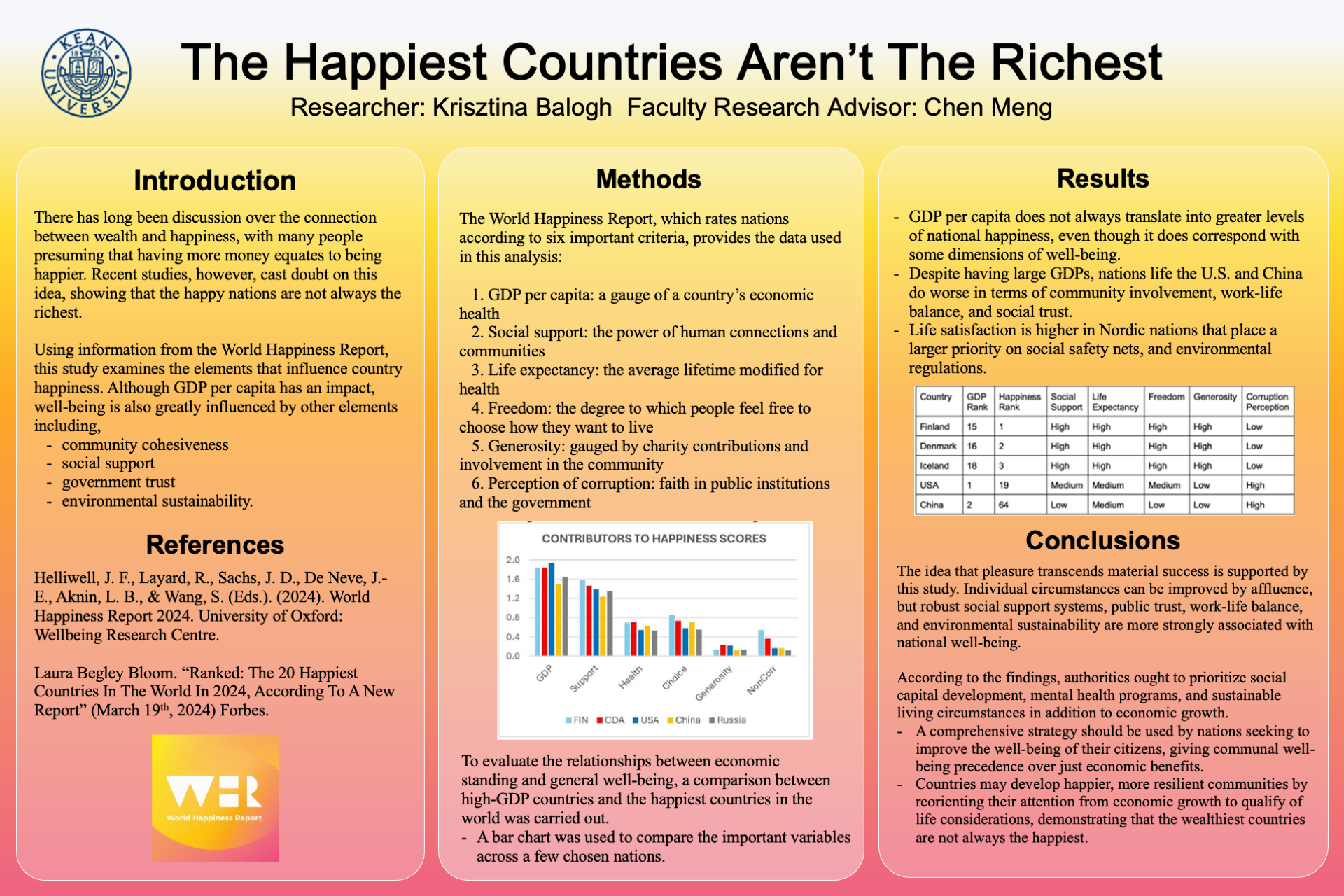
There has long been discussion on the connection between wealth and happiness, frequently supposing that increased income inevitably leads to a better well-being. Recent research casts doubt on this idea, showing that the happy nations are not always the richest. Using data from the World Happiness Report, which rates nations according to criteria including GDP per capita, social support, life expectancy, freedom to make life decisions, generosity, and views of corruption, this study investigates the intricate relationships between national wealth and happiness. In terms of life satisfaction, wealthy countries are not always at the top, even though they typically score highly on these metrics. Countries such as Finland, Denmark, and Iceland, even though they often rank among the happiest countries, don't have the greatest GDPs. They place more emphasis on social equality, community cohesiveness, government trust, and environmental sustainability-aspects that have a greater impact on the well-being of their population.This study emphasizes that happiness is a complex concept that cannot be only attributed to material prosperity. National happiness levels are significantly shaped by societal characteristics, such as the strength of community relationships, social safety nets, and the calibre of government. Furthermore, the pursuit of meaningful experiences, work-life balance, and cultural values are becoming more widely acknowledged as important factors that affect a country’s level of happiness. Regardless of a nation’s economic status, this study’s analysis of the relationship between wealth and happiness calls for a reassessment of policy priorities and a move toward fostering social capital, mental health, and environmental stewardship as ways to improve citizen’s quality of life. The results urge countries to take a more comprehensive approach to well-being, arguing that although income might enhance individual situations, national happiness is truly reflected by quality of life.