
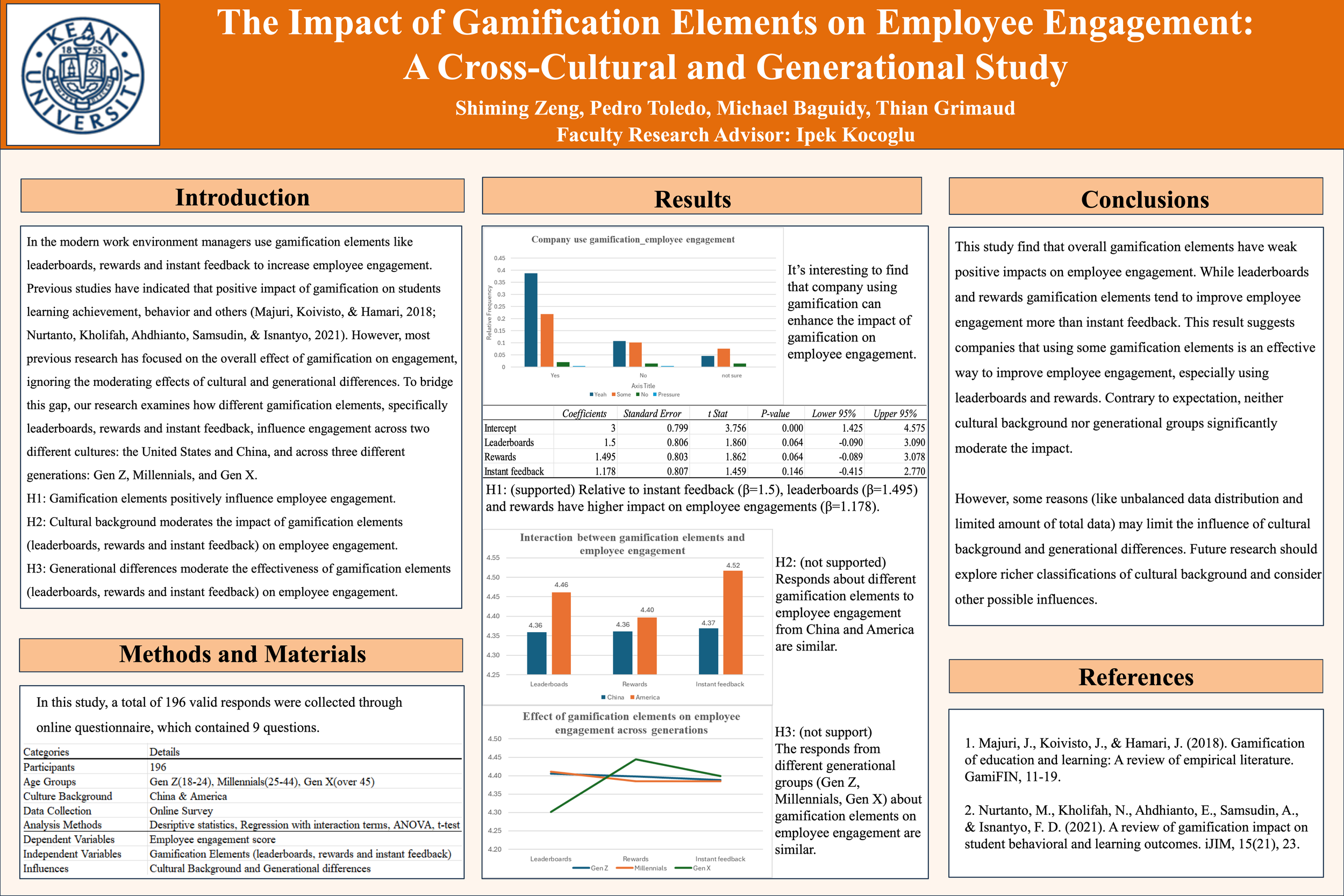
The Impact of Gamification Elements on Employee Engagement: A Cross-Cultural and Generational Study
Shiming Zeng
Co-Presenters: Pedro Toledo, Michael Baguidy, Thian Grimaud
College: College of Business and Public Management
Major: Finance
Faculty Research Mentor: Ipek Kocoglu
Abstract:
Under the increasing business competition, gamification becomes a popular new strategy to increase employee's engagement. While previous studies have generally shown a positive relationship between gamification and employee engagement, they often treat gamification as a single, unified concept and overlook the influence of cultural and generational differences. This study investigates how specific gamification elements — leaderboards, rewards, and instant feedback — affect employee engagement, with a focus on cross-cultural and generational differences.Over 150 employees from China and U.S. participated in this study, completing surveys on gamification elements and self-reported work motivation. Data analysis involved descriptive statistics, reliability tests and hierarchical regression.The study found that gamification elements vary in their impact across cultures and generations. The findings suggest that gamification has a stronger impact on employee engagement in the U.S. than in China, with the most significant effect observed in Gen Z employees.This research highlights that it is necessary to tailor measures according to different cultural and generational backgrounds.Keywords: gamification, employee engagement, cross-cultural, generational differences, workplace motivation