
Access vs Ownership: Understanding Why Consumers Stream, Subscribe, or Collect Media

Doaa Abdelazem
Co-Presenters: Individual Presentation
College: College of Business and Public Management
Major: MBA.GLOBAL
Faculty Research Mentor: Reza Fazli Salehi
Abstract:
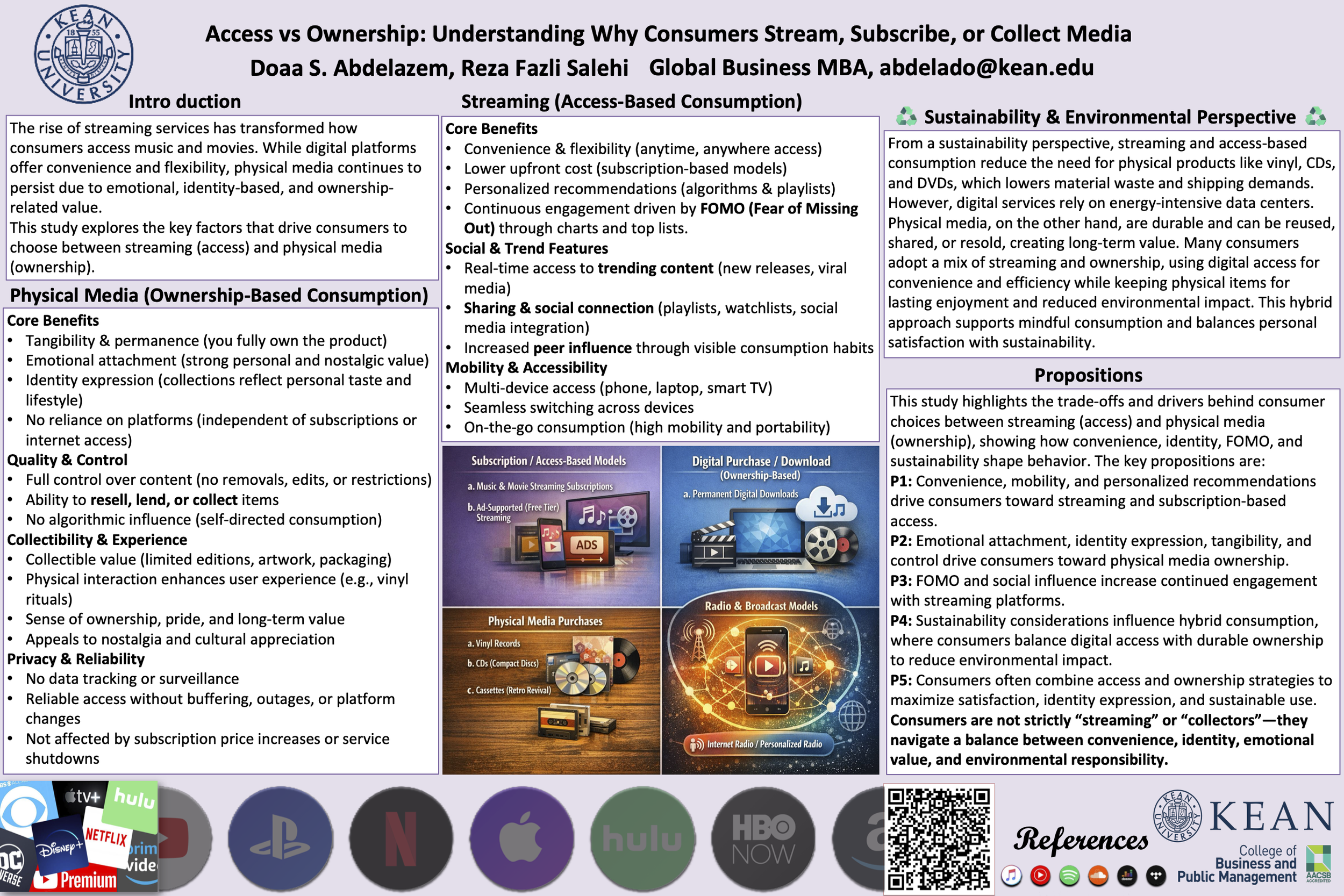
This preliminary paper presents a proposed study that investigates differences between ownership and access in digital and physical consumption formats, as well as the influence of consumer psychology on these choices. Drawing on existing literature, the study examines how feelings of belonging, fear of missing out (FOMO), and identity formation shape consumer preferences and behaviors, situating these patterns within the framework of liquid consumption.The study examines four primary types of consumption: ownership of digital items, ownership of physical goods, access to digital materials through subscription-based services, and access to physical goods via rental or membership models. The analysis emphasizes how consumer personality traits and expectations of convenience influence subscription behaviors across these formats. Access-based consumption, characterized by simplicity, rapid availability, personalization, cross-device access, and automatic upgrades, often aligns with fast-paced, mobile, and digitally integrated lifestyles. In contrast, ownership, particularly of physical goods, has traditionally been associated with permanence, materialism, and identity signaling.The psychological foundations of access-based models, including reduced attachment, increased convenience, enhanced social connection, and experiential motivations, are also explored. The study investigates how platform accessibility, specific features, and seamless user experiences influence consumer relationships with entertainment media platforms and retailers. It further examines how ownership norms are shaped by digital subscriptions and physical rental systems, and how access-based models prioritize ease of use over possession.The paper further analyzes how platform accessibility and seamless user experiences affect consumer relationships with digital media platforms and physical rental systems. Sustainability is a key factor influencing both consumer choice and corporate strategy, with particular attention to expectations for reduced environmental impact, lower waste, and increased resource efficiency. The proposed framework aims to assess how access and ownership influence consumer satisfaction, identity, and long-term consumption behavior across digital and physical markets.Keywords: Access-based consumption, Consumer behavior, Consumer psychology, Subscription-based services, Digital and physical consumption, Fear of missing out (FOMO), Sustainability