
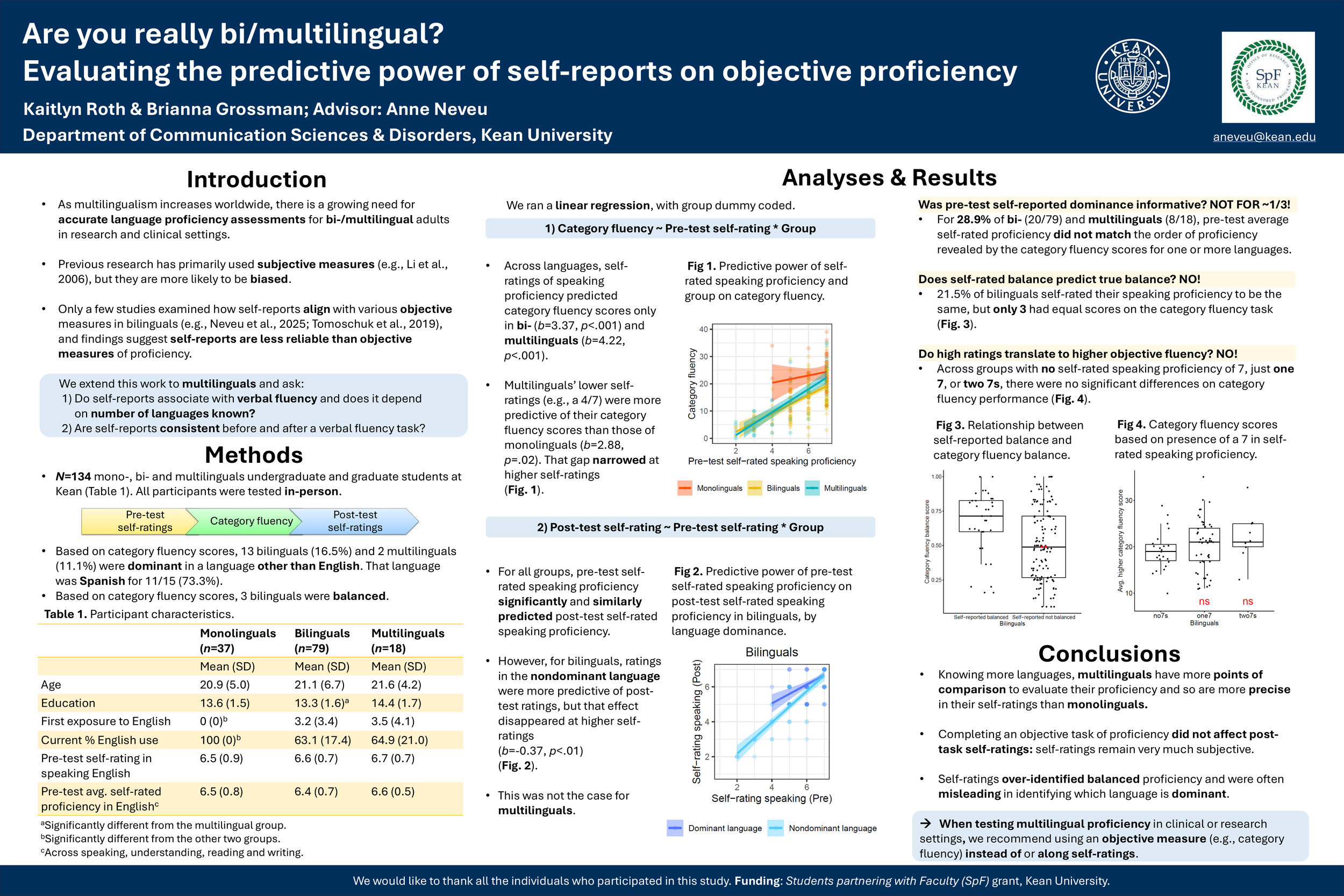
Are you really bi/multilingual? Evaluating the predictive power of self-reports on objective proficiency
Kaitlyn Roth
Co-Presenters: Brianna Grossman
College: College of Health Professions and Human Services
Major: BA.SPCHLANG/HESCI
Faculty Research Mentor: Anne Neveu
Abstract:
Self-reports of proficiency (SRs) are known to be biased in bilinguals to determine dominance and balance, but little is known about the extent to which self-reported proficiency is reliable per additional language known. We are examining the predictive power of SRs on an objective measure of proficiency, the category fluency task (CFT), in mono- (n=7/20), bi- (n=13/20) and multilinguals (n=2/20). We additionally are examining the reliability of self-ratings pre- and post-CFT administration. Average SRs (across speaking, understanding, reading and writing) significantly predicted CFT scores in the dominant language across monolinguals (n=7) and non-signing bilinguals (n=11). Although SRs were at ceiling in monolinguals, CFT scores revealed between-subjects variability. While pre- and post-test SRs were not significantly different across groups and languages, they aligned with CFT scores to show a discrepancy in initial dominance report in 10% of the bilingual sample. These preliminary findings once more caution against sole reliance on SRs.