
Beach Performance 10 Months after Nourishment at Ortley Beach, New Jersey
Madelyn Tomasello
Co-Presenters: Joshua Dovey. Mateo Gonzalex, Elizabeth Macchioni, Benjamin Okun, Amber Newell
College: Hennings College of Science Mathematics and Technology
Major: BS.BIO/ENVIR
Faculty Research Mentor: Jun Cheng
Abstract:
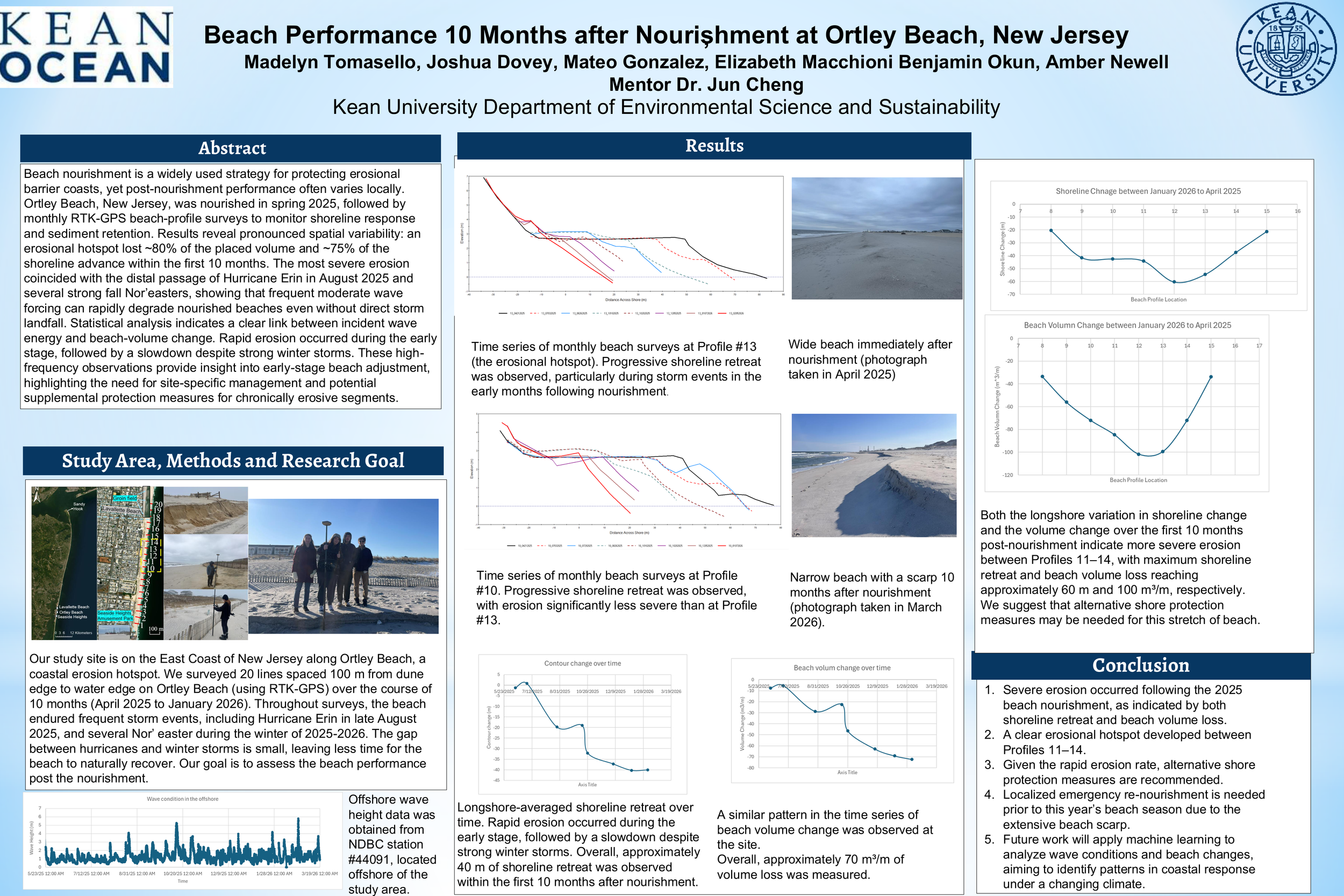
Beach nourishment is a widely used strategy for protecting erosional barrier coasts, yet post-nourishment performance often varies locally. Ortley Beach, New Jersey, was nourished in spring 2025, followed by monthly RTK-GPS beach-profile surveys to monitor shoreline response and sediment retention. Results reveal pronounced spatial variability: an erosional hotspot lost ~80% of the placed volume and ~75% of the shoreline retreat within the first 10 months. The most severe erosion coincided with the distal passage of Hurricane Erin in August 2025 and several strong fall Nor’easters, showing that frequent moderate wave forcing can rapidly degrade nourished beaches even without direct storm landfall. Statistical analysis indicates a clear link between incident wave energy and beach-volume change, suggesting wave climate (rather than isolated extreme events) drives short-term post-nourishment evolution. Local shoreline configuration also influenced sediment redistribution and hotspot persistence. These high-frequency observations provide insight into early-stage beach adjustment, highlighting the need for site-specific management and potential supplemental protection measures for chronically erosive segments.