
Effectiveness of targeted interventions for older adults with concussion: a retrospective case series

Dylan Cumella
Co-Presenters: Eden Schechter, Haley D’Angelo
College: College of Health Professions and Human Services
Major: DPT.PHYSTHERAPY
Faculty Research Mentor: Jenna Tucker Thomas Koc Mary Kleban
Abstract:
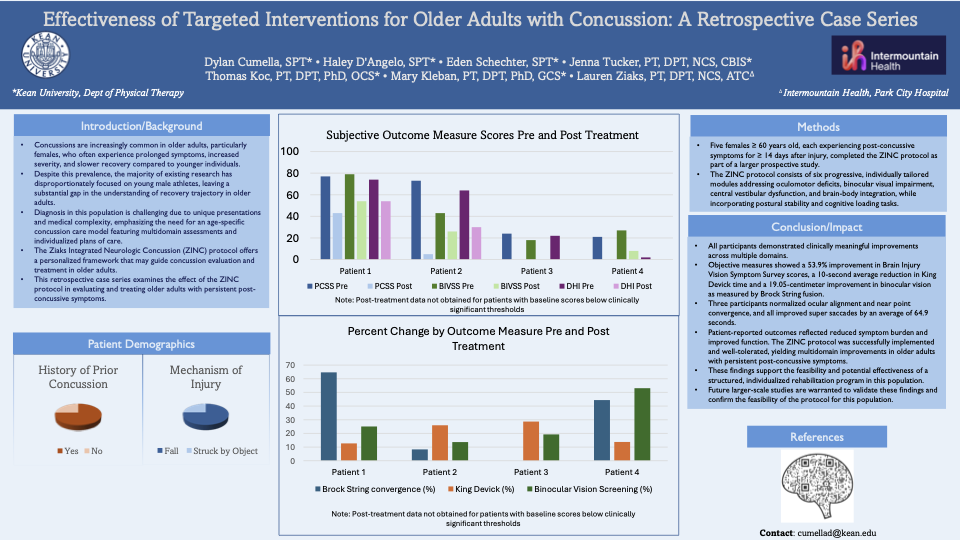
Introduction/Background: Concussions are increasingly common in older adults, particularly females, who often experience prolonged symptoms, increased severity, and slower recovery compared to younger individuals. Despite this prevalence, the majority of existing research has disproportionately focused on young male athletes, leaving a substantial gap in the understanding of recovery trajectory in older adults. Diagnosis in this population is challenging due to unique presentations and medical complexity, emphasizing the need for an age-specific concussion care model featuring multidomain assessments and individualized plans of care. The Ziaks Integrated Neurologic Concussion (ZINC) protocol offers a personalized framework that may guide concussion evaluation and treatment in older adults. This retrospective case series examines the effect of the ZINC protocol in evaluating and treating older adults with persistent post-concussive symptoms.Methods: Five females ≥ 60 years old, each experiencing post-concussive symptoms for ≥ 14 days after injury, completed the ZINC protocol as part of a larger prospective study. The ZINC protocol consists of six progressive, individually tailored modules addressing oculomotor deficits, binocular visual impairment, central vestibular dysfunction, and brain-body integration, while incorporating postural stability and cognitive loading tasks.Conclusion/Impact: All participants demonstrated clinically meaningful improvements across multiple domains. Objective measures showed a 53.9% improvement in Brain Injury Vision Symptom Survey scores, a 10-second average reduction in King Devick time and a 19.05-centimeter improvement in binocular vision as measured by Brock String fusion. Three participants normalized ocular alignment and near point convergence, and all improved super saccades by an average of 64.9 seconds. Patient-reported outcomes reflected reduced symptom burden and improved function. The ZINC protocol was successfully implemented and well-tolerated, yielding multidomain improvements in older adults with persistent post-concussive symptoms. These findings support the feasibility and potential effectiveness of a structured, individualized rehabilitation program in this population. Future larger-scale studies are warranted to validate these findings and confirm the feasibility of the protocol for this population.Keywords: concussion, older adult, rehabilitation, case series