
Understanding Cardiovascular Risk Across the Adult Lifespan: The Role of Age and Gender
Declan Cioffi
Co-Presenters: Katianna Perez
College: College of Liberal Arts
Major: BS.PSY/PSYCREHAB
Faculty Research Mentor: Alka Bishnoi
Abstract:
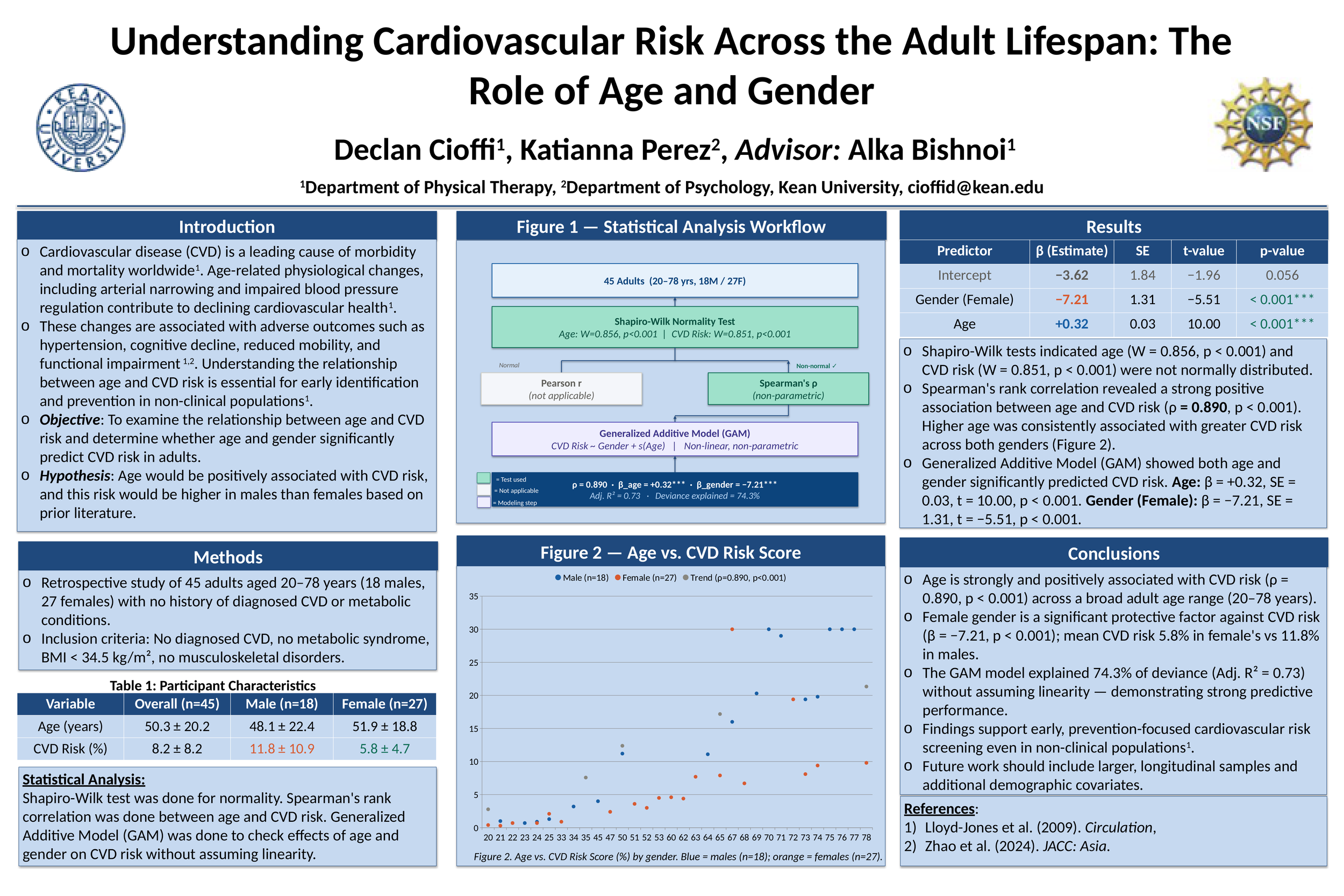
Cardiovascular disease (CVD) risk increases with age and remains a leading cause of morbidity and mortality worldwide. Age-related physiological changes, like impaired blood pressure regulation, contribute to declining cardiovascular health and are associated with adverse outcomes like hypertension, The objective of this study is to examine the relationship between age and CVD risk. We hypothesized that age would positively associate with CVD risk, with higher risk in males than females.This retrospective study had a sample of 45 adults aged 18-65 years old (27 males and 18 females). We extracted the data including metrics such as age, CVD risk score, and gender information. Inclusion criteria of the study: no diagnosed cardiovascular disease, no metabolic syndrome, BMI < 34.5 kg/m2, no musculoskeletaldisorders.In the results, Shapiro–Wilk tests indicated that age and CVD risk were not normally distributed (p < 0.001). Spearman’s correlation showed a strong positive association between age and CVD risk (ρ = 0.89, p < 0.001). GAM results demonstrated that both age and gender significantly predicted CVD risk.Females having lower risk than males (β = −7.12, p < 0.001) and increasing age associated with higher CVD risk (β = 0.32, p < 0.001); the model explained 74.3% of the deviance (adjusted R² = 0.73).This study shows that age and gender significantly predict CVD risk across a broad adult age range. Using generalized additive modeling allowed flexible characterization of age-related effects without assuming linearity. The findings demonstrate a strong age-related increase in CVD risk and consistently lower risk in females.Keywords: (MESH terms)