
Is Reverse Mentoring Truly An Effective Learning Tool?
Glendha Gomes da Silva
Co-Presenters: Aneka Jackson, Hadee Shah, Shary Domingos
College: College of Business and Public Management
Major: BS.MANAGEMNT-GENBUS
Faculty Research Mentor: Ipek Kocoglu
Abstract:
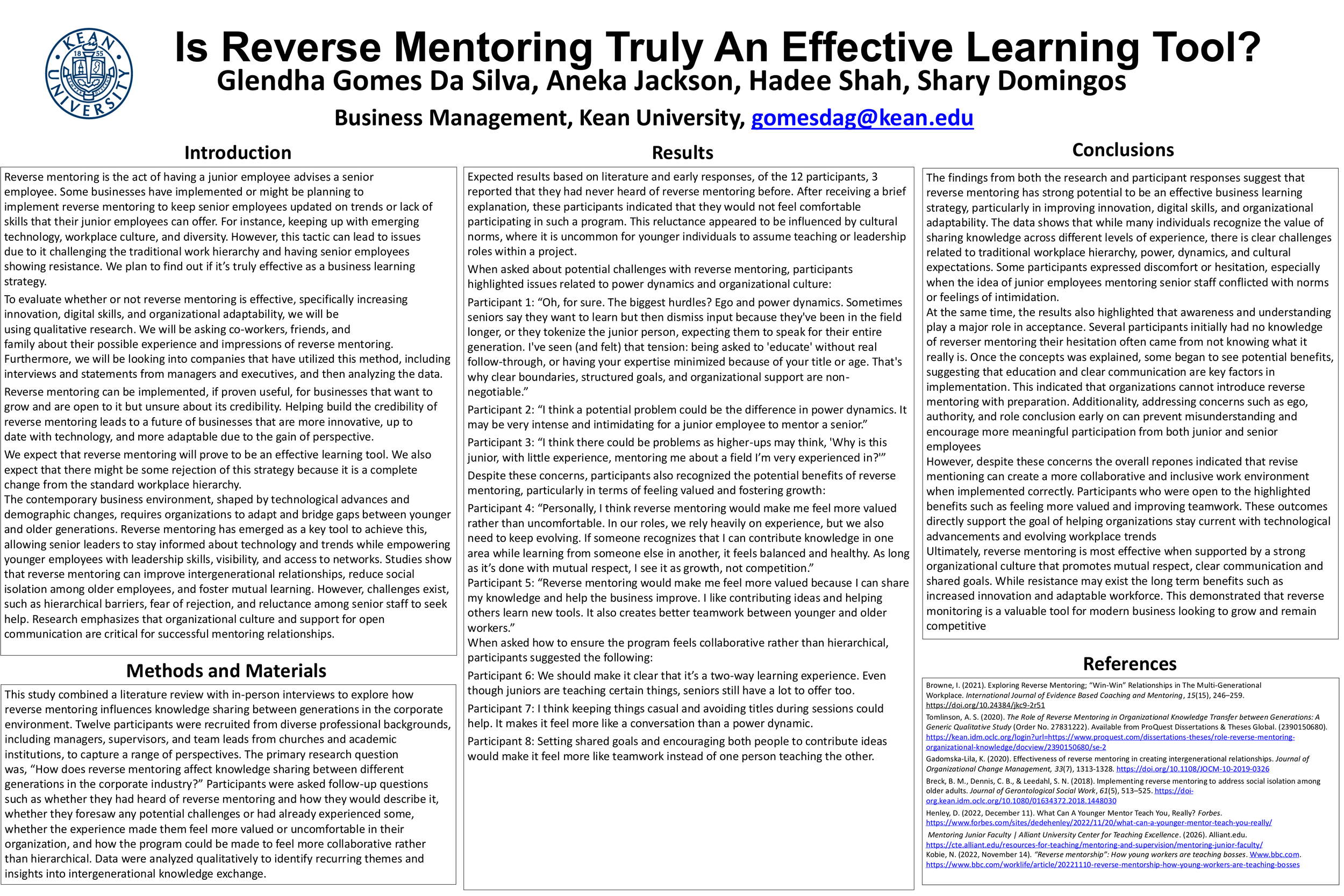
Title: Is Reverse Mentoring Truly an Effective Learning Tool?Authors: Aneka Jackson, Glendha Gomes da Silva, Hadee Shah, Project Management, Kean UniversityAbstract:Reverse mentoring is the act of having a junior employee advises a senior employee. Some businesses have implemented or might be planning to implement reverse mentoring to keep senior employees updated on trends or lack of skills that their junior employees can offer. For instance, keeping up with emerging technology, workplace culture, and diversity. However, this tactic can lead to issues due to it challenging the traditional work hierarchy and having senior employees showing resistance. We plan to find out if it’s truly effective as a business learning strategy.To evaluate whether or not reverse mentoring is effective, specifically increasing innovation, digital skills, and organizational adaptability, we will be using qualitative research. We will be asking co-workers, friends, and family about their possible experience and impressions of reverse mentoring. Furthermore, we will be looking into companies that have utilized this method, including interviews and statements from managers and executives, and then analyzing the data.Reverse mentoring can be implemented, if proven useful, for businesses that want to grow and are open to it but unsure about its credibility. Helping build the credibility of reverse mentoring leads to a future of businesses that are more innovative, up to date with technology, and more adaptable due to the gain of perspective.We expect that reverse mentoring will prove to be an effective learning tool. We also expect that there might be some rejection of this strategy because it is a complete change from the standard workplace hierarchy.Keywords: Reverse Mentoring, Junior Employees, Senior Employees, Learning Strategy