
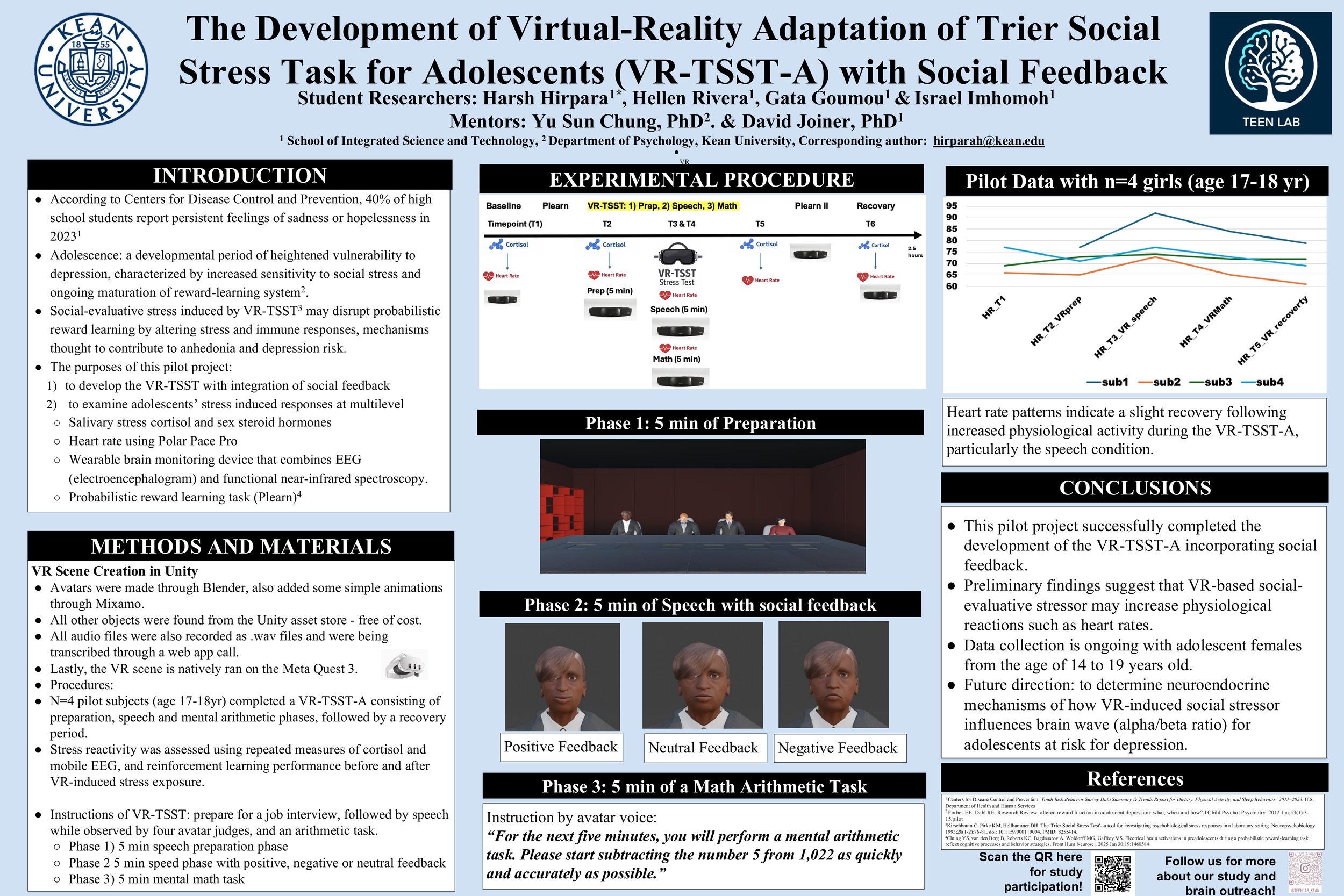
The Development of Virtual-Reality Adaptation of Trier Social Stress Task for Adolescents (VR-TSST-A) with Social Feedback
Harsh Hirpara
Co-Presenters: Gata Goumou, Israel Imhomoh, Hellen Rivera
College: Hennings College of Science Mathematics and Technology
Major: MS.BS/SC/TEC/CPEG
Faculty Research Mentor: David Joiner Yusun Chung
Abstract:
Anhedonia, which is defined as a reduced ability to experience pleasure, is a core feature of depression and is associated with impairments in reinforcement learning supported by frontal-limbic brain circuitry. Stress-induced inflammation has been proposed as a key psychological mechanism contributing to these reward-related dysfunctions, yet efficient and standardized methods for inducing and measuring acute stress responses remain limited. This study aims to validate a virtual reality adaptation of the Trier Social Test (VR-TSST) as a sensitive and scalable tool for examining stress-related immune and behavioral responses in Adolescents. First, this project seeks to determine whether the VR-TSST reliably induces physiological stress responses comparable to traditional laboratory methods while offering greater standardization and accessibility. Our team successfully developed the VR-TSST-Adolescents by incorporating interactive feedback using Unity. The task development process was straightforward, involving the creation of avatars and environments, as well as the development of appropriate scripts and questions, which include avatar feedback. Findings are expected to advance the understanding of stress-induced immune mechanisms underlying reward processing and depression risk in emerging adults. Additionally, the study provides undergraduate researchers with hands-on experience in virtual reality development, behavioral research, and biological data collection, contributing to both scientific knowledge and student research training.