
Growth versus Fixed Mindset in Education and the Classroom
Ashley Acevedo
Co-Presenters: Individual Presentation
College: College of Education
Major: BA.EED/K6/TSD/FA
Faculty Research Mentor: Adara Goldberg
Abstract:
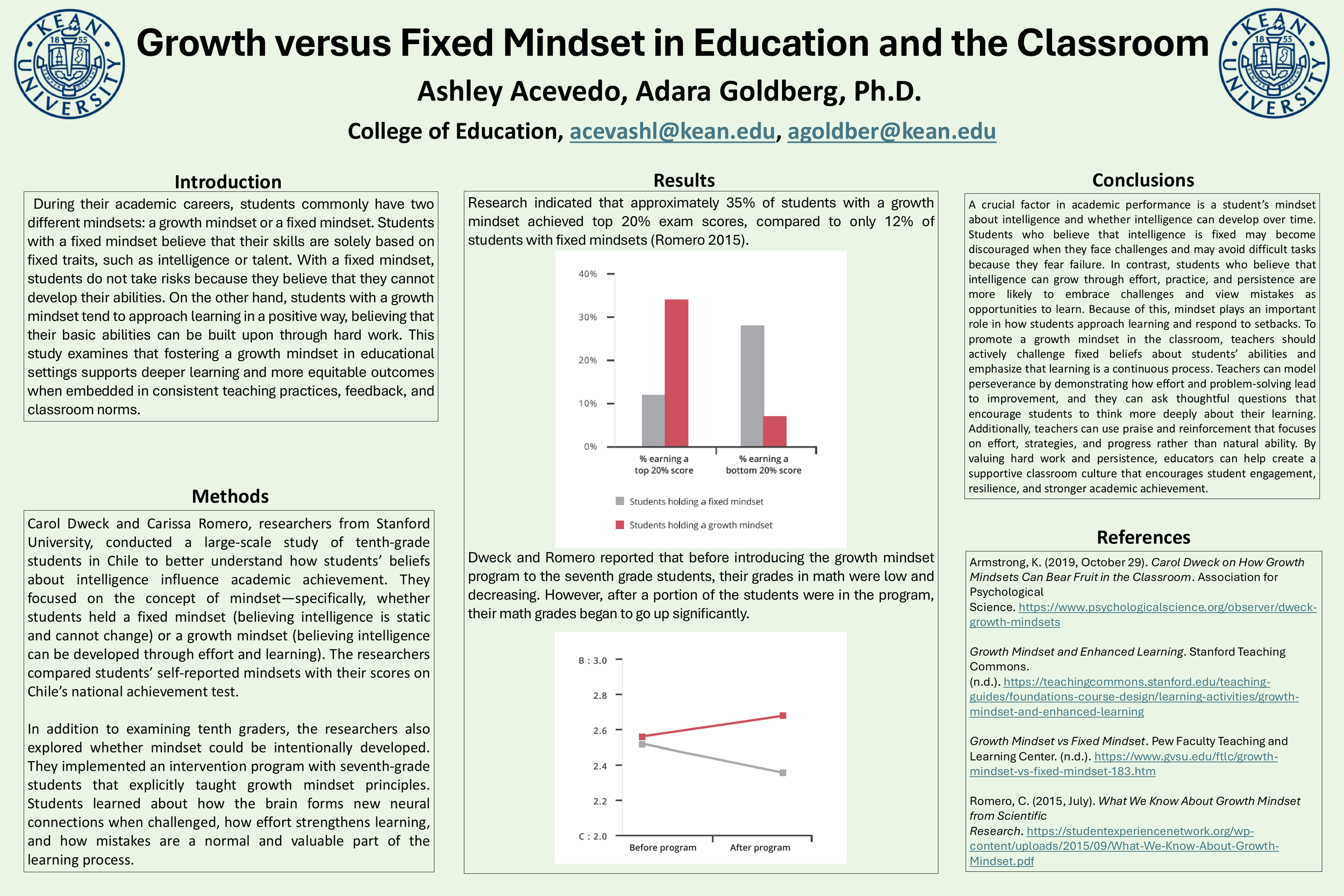
During their academic careers, students commonly exhibit either a fixed mindset or a growth mindset. A fixed mindset reflects the belief that intelligence and abilities are unchangeable, often leading students to avoid challenges and risk-taking. In contrast, students with a growth mindset view learning as a process in which abilities can be developed through effort and persistence. Research by Carissa Romero indicated that approximately 35% of students with a growth mindset achieved top 20% exam scores, compared to only 12% of students with fixed mindsets (Romero 2015). Carol Dweck's research further identifies the mindset as a crucial factor influencing academic performance and motivation (Dweck 2006). Teachers play a critical role in promoting a growth mindset by challenging fixed beliefs, modeling effort, using reflective questioning, and providing effort-focused praise. This study examines how fostering a growth mindset through consistent teaching practices, feedback, and classroom norms supports deeper learning, increased engagement, and more equitable educational outcomes.