
The Effects of Disclosure Within Children's Advertising
Ruben Schmalfeld
Co-Presenters: Individual Presentation
College: College of Business and Public Management
Major: BS.MARKETING
Faculty Research Mentor: Shweta Singh
Abstract:
As the field of marketing has expanded over time, so has marketing towards young children as a demographic. It is important to realize that children cannot understand advertising the same way as adults. Researchers often refer to the psychologist Jean Piaget’s theory of cognitive development with the belief that children don’t begin to understand the intent of advertisement, that is, to sell their product specifically, until they reach the concrete operational thought stage between 7-12 years of age.
Exposure to consumer culture from an early age, especially before one develops abstract reasoning, conditions an individual to become fully entrenched in consumer culture by their adulthood. Despite this, there has not been much long-term research tracking the evolution of consumer behavior of individuals from youth to adulthood.
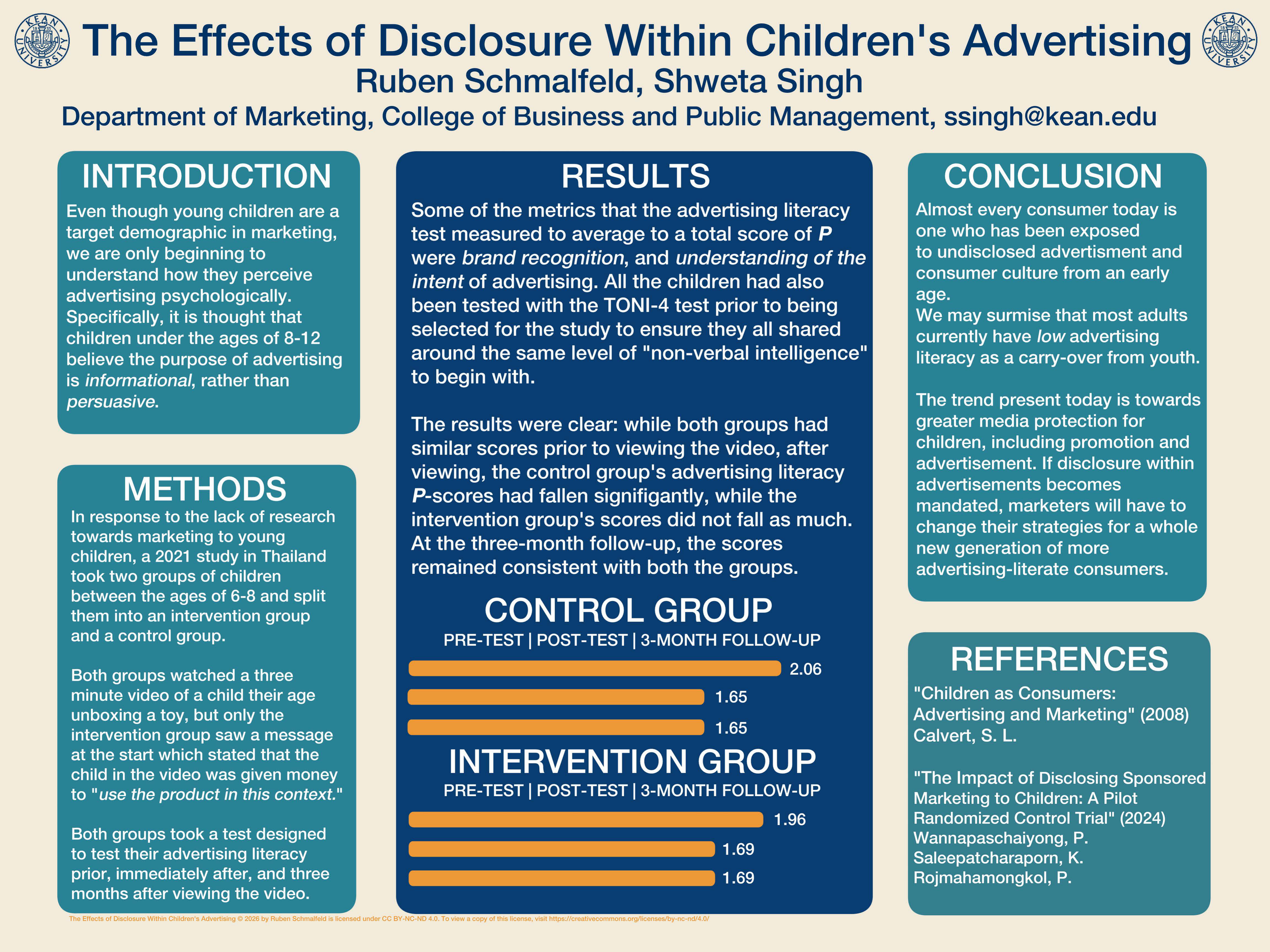
There has been a study tracking short-term changes in children’s consumer behavior however, in which 43 children ages 6-8 were taken and assigned to a control or intervention group. Both groups watched a three-minute video of a child their age unboxing a toy, but only the intervention group saw a message at the start which stated that the person in the video received compensation. The participants also completed a questionnaire to measure their “advertising literacy,” before, after, and three months after watching the video. The results showed that while both groups tested at the same score in the pre-test, the literacy of the control group fell in the post-test, while the intervention group’s literacy did not fall. The three month follow-up showed that scores remained consistent in both groups, with the control group maintaining lower literacy than the intervention group.
This suggests that even though young children may struggle to see the manipulation in advertising on their own, they can be helped to better understand it from a young age when the purpose is stated clearly. It stands to reason that if such disclosure becomes required in the future, a new generation of more advertising-literate consumers may very well rise and change the direction of marketing forever.