
The Fouling Community Thriving on Oyster Restoration Structures in the Hudson Raritan Estuary: Implications for Spat Recruitment?
RASHEL CARABALLO
Co-Presenters: Isabella Soares-Sousa
College: Hennings College of Science Mathematics and Technology
Major: BA.BIOLOGY
Faculty Research Mentor: Allison Fitzgerald
Abstract:
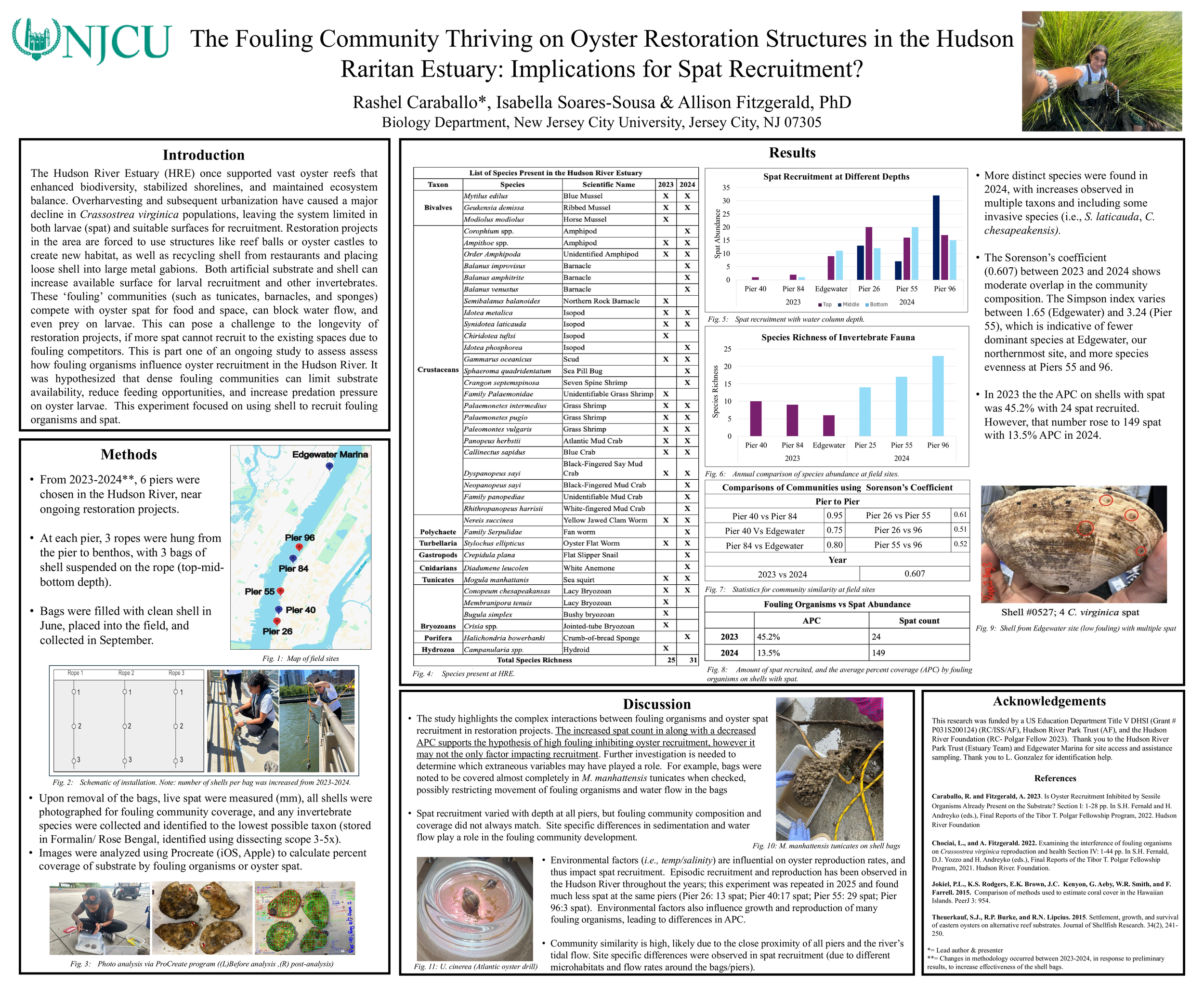
The Hudson River Estuary (HRE) has historically supported abundant oyster reefs that contributed to biodiversity, shoreline protection, and ecosystem stability. However, urbanization, overharvesting, and environmental degradation have caused a dramatic decline of Crassostrea virginica populations, leaving the estuary both spat-limited and substrate-limited. Recognizing oysters as keystone species and ecosystem engineers, recent restoration efforts in the HRE have employed large- and small-scale projects, deploying a variety of structures such as reef balls, gabions, and oyster castles to provide settlement substrate and restore ecological function. While these artificial substrates increase surface area for larval settlement, they also attract fouling organisms that aggressively colonize hard surfaces and compete directly with oyster larvae for food, space, and resources. The dominance of fouling communities poses a substantial obstacle for oyster recruitment, as they can impede larval settlement, reduce water flow, introduce toxins, and in some cases directly predate upon larvae. Organisms such as tunicates, barnacles, and boring sponges have been shown to significantly inhibit oyster recruitment and survival in similar systems, yet little is known about the specific interactions between fouling species and oyster spat in the HRE.The objective of this study was to assess how fouling organisms affect the recruitment of C. virginica in the Hudson River by comparing percent coverage of fouling species and oyster spat on settlement shells and tiles placed at multiple field sites. This research provides the first in-situ evaluation of oyster recruitment dynamics in the presence of fouling organisms in the estuary. Building on earlier work that recorded fouling diversity on restoration structures, this study tested the hypothesis that robust fouling communities in the HRE inhibit oyster recruitment by limiting substrate availability, reducing food accessibility, and increasing predation pressure. The results are intended to provide restoration practitioners with valuable insight into how fouling communities shape oyster settlement success and to inform strategies for optimizing substrate design and placement. By filling this critical knowledge gap, the study contributes to oyster restoration efforts in the HRE and improving the long-term resilience of urban estuarine ecosystems.