
The Social Simulation: Training Adolescents with ASD in Virtual Spaces
Lauren Dennis
Co-Presenters: Individual Presentation
College: College of Health Professions and Human Services
Major: SLPD.SPCHLANGPATH
Faculty Research Mentor: Sarah Patten, Iyad Ghanim
Abstract:
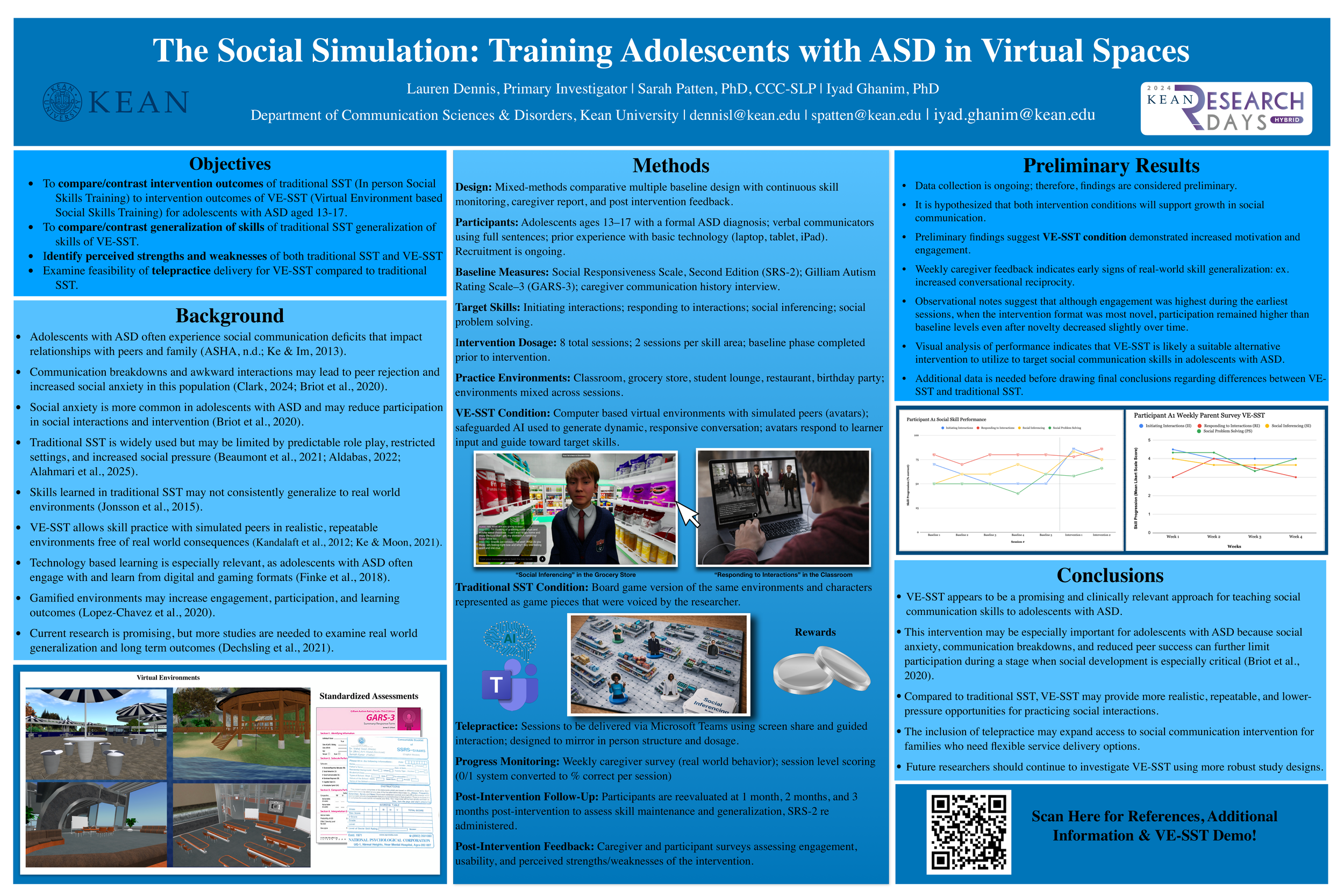
Adolescents with Autism Spectrum Disorder (ASD) often present with social communication deficits that impact their ability to form meaningful connections with others (ASHA, n.d.a.). These deficits may lead to communication breakdowns and misunderstandings that, in some cases, result in peer rejection (Clark, 2024) and contribute to the development of social anxiety within this population (Briot et al., 2020).To address these challenges, speech-language pathologists (SLPs) most commonly provide traditional social skills training (SST), an evidence-based approach designed to improve social competence through targeted instruction (Beaumont et al., 2021). While SST offers clear benefits, it also presents limitations, including restricted practice environments, limited access to appropriate social partners, predictable role-play scenarios, and high-pressure tasks that may increase anxiety and reduce engagement and learning.This study examines the feasibility and clinical applicability of a novel intervention, virtual environment–based social skills training (VE-SST), and compares it to traditional SST for adolescents with ASD aged 13–17, delivered both in person and via telehealth. Participants complete an 8-week individualized intervention targeting social initiation, conversational reciprocity, perspective-taking, and social problem-solving. Outcome measures include standardized social communication rating scales, session performance data, reports of skill generalization, and participant perspectives.By comparing outcomes across intervention formats, this study aims to inform clinical decision-making regarding intervention selection and delivery, particularly for adolescents whose anxiety limits participation in traditional formats. Findings intend to guide SLPs in determining when VE-SST may serve as an appropriate alternative, preparatory step, or complement to traditional SST across intervention settings.