
Grand Rounds and Interprofessional Preparedness: Attitudes, Beliefs, and Self Efficacy Among Occupational Therapy & Speech Language Pathology Students
Lauren Ernst
Co-Presenters: Tanya Teixeira, Ana Fernandes, Samantha Teoh
College: College of Health Professions and Human Services
Major: OTD.OCCUPATHERAPY
Faculty Research Mentor: Jennifer Gardner, Sarah Patten
Abstract:
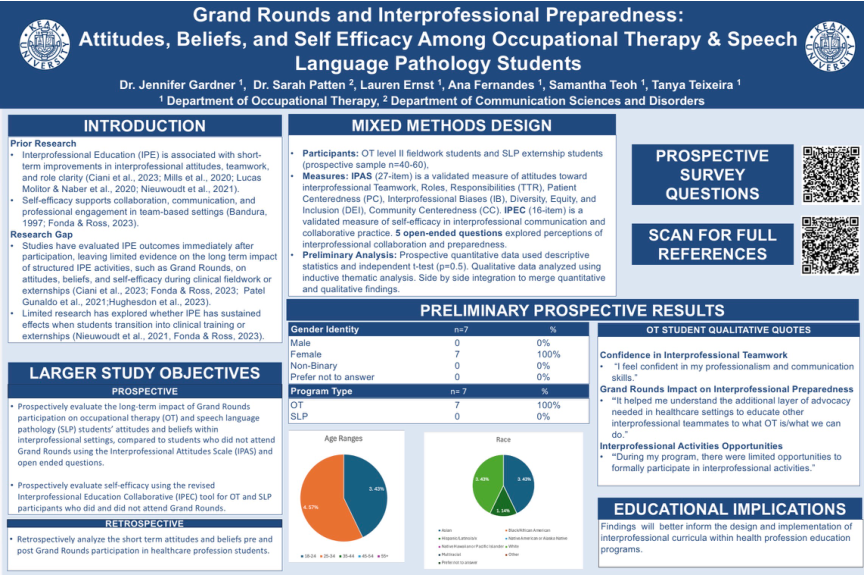
Purpose: Although interprofessional education (IPE) prepares students for collaborative care, evidence of sustained effects during clinical education remains limited for Occupational Therapy (OT) (Nieuwoudt et al., 2021) and Speech-Language Pathology (SLP) students (Fonda & Ross, 2023). This study examined short- and long-term impacts of IPE Grand Rounds on students’ interprofessional attitudes, beliefs, and self-efficacy.Objectives: To retrospectively analyze the short-term impact of Grand Rounds on interprofessional attitudes and beliefs, using existing Interprofessional Attitudes Scale (IPAS) data collected from a variety of health profession students at Kean University; and to prospectively evaluate the long-term impact of Grand Rounds participation on OT and SLP students’ attitudes, beliefs and self-efficacy within interprofessional settings, compared to non-participants.Design: A sequential mixed-methods design was used. The retrospective component analyzed IPAS data, while the prospective component analyzed both IPAS and Interprofessional Education Collaborative (IPEC) assessment data alongside qualitative responses.Participants: Retrospective data included pre- and post- IPAS scores from (n= ~850) health profession students who attended Grand Rounds at a public university in the northeastern U.S. Prospectively, up to 60 OT and SLP students (≥18 years) completing clinical coursework during the 2025-2026 academic year will be recruited.Intervention: Interprofessional Grand Rounds were faculty-developed, delivered, and were not administered or modified by the research team. Events were held once per semester for three hours and involved interdisciplinary, case-based analysis among a variety of health profession students.Methods: Retrospective IPAS data was analyzed using inferential statistics to examine interprofessional attitudes and beliefs of pre- and post- Grand Rounds attendance. Prospectively, participants completed an online survey including demographics, the IPAS, IPEC-aligned items, and five open-ended questions informed by IPEC and IPAS frameworks. Group comparisons to be conducted using Mann-Whitney U tests or independent t-tests. Qualitative responses to be analyzed using inductive thematic analysis.Limitations: This single-site study limits generalizability, and self-reported measures may introduce response bias.Results: Data collection and analysis are expected to be completed in Spring 2026.Educational Implications: Findings will inform the design and implementation of interprofessional curricula within health professions education programs.