
Exploring the Future of Artificial Intelligence and Its Potential Economic Impact on Industries and Global Economic Growth
Noorulain Balouch
Co-Presenters: Individual Presentation
College: The Dorothy and George Hennings College of Science, Mathematics and Technology
Major: Information Technology
Faculty Research Mentor: Bin Hu
Abstract:
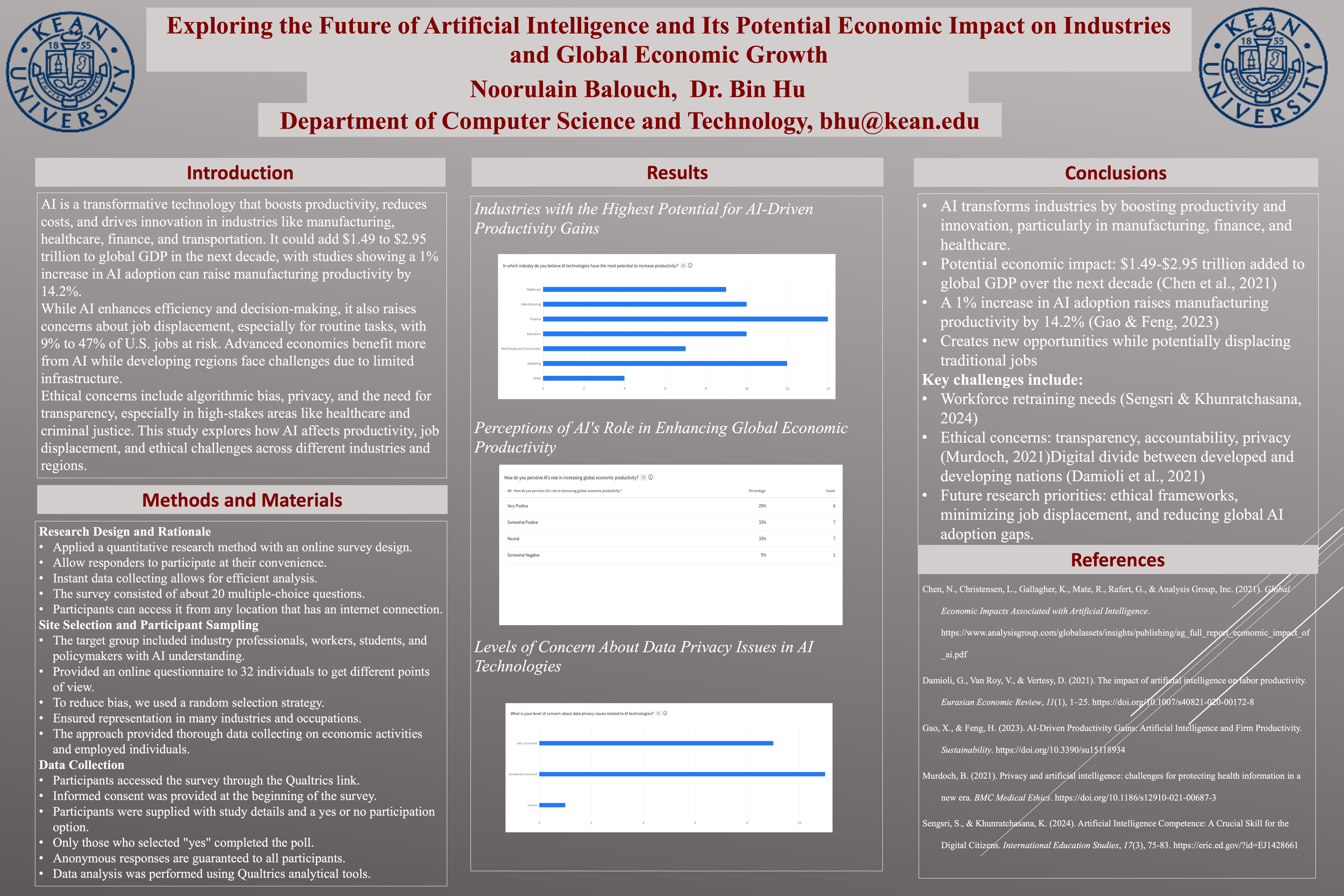
Artificial intelligence (AI) has the potential to revolutionize entire industries and spur world economic expansion. AI is the most important technical development of the twenty-first, and it has the potential to drastically alter economies and industries throughout the world. Artificial intelligence (AI) is transforming how organizations run and compete, from automating complicated operations in manufacturing to spurring innovation in healthcare, banking, and other industries. AI is positioned to be a major force behind future economic growth due to its capacity to analyze enormous volumes of data, improve decision-making, and increase productivity. It is anticipated that the incorporation of AI technology into a range of industries, including manufacturing, services, healthcare, and finance, would result in notable economic benefits through increased efficiency, innovation, and productivity. The need for specialized skills in fields like software development, data science, and machine learning is being driven by AI at the same time, which calls for extensive worker retraining and education. Though the need for AI-related skills is growing, the quick adoption of AI technology also raises serious worries about potential disruptions to the labor market due to the possibility of automation replacing traditional jobs. AI's economic impact is made more complex by regional differences in AI infrastructure, moral dilemmas like data privacy, and possible rises in inequality. This study explores the revolutionary potential of artificial intelligence (AI) and its significant effects on various industries and the expansion of the world economy. This research seeks to offer a thorough grasp of the economic prospects and difficulties related to AI adoption by looking at the most recent developments in AI technology and evaluating its applications across multiple industries. Understanding AI's long-term effects on various industries and the global economy is essential for creating growth and equity promoting strategies as the world embraces AI-driven innovations.
Keywords: Artificial Intelligence, Global Economy, AI Ethics.