
RFID Tag for Continuous User Verification
Christian Zambrano
Co-Presenters: Individual Presentation
College: The Dorothy and George Hennings College of Science, Mathematics and Technology
Major: Information Technology
Faculty Research Mentor: Bin Hu
Abstract:
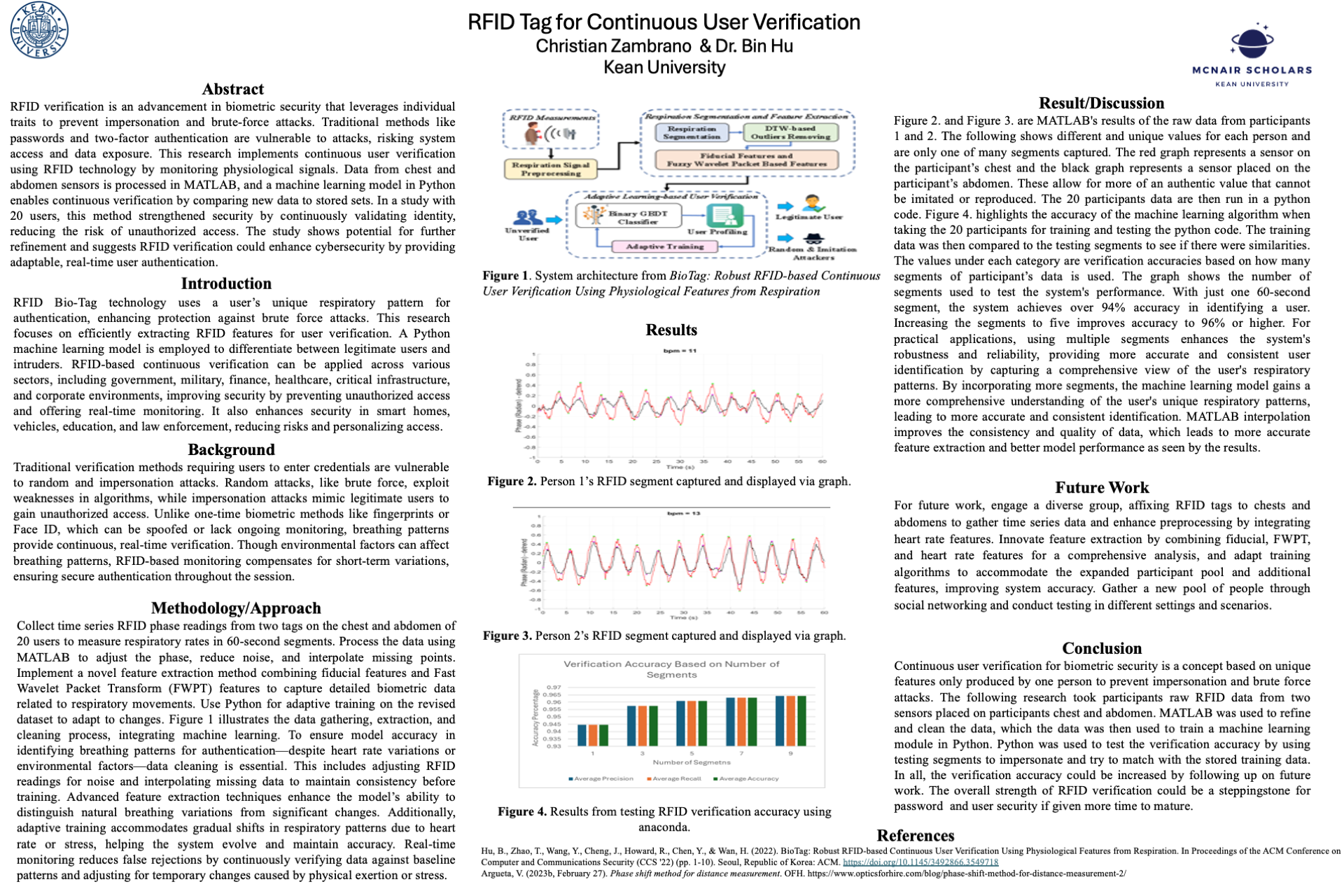
In a study conducted with 15 participants, the results demonstrated that RFID-based continuous verification adds a substantial layer of security to traditional authentication systems. The continuous nature of this verification system mitigates the risks associated with single-point authentication processes, where a user is only validated once at login. This method ensures ongoing monitoring, reducing the window of opportunity for an attacker to exploit a session after initial authentication. The research highlights areas for potential improvement, such as optimizing sensor placement for better data accuracy or refining the machine learning algorithm for faster processing times. In a pool of 15 participants under imitation attacks the verification accuracy is 90.9% and above when using five or more segments of user RFID data. As the technology matures, RFID-based continuous verification offers strong security solutions across multiple sectors. In high-security facilities like government installations, military bases, and research laboratories, it prevents unauthorized access even if initial credentials are compromised. In the financial sector, it defends against insider threats and fraud in environments like trading floors and bank vaults. Healthcare benefits from secure access to sensitive patient data and pharmaceutical storage, while critical infrastructure, such as power plants and air traffic control systems, is protected from cyberattacks. Corporate environments gain enhanced control over confidential business strategies, and law enforcement can secure access to evidence rooms and witness protection programs. RFID technology also improves exam proctoring in education, secures smart homes by personalizing access to automation systems, and prevents vehicle theft while personalizing driver settings in the automotive industry.By integrating RFID technology with machine learning, this continuous verification system evolves alongside each user's unique physiological patterns. The adaptability of this approach makes it highly suitable for a wide range of systems and environments, providing stronger protection against unauthorized access. Ultimately, this research suggests that RFID verification, with its dynamic, real-time capabilities, could become a cornerstone of future cybersecurity strategies, enhancing the confidentiality, integrity, and availability of sensitive data while drastically reducing the risk of breaches.