
Genetic Connectivity of Invasive Spotted Lanternfly Populations Across an Urbanization Gradient
Nicolas Largotta
Co-Presenters: Individual Presentation
College: The Dorothy and George Hennings College of Science, Mathematics and Technology
Major: Biotechnology/Molecular Biology - STEM 5 Year B.S./M.S.
Faculty Research Mentor: Brenna Levine
Abstract:
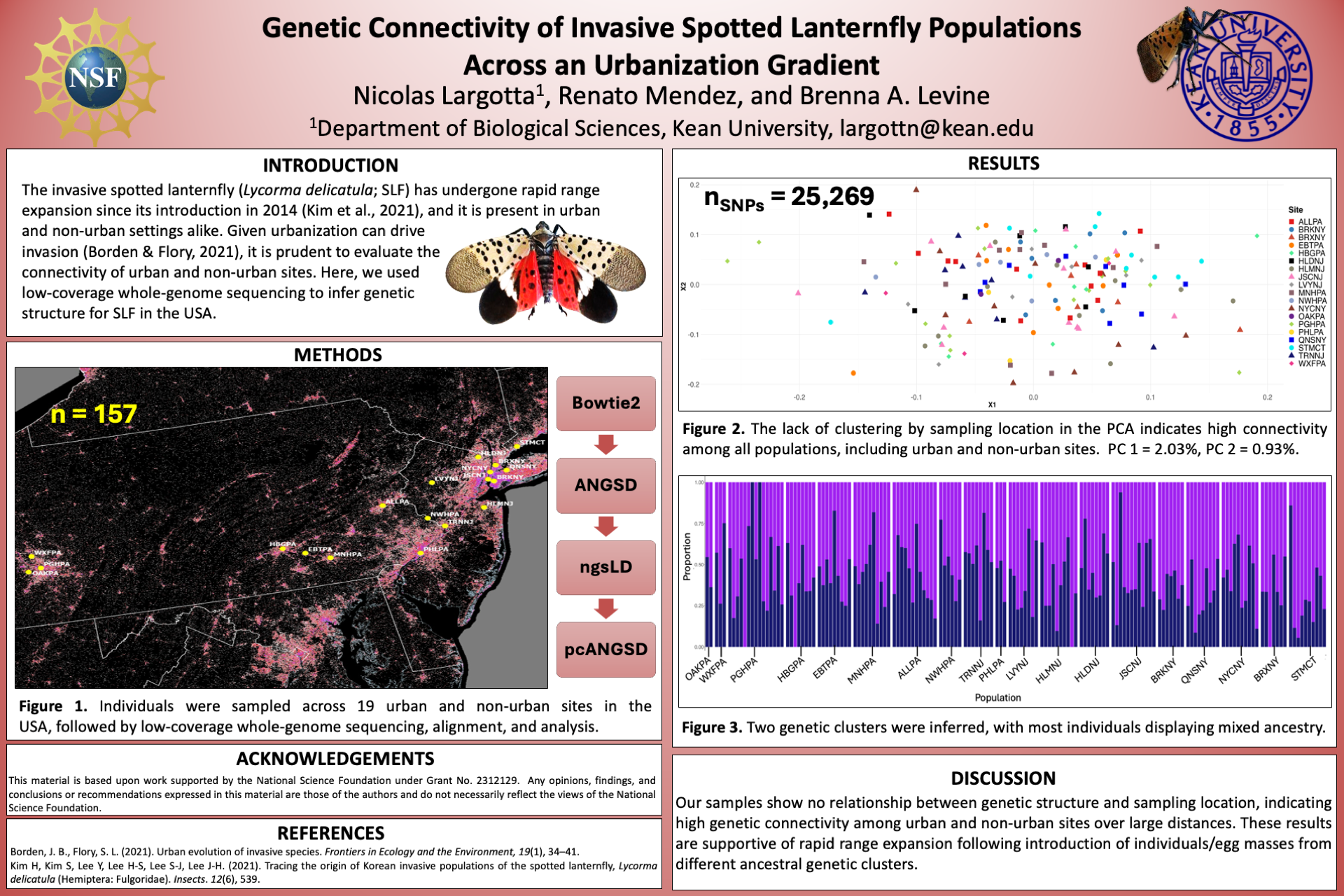
The planet is experiencing unprecedented rates of change caused by humans. One type ofanthropogenic change, urbanization, is rapidly transforming the landscape into a mosaic of rural,non-urban, and urban environments, with major implications for evolutionary processes. Variation inthese processes among environments can impact invasive species range expansions, and byconsequence, community and ecosystem structure and stability. Yet, we lack resolution regardinghow evolutionary processes vary across the rural-urban gradient landscape and the consequencesthat this variation may have for the future range expansion of invasive species. To begin to addressthis gap, we used low-coverage whole genome resequencing of 95 invasive spottedlanternflies ( Lycorma delicatula; a rapidly spreading invasive species of considerable concern inthis USA) collected from sites of varying degrees of urbanization to evaluate how landscape typeaffects the genetic structure of this species. We identified over 500,000 SNPs present in > 95% ofthe samples. Subtle and complex genetic structure was present, with greater homogeneity apparentamong the rural samples. We are currently identifying loci under selection in these varyingenvironments to parse the effects of urbanization on the evolution of invasive potential.