
Measuring proficiency in diverse mono-, bi- and multilinguals
Jessica Awad
Co-Presenters: Alexa Cesaro, Amanda Singler, Nyasia Rivera, Yarelis Cruz-Corchado, Ashley Muhando, Ziara Jones-Coston
College: The College of Health Professions and Human Services
Major: Speech-Language Pathology (M.A.)
Faculty Research Mentor: Anne Neveu
Abstract:
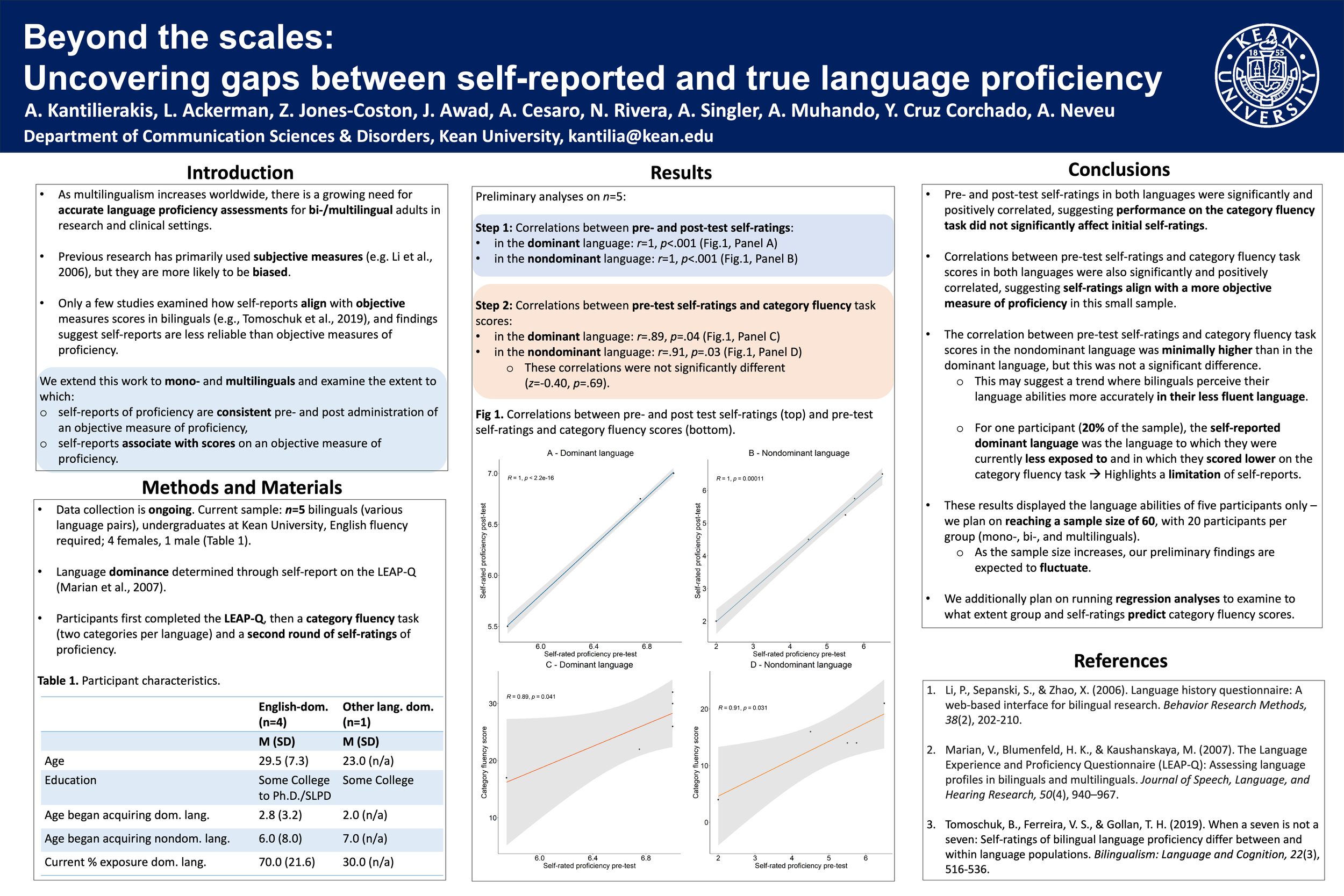
As bi-/multilingualism continues to grow worldwide, there is an increasing need for accurate and effective methods to assess language proficiency in bi- and multilingual adults in research, clinical and educational settings. The most common measures used are subjective (i.e., self-reports on Likert scales), which are known to be biased. This has hindered replication and generalization of findings in the field, emphasizing the need for a standard method of language proficiency assessment. The current study examines the extent to which homogenous results will be found across subjective and objective measures of language proficiency in monolingual, bilingual, and multilingual adults. Data collection is ongoing (N=3/60). Participants complete an adapted version of the LEAP-Q, a category fluency task in each of the language(s) reported, and the self-ratings portion of the LEAP-Q a second time. We will use linear regression to examine whether initial self-reports of proficiency predict category fluency task scores, and whether individuals reconsider their self-reports based on category fluency performance. Based on previous findings, we expect less variability in the alignment between self-reports and category fluency scores in monolinguals compared to bi- and multilinguals. We may observe increasing variability in alignment between self-reports and objective scores per additional language known. Similarly, we expect more alignment in self-reports from monolinguals at pre- and post-test compared to bilinguals, and potentially least alignment in multilinguals. Future research should continue to investigate potential variability in self-reported proficiency across monolingual, bilingual, and multilingual speakers to validate results and promote further progress in the field of bi-/multilingualism.